
Supervised versus Unsupervised Learning, With Examples
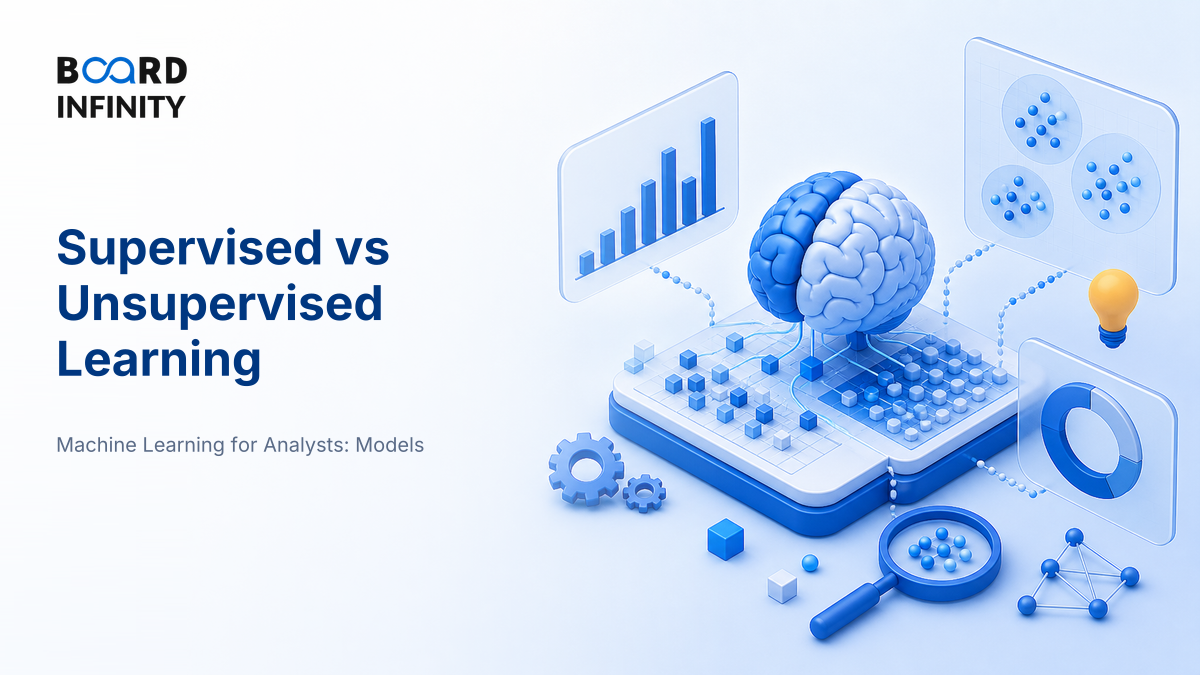
The biggest misconception is that supervised learning is “advanced” and unsupervised learning is “basic.” Walk into a retail app, a bank, or a logistics control room and you will see both working together: one predicts a known outcome, the other discovers structure nobody labelled in advance.
- Supervised learning trains on labelled data: input features plus the correct output. It predicts known outcomes such as churn, credit default, fraud, demand or delivery time.
- Unsupervised learning trains on unlabelled data. It discovers hidden patterns such as customer segments, product clusters, anomalies or lower-dimensional representations.
- The quickest test is: Do I have a target variable? If yes, it is usually supervised. If no, it is usually unsupervised.
- Supervised tasks are mainly classification and regression. Unsupervised tasks are mainly clustering, dimensionality reduction and anomaly detection.
- Supervised models are evaluated against known answers using metrics like accuracy, precision, recall, F1, RMSE or AUC. Unsupervised models need proxy metrics plus business validation.
- In business, the two often combine: cluster customers first, then build a supervised model to predict purchase or churn within each segment.
- The interview-winning answer always links the learning type to the business question, available data, model output and evaluation metric.
Big Picture
Think of machine learning as a learning problem, not an algorithm list. The business team brings data and a question. The decisive fork is whether the data includes a reliable answer column - the label - that the model can learn from.
Core Explanation: The Label Is the Fork in the Road
Supervised learning is like giving the model solved examples. A bank shows past applicants, their income, bureau score, repayment history and whether they defaulted. The model learns the mapping from inputs to the known output, then predicts default risk for new applicants.
Unsupervised learning is like giving the model a messy market and asking it to find natural structure. A fashion platform may not begin with labelled “value seeker,” “trend follower,” or “premium shopper” tags. It can still group customers based on browsing, purchase frequency, price sensitivity and category affinity.
The distinction is not “which algorithm is cooler.” It is what learning signal exists. If the correct answer is available during training, the model can learn directly from errors. If not, it has to infer structure from similarity, density or variance.
Definitions You Can Say Cleanly
- Supervised learning: learning a mapping from inputs to known output labels to predict labels for new cases.
- Unsupervised learning: finding structure in unlabelled data, such as clusters, anomalies or lower-dimensional representations.
- Feature: an input variable used by a model to make a prediction or discover a pattern.
- Label: the known target outcome a supervised model is trained to predict.
- Classification: supervised learning where the output is a category or class.
- Regression: supervised learning where the output is a continuous number.
One useful nuance: semi-supervised learning uses a small labelled dataset plus a larger unlabelled dataset. Self-supervised learning, common in modern AI, creates learning signals from raw data itself - for example, predicting missing words or image patches - before later fine-tuning on labelled tasks.
A bank such as HDFC Bank can use supervised learning to predict credit default because past repayment outcomes create labels. The same bank can use unsupervised learning to group customers by transaction behaviour or flag unusual account activity for review. The strategic so what: supervised learning improves decisions with known outcomes, while unsupervised learning reveals patterns that product, risk and compliance teams may not have pre-defined.
Metrics and a Worked Example
Supervised learning is easier to evaluate because you can compare predictions with actual answers. Unsupervised learning is trickier: you usually combine statistical quality, stability and business usefulness.
Worked example - supervised classification: A lender tests a model on 100 loan applications. It correctly identifies 30 defaulters, wrongly flags 10 non-defaulters as defaulters, misses 5 actual defaulters, and correctly clears 55 non-defaulters.
- True positives = 30
- False positives = 10
- False negatives = 5
- True negatives = 55
Accuracy = (30 + 55) / 100 = 85%. Precision = 30 / (30 + 10) = 75%. Recall = 30 / (30 + 5) = 85.7%. F1 = 2 × 0.75 × 0.857 / (0.75 + 0.857) ≈ 80%.
The managerial interpretation matters more than the arithmetic: if the lender wants to avoid bad loans, recall matters; if it wants to avoid rejecting good customers, precision matters.
The Learning Loop: Why Models Improve
In real companies, models are not built once and forgotten. Supervised systems improve as new labelled outcomes arrive. Unsupervised systems improve when analysts validate clusters, rename segments, remove noise and turn discovered patterns into action.
Case Study: Myntra Uses Both Learning Modes in One Fashion Marketplace
Myntra shows why supervised and unsupervised learning are complements in a high-variety fashion marketplace, not substitutes.

Situation: Fashion e-commerce has a hard data problem. New styles appear constantly, user taste changes quickly, and two products can be similar even when their text descriptions differ. For an Indian platform like Myntra, the marketplace also spans price-sensitive shoppers, festive demand, regional preferences, fast delivery expectations and a large seller catalogue.
The strategic move: Myntra’s platform logic depends on using data to improve discovery, ranking, recommendations, inventory and trust. Supervised learning fits problems where outcomes are known: whether a user clicked, purchased, returned an item, or whether a product belongs to a category. Unsupervised learning fits problems where the platform needs to discover style groups, look-alike products, customer taste clusters or unusual behaviour without a clean pre-written label.
Outcome or lesson: The primary driver is Myntra’s data-rich, high-variety fashion context: every search, click, image, return and purchase can become a signal. Supporting drivers include labelled catalogue data, visual similarity models, recommendation systems, merchandising knowledge and continuous feedback. The case proves the main interview point: mature analytics systems rarely choose supervised or unsupervised learning once and for all - they combine both around the customer journey.
How AI Changes Supervised versus Unsupervised Learning
AI in 2026 does not erase the distinction between supervised and unsupervised learning. It makes the boundary more practical, because teams can generate representations, labels and model prototypes faster.
- Foundation models turn raw data into embeddings: Text, images, audio and behaviour logs can be converted into vector representations. Those embeddings often come from self-supervised learning and are then used for supervised classification or unsupervised clustering.
- AutoML speeds up supervised modelling: Tools can test algorithms, tune hyperparameters and compare metrics quickly. The human still decides the target variable, prevents leakage and chooses the business metric.
- LLMs make unsupervised discovery easier to explain: After clustering customer reviews, an LLM can summarize each cluster into plain-language themes. The risk is false confidence, so analysts must validate clusters with real data and business checks.
Use ChatGPT or Claude like an interview sparring partner: paste a company description and ask, “List 10 analytics use-cases and classify each as supervised, unsupervised, semi-supervised or self-supervised. For each, name the target variable if any, features, output and evaluation metric.” Then challenge weak answers by asking, “What data leakage or business risk could make this model fail?”
Interview Relevance
“Explain supervised versus unsupervised learning with business examples. If you were solving a customer churn problem and a customer segmentation problem, how would your approach differ?”
Always say what the model output will be. “A churn model gives a churn probability for each customer” sounds far sharper than “we will apply machine learning.”
Common Mistake
The mistake that costs candidates: choosing supervised or unsupervised learning by naming an algorithm, not by checking whether a target label exists. Why it hurts: it shows you memorized tools but did not understand the problem setup. One-line fix: first ask, “What is the target variable, and do we have reliable past labels?”
What to Revise Next
Next, revise Train, Validation & Test Splits, and Cross-Validation so you can explain how models are tested fairly. Then study Overfitting, Underfitting & the Bias-Variance Trade-off because interviewers often follow this topic by asking why a model performs well on training data but fails in the real world.