
Three Annotated Mock Interviews, Line by Line
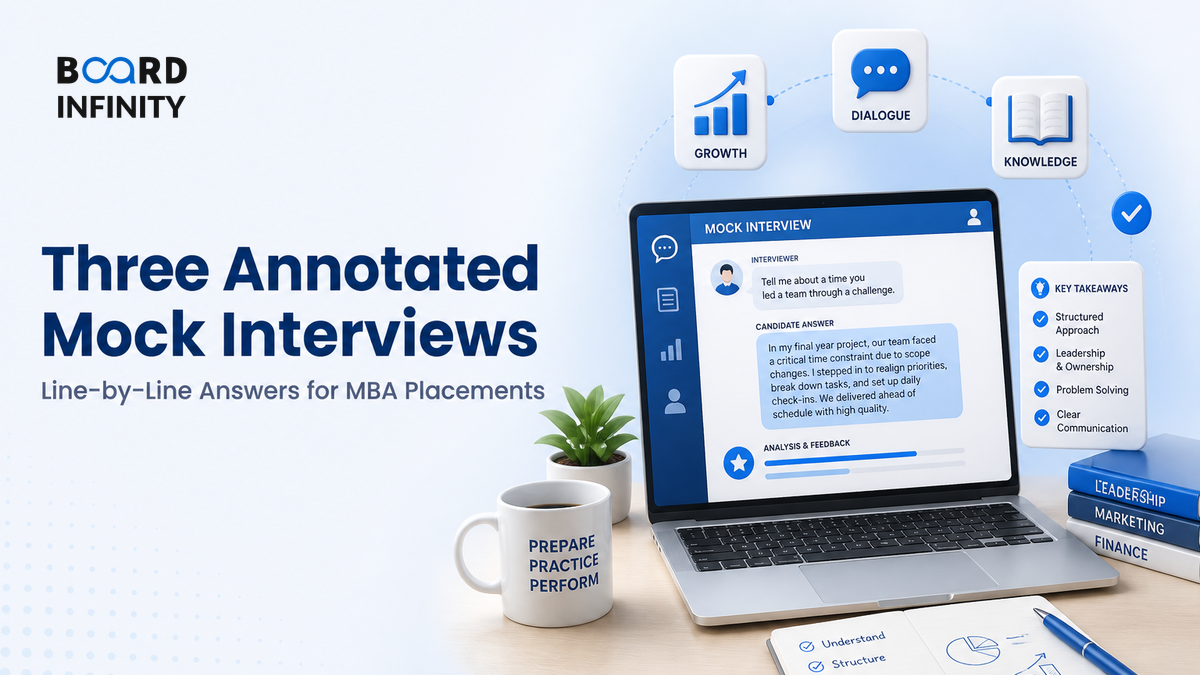
The biggest misconception about mock interviews is that they are rehearsals. The best mock interviews work more like match footage - you pause the play, inspect the decision, fix the pattern, and then run the same situation again with better judgment.
- A strong interview answer is not a memorised paragraph; it is a repeatable thinking loop: decode, structure, answer, handle probe, reflect.
- Every good answer has three layers: headline first, 2-3 clear buckets, and specific evidence from your experience or business awareness.
- For HR questions, use story plus fit; for business questions, use problem diagnosis plus prioritised action; for finance questions, use concept plus implication.
- Line-by-line annotation helps you spot hidden issues: vague claims, late structure, no metric, no trade-off, or an answer that sounds polished but says little.
- Use mock interview metrics: answer length, structure score, evidence density, follow-up conversion, and specificity ratio.
- The best candidates do not sound perfect; they sound clear, coachable, commercially aware, and calm under follow-up.
A mock interview has one job: to convert anxiety into an observable system. Once you can see the loop, you stop judging yourself vaguely - “I did badly” - and start improving precisely - “I missed the issue tree, so my answer became a story.”
The Core Method: Annotate the Answer, Not the Person
Weak mock feedback sounds like this: “Be more confident.” Strong mock feedback sounds like this: “Your first sentence did not answer the question; move your conclusion to the top, then give two evidence points.” The second one is useful because it points to a line you can rewrite.
Use this three-layer answer stack for almost every placement interview answer.
Mock Interview 1: HR Fit - “Tell Me About Yourself”
Question: “Tell me about yourself and why this role makes sense for you.”
What the interviewer is testing: clarity of identity, relevance to the role, evidence of self-awareness, and whether your story connects to the company’s need.
“I am an MBA student focused on consumer and revenue roles. My strongest pattern so far has been working close to customers, translating their problems into execution, and coordinating with teams to get outcomes. During my internship, I realised I enjoy the point where market insight becomes an operating plan. That is why this role interests me - it needs analysis, stakeholder management, and ownership. In the short term, I want to build execution depth; in the long term, I want to manage a category or business line. So the three things I would want you to remember are customer orientation, structured problem-solving, and learning speed.”
Mock Interview 2: Business Case - “Repeat Orders Are Falling”
Question: “You are working for a food delivery app. Repeat orders have fallen in one city. How will you diagnose the problem?”
What the interviewer is testing: whether you jump to ideas or first isolate the problem. Strong candidates do not say “give discounts” immediately. They locate the leak.
Mock Interview 3: Finance Concept - “Can a Profitable Company Run Out of Cash?”
Question: “If a company is profitable, can it still face a cash crunch?”
What the interviewer is testing: whether you understand the difference between accounting profit and cash flow. This is a favourite because it separates formula-memorisers from business thinkers.
A company sells goods worth ₹10 lakh on credit and earns an accounting profit of ₹2 lakh. If customers have not paid yet, the company may show ₹2 lakh profit but receive ₹0 cash from those sales in that period. If it must pay salaries, rent, suppliers, or loan instalments immediately, it can face a cash crunch despite being profitable.
How to Score a Mock Interview Like a Coach
Do not score yourself only on “confidence.” Confidence is an output. These five measures show what to fix.
Definitions You Should Be Able to Say in One Breath
- Mock interview: A simulated interview used to practise responses, receive feedback, and improve performance before the actual selection process.
- Structured interview: An interview using the same core questions and evaluation criteria for all candidates.
- STAR method: A behavioural answer format: Situation, Task, Action, Result.
- Probe: A follow-up question used to test depth, clarity, ownership, or consistency in the candidate’s answer.
Case Study - Honasa Consumer: Turning Company Research into Interview Answers
Honasa Consumer, the parent company behind Mamaearth, shows how a candidate can convert real business research into crisp, line-by-line interview answers.

Honasa Consumer built a digital-first personal care business in India around sharp consumer positioning, especially with Mamaearth’s focus on safer, toxin-free products for young families. The company later expanded beyond one brand and moved into broader distribution, including online marketplaces and offline retail. Its IPO in 2023 made it a useful interview example because it sits at the intersection of D2C branding, customer acquisition, portfolio expansion, and profitability questions.
The primary driver of the story is clear consumer positioning in a crowded beauty and personal care market. The supporting drivers are influencer and content-led discovery, online-first distribution, brand portfolio expansion, and eventual offline reach. A weak candidate says, “Mamaearth grew because of digital marketing.” A strong candidate says, “Digital marketing amplified the brand, but the business story is positioning plus distribution plus portfolio plus unit economics.”
So what: the case teaches the exact habit this lesson is about. Do not dump facts. Convert facts into a structured answer with driver, support, risk, and lesson.
How AI Changes Three Annotated Mock Interviews, Line by Line
AI is especially useful for mock interviews because it can turn a vague practice session into a transcript you can inspect. But it works only if you ask it to behave like a strict evaluator, not a motivational friend.
Load your resume, the job description, and two reliable company sources into NotebookLM. Ask: “Generate 12 likely interview questions, then score my answers on structure, evidence density, and follow-up risk.” Record one answer, paste the transcript, and rewrite only the weakest three lines.
Interview Relevance
“Tell me about one mock interview where you received tough feedback. What did you change after that?”
If asked about mock interview feedback, do not pretend you were already excellent. Interviewers like candidates who improve fast. A credible improvement story is often stronger than a flawless self-description.
The Single Biggest Candidate Mistake
Mistake: memorising “perfect” answers and then collapsing when the interviewer asks a follow-up. It costs candidates because the answer sounds polished but not owned. Fix: prepare answer structures, proof points, and follow-up logic - not scripts!
What to Revise Next
Move next to The Finance Day 0 Cheat Sheet & Formula Card Deck. You have already seen how a finance concept appears inside a live answer; now revise the formulas, ratios, and cash-flow logic so you can handle follow-ups without hesitation.