
Union Budget & Fiscal Policy Basics for Indian Markets
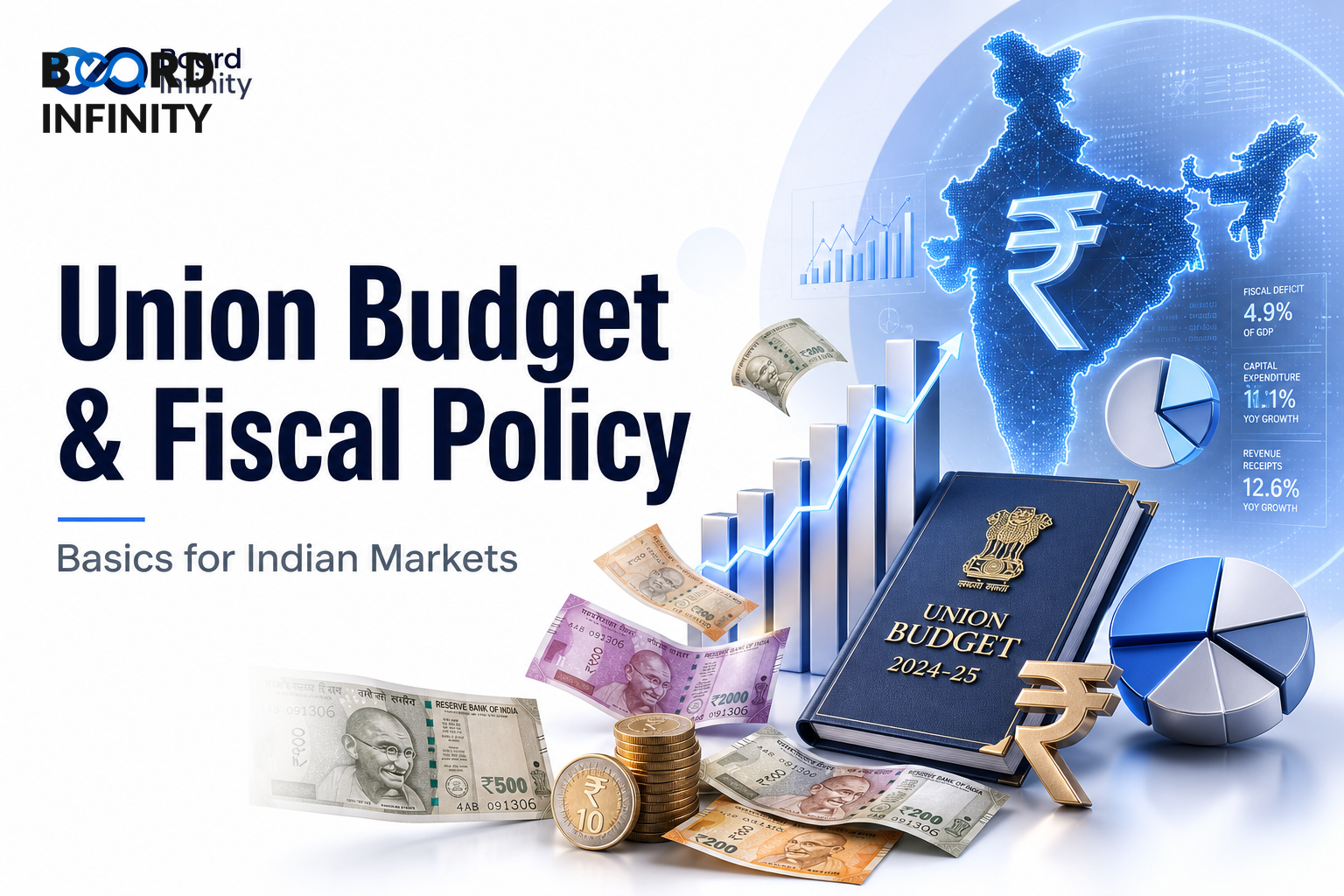
After understanding India's Financial Regulators: RBI, SEBI & IRDAI, the next interview question is how government fiscal policy shapes markets. The Union Budget, presented by the Finance Minister in Parliament, is the most important fiscal event for Indian financial markets. In interviews, it is best framed as a fiscal policy scorecard: deficit control, capex quality, tax capacity and disinvestment credibility together shape rates, growth and investor confidence.
- The Union Budget, presented by the Finance Minister in Parliament, is the most important fiscal event for Indian financial markets.
- Fiscal Deficit = Total Expenditure - Total Revenue (excluding borrowings). FY25 target: 4.9% of GDP, down from 5.8% in FY24.
- A lower fiscal deficit reduces government borrowing pressure, helps keep G-Sec yields in check, and improves sovereign credit profile.
- Revenue expenditure includes salaries, subsidies and interest payments. Capital expenditure includes roads, railways and defence infrastructure.
- FY25 Capex = ₹11.1 lakh crore, 3.4% of GDP - highest ever, boosting infra and creating manufacturing jobs.
- Tax-to-GDP Ratio: FY25 target ≈ 11.7%. India's ratio is lower than global peers - room to increase with formalisation and GST compliance improvement.
- Disinvestment means Government selling stakes in PSUs. LIC IPO was ₹21,000 Cr; Air India privatisation. Targets often missed; key upside risk to fiscal arithmetic.
Union Budget as the Market's Fiscal Policy Scorecard
The Union Budget is read by Indian financial markets through a few core fiscal signals: fiscal deficit, revenue expenditure versus capital expenditure, tax-to-GDP ratio and disinvestment. Each signal matters because it affects government borrowing pressure, G-Sec yields, sovereign credit profile, infrastructure spending, manufacturing jobs and fiscal arithmetic.
Fiscal Deficit = Total Expenditure - Total Revenue (excluding borrowings). FY25 target: 4.9% of GDP, down from 5.8% in FY24.
Disinvestment is Government selling stakes in PSUs. LIC IPO was ₹21,000 Cr; Air India privatisation. The interview so what is that disinvestment targets are often missed, making them a key upside risk to fiscal arithmetic.
Fiscal Deficit and Why Markets Track It
Fiscal Deficit = Total Expenditure - Total Revenue (excluding borrowings). The FY25 target is 4.9% of GDP, down from 5.8% in FY24.
A lower fiscal deficit reduces government borrowing pressure, helps keep G-Sec yields in check, and improves sovereign credit profile. For market interviews, this is the clean link between the Budget and rates: the deficit affects how much the government needs to borrow, and that can influence G-Sec yields.
Revenue Expenditure vs Capital Expenditure
Revenue expenditure means salaries, subsidies and interest payments. It is consumptive. Capital expenditure means roads, railways and defence infrastructure. It is productive and has a multiplier effect.
FY25 Capex = ₹11.1 lakh crore, 3.4% of GDP - highest ever, boosting infra and creating manufacturing jobs. In an interview, this is where you should separate the size of spending from the quality of spending: the same Budget can look very different depending on whether expenditure is consumptive or productive.
Tax-to-GDP Ratio
Tax-to-GDP Ratio shows the government's tax capacity relative to the size of the economy. The FY25 target is ≈ 11.7%.
India's ratio is lower than global peers - room to increase with formalisation and GST compliance improvement. This matters because stronger tax capacity improves the fiscal base without relying only on borrowings or one-off receipts.
Disinvestment
Disinvestment means Government selling stakes in PSUs. LIC IPO was ₹21,000 Cr; Air India privatisation.
Targets are often missed, so disinvestment is a key upside risk to fiscal arithmetic. In interview language, that means candidates should not treat disinvestment proceeds as perfectly certain when discussing deficit control.
Structuring a Union Budget & Fiscal Policy Basics Interview Answer
"How would you read the Union Budget as a fiscal policy scorecard for Indian financial markets?"
The best answers do not stop at quoting the fiscal deficit number. They connect the number to borrowing pressure, G-Sec yields, sovereign credit profile, capex quality, tax capacity and disinvestment credibility.
The most frequent error is treating the Budget as only a fiscal deficit headline. That costs points because the market also looks at revenue expenditure versus capital expenditure, tax-to-GDP capacity and whether disinvestment targets are credible.
Conclusion
The Union Budget is the most important fiscal event for Indian financial markets because it shows how the government plans to manage expenditure, revenue, borrowing and asset sales. For interviews, frame it as a fiscal policy scorecard: deficit control, capex quality, tax capacity and disinvestment credibility.