
Wellbeing, Burnout & Mental Health at Work - Interview-Ready HR Framework
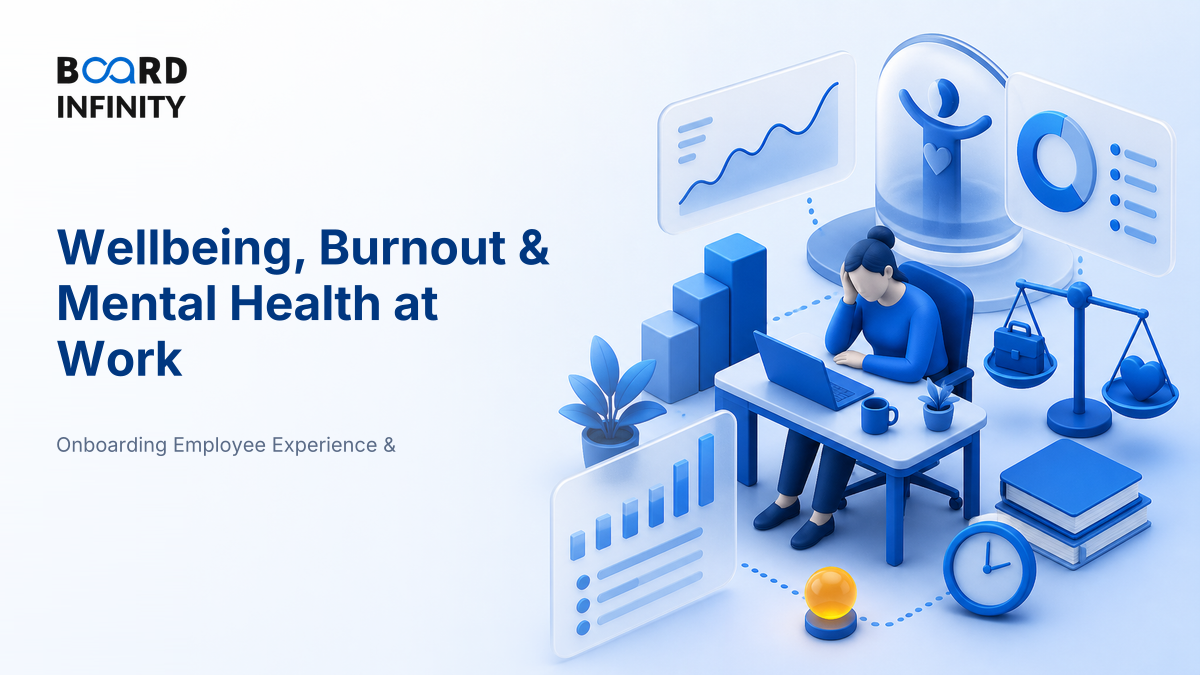
When a young professional’s death becomes a national debate about workload, “wellbeing” stops sounding like an HR poster and starts looking like a business risk. The hard truth: burnout is rarely caused by one bad week - it is what happens when job demands stay high and recovery, control, support and fairness stay low.
- Burnout is an occupational phenomenon caused by chronic workplace stress that is not successfully managed.
- The three classic burnout signals are exhaustion, cynicism or mental distance, and reduced professional efficacy.
- Do not treat wellbeing as yoga sessions alone. Strong answers link it to work design, manager behaviour, workload, psychological safety and recovery.
- The best diagnostic lens is the Job Demands-Resources model: burnout rises when demands exceed resources for too long.
- Measure wellbeing with concrete indicators: burnout risk score, absenteeism, attrition, psychological safety, EAP usage and after-hours load.
- In India, mental health at work also needs privacy-sensitive handling under data protection principles and stigma-aware communication.
- The interview-safe line: Wellbeing is not a perk; it is a system of work that protects health and performance together.
Big Picture: Wellbeing Is a Work System, Not a Wellness Calendar
The most useful way to understand workplace mental health is as a layered system. Benefits help, but they sit on top of more basic foundations: reasonable workload, clarity, control, fair treatment, manager support and recovery time.
Core Explanation: The Practical Model You Can Apply
Wellbeing at work means designing jobs, relationships and support systems so employees can stay healthy, motivated and effective over time. It covers physical health, mental health, emotional safety, social connection and financial security.
Mental health at work is the employee’s capacity to cope, think, relate and perform in a psychologically safe work environment. It is affected by personal factors, but organisations strongly influence it through workload, control, culture, leadership and fairness.
Burnout is the sharpest concept interviewers test because candidates often confuse it with temporary stress. Stress can be short-term and energising when recovery is available. Burnout is the depletion that follows prolonged stress without enough resources or recovery.
The Burnout Mechanism: Job Demands vs Job Resources
The simplest diagnostic model is the Job Demands-Resources model. Job demands are aspects of work that require sustained effort - long hours, emotional labour, ambiguity, conflict, constant interruptions. Job resources are aspects that help people cope and perform - autonomy, role clarity, staffing, manager support, feedback, tools, flexibility and fairness.
The management implication is powerful: you do not only ask, “How do we make employees more resilient?” You ask, “Which demand can we reduce, and which resource can we increase?”
Burnout vs Stress vs Depression: Do Not Mix Them Up
This distinction is an interview differentiator. Burnout is specifically linked to the occupational context. Depression is a clinical mental health condition that may extend beyond work and requires qualified care. Stress is a broader response to pressure and may be temporary.
The Five Levels of Workplace Wellbeing Intervention
A strong HR answer never jumps straight to counselling apps. It shows a hierarchy of interventions - from prevention to crisis response.
Metrics: How to Track Whether Wellbeing Is Actually Improving
Wellbeing cannot be managed by vibes. Use a balanced dashboard with leading indicators, lagging indicators and qualitative signals. Avoid one-number certainty because mental health data is sensitive and context-heavy.
The key is triangulation. If survey scores look good but after-hours work and regretted attrition are rising, the organisation may have a reporting problem, not a wellbeing win.
Definitions You Should Be Able to Say Cleanly
WHO: “Burn-out is a syndrome conceptualized as resulting from chronic workplace stress that has not been successfully managed.”
- Employee wellbeing: A sustainable state of health, safety, purpose and connection that enables effective work.
- Psychological safety: A team climate where people can speak up, ask for help and report mistakes without fear.
- Psychosocial risk: A work-design, management or social factor that can cause psychological or physical harm.
- EAP: An Employee Assistance Programme offering confidential support for personal, emotional, financial or work-related issues.
Case Study: Meesho’s Company-Wide Reset and Recharge Break
Meesho used a company-wide post-festive-season break to make recovery collective, visible and culturally acceptable in a high-pressure Indian e-commerce context.

Situation. Indian e-commerce teams face intense seasonal spikes around festive sales. For a company like Meesho, this means pressure across product, tech, category, seller operations, customer support and logistics coordination. The risk is not only long hours; it is the cultural message that recovery must wait until employees individually “earn” it.
The move. Meesho introduced its publicly discussed Reset and Recharge initiative - a company-wide break after the festive sale period. The important design choice was synchronisation. When everyone disconnects together, employees do not fear missing decisions, looking less committed, or returning to an overflowing inbox created by colleagues who kept working.
The lesson. The primary driver was a collective recovery norm, supported by leadership signalling, predictable timing after peak workload, and the absence of work FOMO during the break. It proves a deep HR point: wellbeing interventions work better when they change the system around the employee, not just the employee’s coping capacity.
The strategic takeaway: Meesho’s move was not “leave as a perk.” It was recovery as operating design - especially relevant for Indian growth companies with sharp demand peaks.
How AI Changes Wellbeing, Burnout & Mental Health at Work
AI is changing this topic in three concrete ways - but it also raises privacy and bias risks.
The caution is critical. Mental health data is sensitive. In India, employers should follow privacy-by-design principles, collect the minimum necessary data, avoid individual surveillance, and be mindful of obligations under the Digital Personal Data Protection Act, 2023.
Use NotebookLM: upload a company’s annual report, ESG or sustainability report, careers page and public employee wellbeing policy. Ask it to create likely HR interview questions on burnout risk, wellbeing metrics and manager accountability - then practise answering with the Job Demands-Resources model.
Interview Relevance
“Suppose employee burnout is rising in a high-growth company. As an HR manager, how would you diagnose and reduce it without hurting performance?”
Use this sentence if you get stuck: “I would treat burnout as a work-design and resource-allocation problem first, and a counselling-support problem second.”
Common Mistake
The mistake: Saying “we will conduct yoga, meditation and fun Fridays” as the main burnout solution. Why it costs candidates: it sounds superficial because it ignores workload, control, manager behaviour and recovery. One-line fix: diagnose job demands and resources first, then add wellbeing benefits as support - not as a substitute for better work design.
What to Revise Next
Once you understand burnout, move to the retention side of the same problem. Revise Retention Strategy: Interventions That Actually Move the Number to connect wellbeing with business outcomes, then study Stay Interviews, Exit Interviews & Attrition Diagnosis to learn how organisations detect risk before people leave.