
What Is Operations Management? Definition and Transformation Model
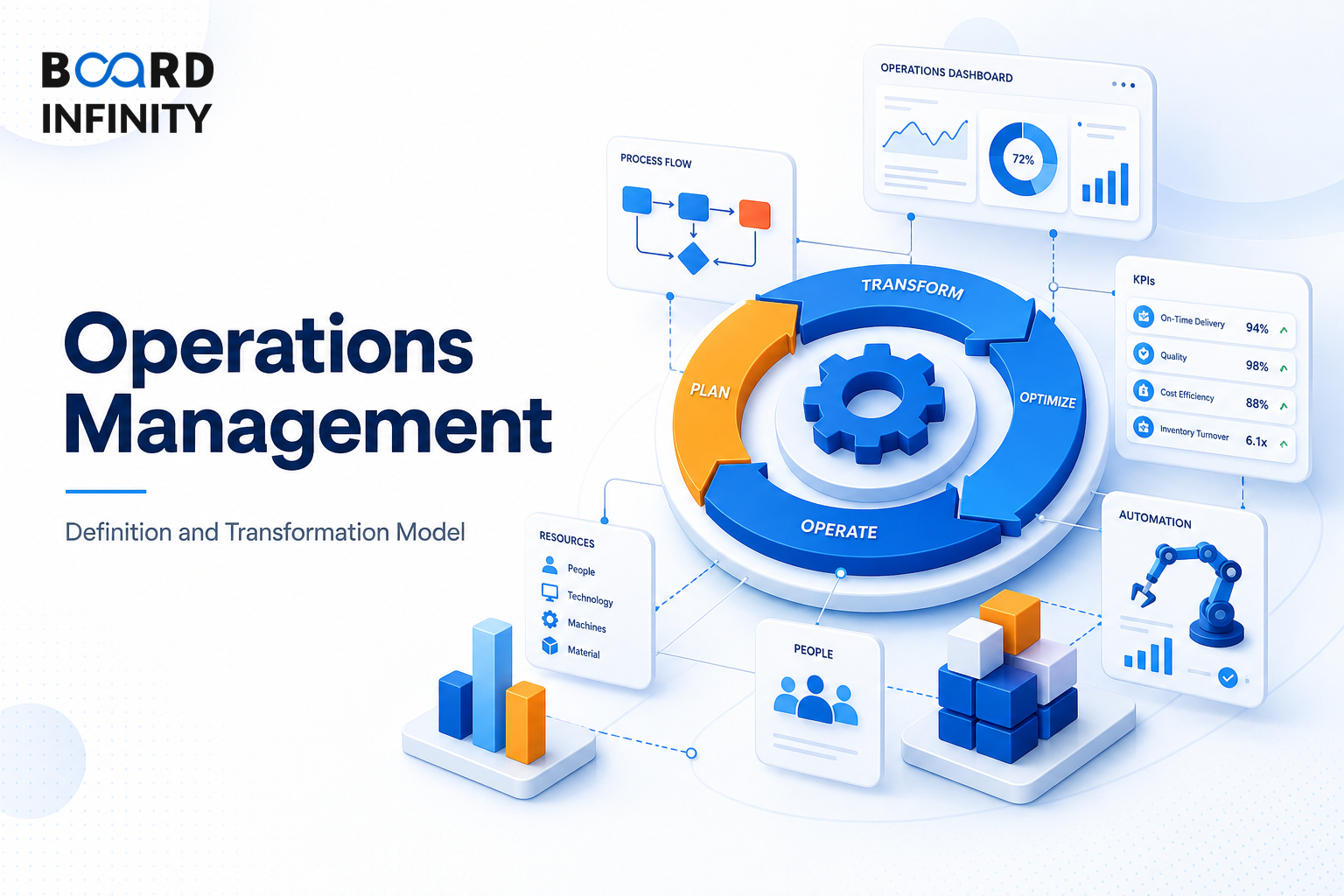
Every organisation has to convert resources into something customers value. Operations Management explains that conversion - from materials, labour, capital, and information into goods, services, and customer value. In interviews at companies such as Tata Motors and Flipkart, this topic matters because it tests whether you can explain how business practices create efficiency across both manufacturing and service settings.
- Operations Management is the administration of business practices to create the highest level of efficiency possible within an organisation.
- It involves planning, organising, and supervising the processes of production and manufacturing, and service delivery.
- Operations management transforms inputs such as materials, labour, capital, and information into outputs such as goods and services that provide value to customers.
- The Transformation Model moves from inputs to transformation to outputs, with feedback loops driving continuous improvement.
- Manufacturing operations create tangible goods such as cars, phones, and steel, while service operations create intangible services such as consulting, IT, and logistics.
- Manufacturing typically has lower customer contact and higher standardisation, while service operations typically have higher front-office interaction and more variable customised delivery.
- Operations Management has evolved from craft production to mass production, lean manufacturing, agile and digital operations, and Industry 4.0.
The Big Picture: Inputs, Transformation, Outputs
Operations Management is built around one central idea: inputs are converted through a transformation process into outputs that provide customer value. The nature of this transformation differs across manufacturing and service operations, but the logic remains the same.
Operations Management is the administration of business practices to create the highest level of efficiency possible within an organisation. It involves planning, organising, and supervising the processes of production and manufacturing, and service delivery.
Operations Management as a Transformation Model
"Operations management transforms inputs (materials, labour, capital, information) into outputs (goods and services) that provide value to customers." - Slack, Brandon-Jones & Johnston
The transformation process is not a one-way conversion. Feedback loops connect outputs back to inputs - quality metrics, customer feedback, and market data drive continuous improvement of the transformation process.
Inputs - materials, labour, capital, information - move through transformation - manufacturing, service delivery, value addition - to create outputs - goods, services, customer value.
Manufacturing Operations vs Service Operations
Manufacturing operations and service operations are both part of Operations Management, but their transformation logic differs. Manufacturing focuses on tangible goods such as cars, phones, and steel, while service operations focus on intangible services such as consulting, IT, and logistics.
The contrast is especially important in interviews because it shows that Operations Management is defined by the nature of the process, not the product alone. Tata Motors, Maruti, and Amul represent manufacturing examples, while TCS, Flipkart, and Apollo Hospitals represent service operations examples.
Evolution of Operations Management
Operations Management has evolved through different production systems and operating models. The shift moves from skilled artisans to assembly lines, then to Toyota Production System based lean manufacturing, and later to agile, digital, and Industry 4.0 operating models.
Structuring a What Is Operations Management? Definition & Transformation Model Explained Interview Answer
"What is Operations Management, and how does the transformation model differ in manufacturing and service operations?"
Operations interviews reward structured thinking, quantitative rigour, and practical awareness. Show that you can think like a manager, calculate like an analyst, and communicate like a leader.
The most frequent error is treating Operations Management as only factory production. That misses service delivery, customer feedback, and the broader transformation of inputs into customer-valued outputs, which costs points in interviews.
Conclusion
Operations Management is the discipline of planning, organising, and supervising transformation processes so that inputs become goods, services, and customer value. The strongest interview answers explain the model clearly, contrast manufacturing with service operations, and anchor the explanation in examples such as Tata Motors, Maruti, Amul, TCS, Flipkart, and Apollo Hospitals.