
Where AI Is Landing in Healthcare Delivery
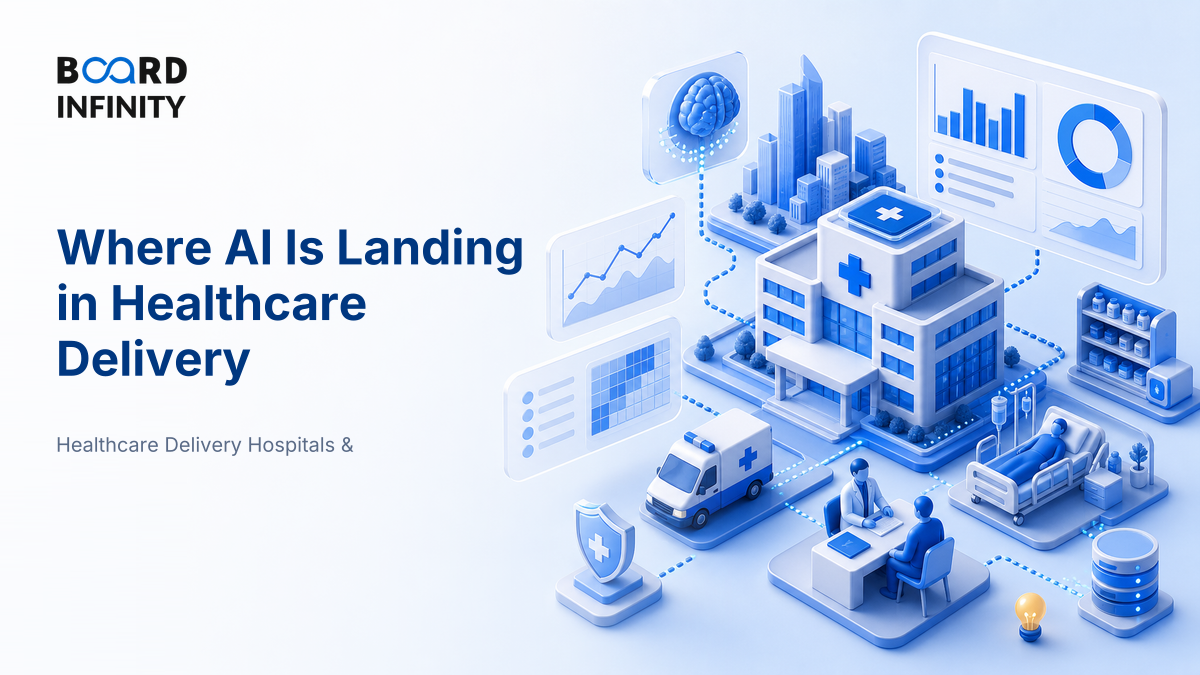
A patient walks into a crowded clinic, gets a chest X-ray, and before the radiologist opens the image, a software layer has already flagged it as urgent. In another room, a doctor speaks naturally to a patient while an AI scribe drafts the clinical note in the background. This is where AI is really landing in healthcare delivery - not as a robot doctor, but as a workflow accelerator around scarce clinical time.
- AI in healthcare delivery creates value when it improves access, speed, accuracy, capacity, or continuity of care.
- The strongest use cases sit at workflow bottlenecks: triage, radiology support, clinical documentation, scheduling, claims, and remote monitoring.
- AI rarely replaces clinicians in high-risk care; it prioritises, recommends, drafts, detects, or follows up under human supervision.
- The core interview frame is: use case - data - workflow owner - risk - metric - scale economics.
- In India, AI becomes more powerful when combined with digital identity, health records, insurance, telemedicine, and hospital operations data.
- The main risks are bias, false confidence, privacy leakage, medico-legal accountability, and poor adoption by clinicians.
- The best answer says where AI should land first, where it should not, and how to measure whether it genuinely improves care.
Big Picture: AI Lands Where Care Gets Stuck
Healthcare delivery is a chain of decisions and handoffs. AI creates value where the chain is overloaded, repetitive, data-heavy, or delayed - especially when a human expert still makes the final call.
Core Explanation: The Six Landing Zones of AI in Healthcare Delivery
The mistake is to discuss AI in healthcare as one giant category. A sharper answer breaks it into where in the delivery pathway AI is landing.
1. Digital Front Door: Access, Navigation, and Triage
This is the patient entry point - symptom checkers, appointment routing, chat support, insurance eligibility, and care navigation. AI helps answer: who should be seen, by whom, how urgently, and through which channel?
Good use cases are low-to-moderate risk and high-volume: appointment booking, pre-visit questionnaires, language support, basic triage, and escalation to a nurse or doctor when needed.
2. Diagnostics Support: Imaging, Pathology, and Clinical Decision Support
AI is strong where data is visual, pattern-heavy, and scarce specialists create delays. Radiology, ophthalmology, dermatology, and pathology are common landing zones.
The right framing is not “AI diagnoses instead of doctors.” It is: AI pre-screens, prioritises abnormal cases, highlights findings, and reduces time-to-review.
3. Clinical Documentation: Notes, Coding, and Summaries
Doctors spend large chunks of time documenting care. AI scribes and summarisation tools can convert conversations into draft notes, generate discharge summaries, prepare referral letters, and suggest billing or diagnostic codes.
The value is not glamorous, but it is powerful: more doctor time, cleaner records, faster claims, and better continuity of care.
4. Hospital Operations: Beds, Staff, OT, Pharmacy, and Queues
Hospitals are capacity systems. AI can predict no-shows, emergency department load, bed demand, inventory shortages, staffing needs, and operating theatre delays.
This is a classic MBA angle: even without touching diagnosis, AI can improve throughput, asset utilisation, and patient experience.
5. Remote Monitoring and Chronic Care
For diabetes, hypertension, cardiac care, respiratory illness, and post-surgery recovery, AI can monitor signals from devices, apps, calls, and patient-reported symptoms. It flags deterioration early and nudges follow-up.
The value comes from continuity: healthcare shifts from episodic hospital visits to ongoing managed care.
6. Revenue Cycle, Claims, and Administrative Workflows
Hospitals and insurers deal with authorisations, discharge billing, claims, denials, fraud checks, and documentation gaps. AI can detect missing information, predict claim rejection, route cases, and reduce manual back-and-forth.
This is often where AI scales fastest because risk is commercial and operational before it becomes clinical.
Definitions You Can Say in One Breath
- Healthcare delivery: The organised provision of health services to patients through clinicians, facilities, technology, and care processes.
- AI in healthcare delivery: Machine intelligence used to support decisions, automate tasks, or improve workflows across patient care.
- Clinical decision support: Tools that provide patient-specific recommendations or alerts to help clinicians make better decisions.
- Human-in-the-loop AI: An AI system where a qualified human reviews, approves, or overrides important outputs.
- Software as a Medical Device: Software intended for a medical purpose without being part of a hardware medical device.
Where AI Should and Should Not Be Automated First
Interviewers like candidates who can separate attractive use cases from safe, scalable use cases. Use this matrix: start with low-risk, high-clarity workflows; be careful with high-risk, ambiguous clinical decisions.
How to Judge Whether a Healthcare AI Use Case Is Real
A good AI use case is not “we have a model.” It is a solved workflow problem with measurable clinical, operational, and financial value.
Metrics That Prove AI Is Working in Healthcare Delivery
Do not stop at “accuracy.” Healthcare AI needs clinical, operational, adoption, and economic measures together.
Indian Example: ABDM Makes the Data Layer More Important
In India, AI in healthcare delivery will depend heavily on whether patient data can move safely across providers. The Ayushman Bharat Digital Mission creates building blocks such as ABHA, health facility registries, and consent-linked digital health records through its official ABDM platform.
The strategic point: AI models become more useful when they sit on interoperable data, but they also raise the bar for consent, privacy, identity, and accountability. If you are unclear which public body or regulation controls a healthcare use case, revise locating the regulator and what it controls before the interview.
Case Study: Qure.ai and the Radiology Triage Bottleneck
Qure.ai shows how healthcare AI lands first in a specific bottleneck: reading and prioritising medical images when specialist time is scarce.

Situation: Imaging is central to diagnosis, but radiologist availability is uneven across geographies and care settings. In high-volume screening or emergency contexts, the operational pain is not just “can we read an image?” It is “which image must be read first?”
The move: Qure.ai, an India-born healthcare AI company, built tools that analyse medical images such as chest X-rays and head CT scans. In a delivery workflow, the AI layer can flag suspicious scans, prioritise urgent cases, and support clinicians with structured findings.
Outcome and lesson: The strategic value is triage plus throughput. The primary driver is AI applied to a narrow, image-heavy, high-volume task. Supporting drivers are workflow integration, clinician review, deployment in screening settings, and the ability to prioritise scarce specialist attention. That is why the case is stronger than a generic “AI diagnoses disease” story.
How AI Changes Healthcare Delivery
By 2026, AI is changing healthcare delivery in three practical ways that MBA students should be able to explain clearly.
1. From Digital Records to Clinical Copilots
Earlier digitisation stored information. The next wave helps clinicians use it - drafting notes, summarising patient history, preparing discharge summaries, suggesting follow-up tasks, and identifying missing documentation.
2. From Single-Point Diagnosis to Multimodal Triage
AI is moving beyond one image or one lab result. Stronger systems combine imaging, vitals, clinical notes, past records, and operational context to decide urgency, routing, and escalation. The risk also rises because multimodal systems are harder to audit.
3. From Hospital Care to Continuous Care
AI supports monitoring after discharge, chronic disease follow-up, medication reminders, risk alerts, and nurse outreach. The care model shifts from “patient appears when sick” to “system watches for deterioration.”
Use NotebookLM or Perplexity to build a two-page brief: upload a hospital annual report, ABDM notes, and company pages; ask for AI use cases by care pathway; then verify every claim using AI research without importing its errors. For sector numbers, cross-check with current sector data sources you can trust.
Interview Relevance
“Where do you see AI creating the most value in healthcare delivery in India, and what risks would you watch before scaling it?”
A strong answer sounds like a product manager and an operations manager together: it names the user, the workflow, the risk, the metric, and the scale path.
Common Mistake
The mistake that costs candidates is saying “AI will replace doctors.” That sounds shallow because healthcare is high-trust, regulated, workflow-heavy, and clinically risky. The fix: say AI will first replace delays, duplication, and manual screening - while clinicians remain accountable for high-stakes decisions.