
15 Situational & Case Interview Questions for Operations Roles
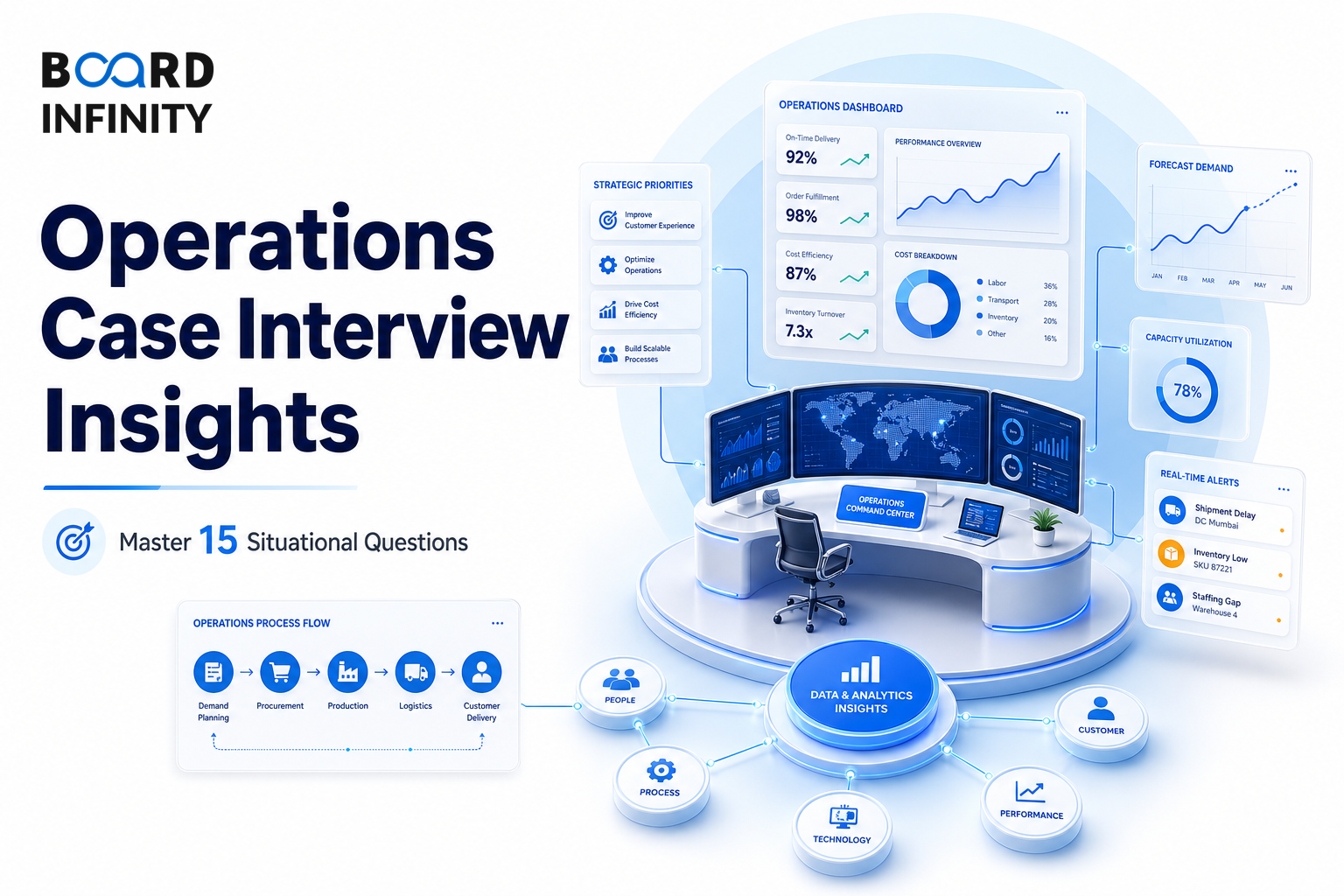
After practising 25 Operations & SCM Conceptual Interview Questions & Answers, the next step is applying those concepts under pressure. Operations interviews often test whether you can diagnose the issue, quantify the impact, and structure actions across immediate, medium-term, and long-term horizons. This playbook shows how to handle supplier delays, OEE drops, distribution design, returns, supply chain cost reduction, factory setup, labour strikes, supplier quality, demand spikes, and warehouse cost overruns.
- For supplier lead time doubling from 2 weeks to 4 weeks, assess impact on production schedule, increase safety stock for critical parts, and expedite urgent orders via air freight.
- For OEE dropping from 78% to 62%, decompose into Availability, Performance, and Quality, then use Pareto to find the #1 contributor.
- For a D2C brand entering 50 cities, start with 2-3 regional fulfillment centres in Mumbai, Delhi, Bengaluru, use 3PL for delivery, then expand in phases.
- For 25% fashion returns, analyse return reasons and target size mismatch, quality issues, different from image, late delivery, and buyer's remorse.
- For 15% supply chain cost reduction without reducing service levels, decompose cost across Procurement, Manufacturing, Warehousing, Transport, and Returns.
- For new supplier quality, use supplier qualification audit, sample testing, pilot production, PPAP sign-off, and ongoing monitoring.
- For demand spikes, labour strikes, and warehouse cost overruns, separate short-term containment from medium-term recovery and long-term resilience.
Operations Case Questions: Big Picture
The strongest operations case answers do not jump straight to a fix. They first identify the operational failure mode, quantify the size of the issue, and then structure actions by time horizon or by root-cause component.
Immediate: assess impact and contain disruption. Medium-term: fix the operating constraint. Long-term: build resilience through alternate suppliers, risk dashboards, flexible capacity, or operational flexibility.
Supplier Lead Time Doubling
When an interviewer asks, "Your supplier's lead time has doubled from 2 weeks to 4 weeks. What do you do?", the answer should be split across immediate, medium-term, and long-term actions.
Immediate: (1) Assess impact on production schedule, (2) Increase safety stock for critical parts, (3) Expedite urgent orders via air freight. Medium-term: (4) Qualify alternate supplier, (5) Renegotiate SLA with penalty clause. Long-term: (6) Dual-source A items, (7) Review supplier risk dashboard monthly.
Diagnosing an OEE Drop
When OEE dropped from 78% to 62% this month, the expected answer is diagnostic, not solution-first. Decompose: Check Availability first - any major breakdowns? - then Performance - speed losses, small stops? - then Quality - higher reject rate?
Use Pareto to find the #1 contributor. If Availability dropped: check maintenance logs, changeover records. If Quality: check SPC charts for shifts in process. Root cause before solution.
Designing a Distribution Network for a D2C Brand
For "Design a distribution network for a D2C brand entering 50 cities," the answer should phase the network build instead of assuming a fully built national footprint on day one.
Phase 1: Start with 2-3 regional fulfillment centres - Mumbai, Delhi, Bengaluru - covering Tier 1. Use 3PL for delivery. Phase 2: Add Kolkata/Hyderabad/Chennai for Tier 2 reach. Phase 3: Micro-fulfillment for same-day in top 10 cities.
Key decisions: Own warehouse vs 3PL, last-mile partner selection, returns strategy. 3PL - Third-Party Logistics - operates logistics on your behalf: warehousing, transport, fulfillment. 4PL - Lead Logistics Provider - manages your entire supply chain including multiple 3PLs; they're the orchestrator. 3PL = outsourced operations, 4PL = outsourced strategy + operations. Example: Delhivery is 3PL, Accenture SCM is 4PL.
Worked Example: Reducing Fashion Returns
A customer returns 25% of fashion orders. The answer starts with root cause analysis on return reasons and turns each reason into an operational action.
The target is to reduce returns to 15% in 6 months. The learning is that an operations answer improves when it links the biggest reason to the most direct fix instead of treating all returns as one generic problem.
Cutting Supply Chain Costs Without Reducing Service Levels
When asked to cut supply chain costs by 15% without reducing service levels, use SCOR cost decomposition. The answer should show multiple cost levers, because layer effects can achieve 15%.
Factory Setup From Scratch
For "How would you set up a new factory from scratch?", the structure is sequential. Start with location selection - proximity to market, suppliers, labour, infra - then capacity planning, using lead strategy for growth market.
Then move to layout design using product-process matrix, equipment procurement with make vs buy, supply chain design covering suppliers, logistics, warehouse, people through hire and train, pilot run, and ramp-up. Timeline: typically 12-24 months.
Labour Strike and Production Halt
If the factory has a labour strike and production is halted, the first priority is containment and safety. Immediate Day 1: (1) Assess situation, ensure safety, (2) Communicate with customers about delays, (3) Activate BCP - can other plants absorb?
Medium-term: (4) Engage with union leadership, understand demands, (5) Negotiate with mediator if needed. Long-term: (6) Improve employee engagement, (7) Build operational flexibility - multi-site, automation for critical processes.
Ensuring Quality From a New Supplier
For a new supplier, use a 5-step approach. The answer should move from qualification to production approval to ongoing monitoring.
Include quality SLA in contract with penalty clause.
Demand Spike Response
When demand for your product suddenly spikes 3x, the answer should protect current service first and then build capacity. Short-term: (1) Prioritise A-class customers, (2) Activate safety stock, (3) Add overtime/shifts.
Medium-term: (4) Ramp up with contract manufacturers, (5) Expedite raw material with premium freight. Long-term: (6) Install flexible capacity, (7) Build demand sensing capability to detect earlier.
Warehouse Costs Above Benchmark
If warehouse costs are 30% above industry benchmark, analyse: (1) Space utilisation - vertical racking? dead stock? - (2) Labour productivity - picks/hour vs benchmark - (3) Inventory mix - too many slow-movers? - (4) Location - rent in premium area? - (5) Technology - manual vs WMS-driven?
Usually it's a combination of poor slotting, excess inventory, and manual processes.
Structuring an Operations Situational and Case Interview Answer
"Your supplier's lead time has doubled from 2 weeks to 4 weeks. What do you do?"
The #1 way candidates get this wrong is giving a solution before diagnosis. Use the same principle as the OEE case: root cause before solution.
The most frequent error is treating every operations case as a single-action firefight. That costs points because the interviewer wants to see diagnosis, impact sizing, and a structured path across immediate, medium-term, and long-term actions.
Conclusion
Strong operations case interview answers are structured, diagnostic, and practical. Whether the issue is supplier risk, OEE loss, returns, cost reduction, quality, demand spikes, labour disruption, or warehouse cost, start with the root cause, quantify the impact, and then sequence actions by horizon.