
Agentic AI: Multi-Step Work and Where It Breaks
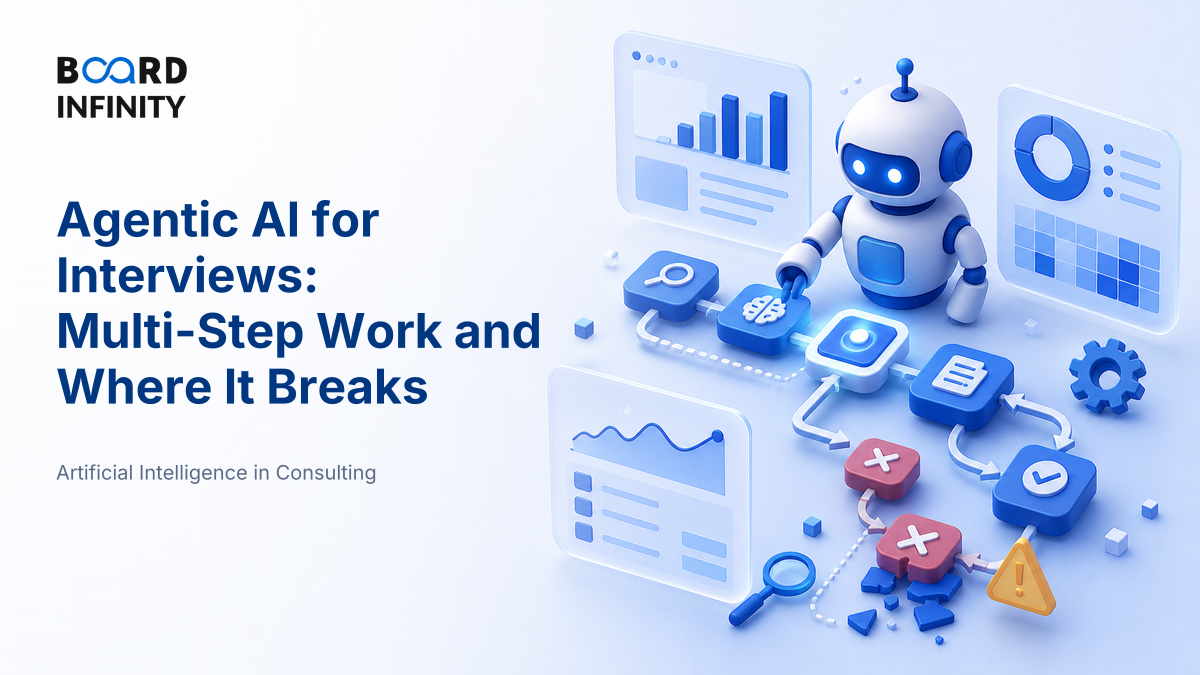
A travel agent that can compare flights, read your calendar, book the ticket, file the expense, and message your manager sounds magical - until it books the wrong date because one webpage changed its layout. That is the promise and danger of agentic AI: it can do multi-step work, but every extra step creates another place to drift, fail, or need supervision.
- Agentic AI means an AI system can plan, use tools, take actions, observe results, and iterate toward a goal.
- The core loop is goal - plan - act - observe - revise; most failures happen when one loop compounds an earlier mistake.
- Agents are useful when work is multi-step, tool-heavy, and semi-structured: research, support resolution, coding, sales ops, compliance checks, and analytics workflows.
- Agents break at five points: unclear goals, weak planning, unreliable tools, bad memory/context, and missing guardrails.
- Do not judge an agent only by “answer quality.” Track task success rate, tool error rate, intervention rate, cost per successful task, and time saved.
- The safest business design is not “full autonomy.” It is bounded autonomy: clear permissions, logs, checkpoints, and human approval for high-risk actions.
- Interview answer structure: define agentic AI, show the loop, give use cases, explain failure modes, then recommend controls.
Big Picture: Agentic AI Is a Work Loop, Not a Chatbot
A chatbot answers. An agent does. The mental shift is simple: instead of one prompt producing one response, an agent repeatedly reasons about the next best action, calls tools, checks outcomes, and continues until the task is complete or blocked.
Core Explanation: How Multi-Step AI Work Actually Runs
Think of an AI agent as a junior analyst with software access. It receives an objective, decomposes the work, uses tools like search, spreadsheets, CRMs, code interpreters or APIs, then checks whether the output satisfies the goal.
The important word is multi-step. A normal LLM prompt might say, “Summarise this report.” An agentic workflow might say, “Find the latest annual report, extract revenue segments, compare margins with two competitors, create a slide outline, and flag risks.” That requires planning, tool use, memory, judgment, and error recovery.
Anthropic describes workflows as systems where LLMs and tools follow predefined code paths, while agents dynamically direct their own process and tool use (Anthropic, 2024).
The 5-Part Anatomy of an AI Agent
When you explain agentic AI, avoid vague phrases like “it thinks and executes.” Use this structure instead.
Where Agentic AI Breaks
The easiest way to understand failures is to separate thinking failures from execution failures. A human intern can misunderstand the task or click the wrong button. Agents have the same two broad risks, except they can repeat mistakes faster.
Definitions You Should Be Able to Say in One Breath
- Agentic AI: An AI system that plans, uses tools, acts, observes results, and iterates toward a goal.
- Tool use: The agent’s ability to call external systems such as search, APIs, databases, code or enterprise apps.
- Human-in-the-loop: A control design where humans approve, correct or stop high-risk AI actions before completion.
- ReAct pattern: A prompting approach that interleaves reasoning and acting so models can decide, use tools, and update from observations (Yao et al., 2022).
How to Evaluate an AI Agent in Business
If you say “the agent is good because the output looks fine,” an interviewer will push back. In operations, consulting, product or analytics roles, you need measurable reliability.
Example: Agentic AI in an Indian Consulting Workflow
Imagine a consulting team studying entry into Indian quick commerce. A basic LLM can summarise articles. An agentic workflow could monitor category prices across selected PIN codes, pull company filings, compare delivery promises, draft a competitor map, and flag assumptions that need primary research.
The India-specific mechanics matter: PIN-code level availability, UPI-heavy payments, dark-store density, city-level regulation, local assortment, and discounting intensity can change the answer. This is why the agent must be grounded in a clear problem statement; if the problem is fuzzy, revise Defining the Problem Before Solving It before trying to automate the research.
Agentic AI is most valuable when it compresses analyst legwork, but the consultant must still own judgment: which sources matter, what assumptions drive the answer, and what recommendation follows.
Case Study: Klarna’s AI Assistant Shows Both Power and Control Needs
Klarna used an AI assistant for customer service, showing how agents can handle multi-step support work when the task boundaries are clear.

Situation: Klarna, the payments and shopping company, had a high-volume support environment where users needed help with refunds, payments, returns, account questions, and order issues. These are not just “answer a FAQ” tasks. Many require reading context, identifying the customer’s intent, checking policy, and deciding whether to resolve or escalate.
The move: Klarna launched an AI assistant powered by OpenAI. In its public announcement, Klarna said the assistant handled two-thirds of customer service chats in its first month, managed 2.3 million conversations, performed work equivalent to 700 full-time agents, and maintained customer satisfaction on par with human agents (Klarna, 2024).
The result and lesson: The primary driver was not “AI is smart.” The primary driver was a bounded, repetitive, high-volume service domain where the assistant could access relevant context and resolve common workflows. Supporting drivers included clear escalation paths, integration into the customer support journey, measurable service outcomes, and a narrow enough task universe to control risk.
The interview takeaway: agentic AI succeeds when the workflow is repetitive enough to systematise, but varied enough that automation saves meaningful time. It fails when companies give it broad autonomy without defining what it may do, what it must not do, and when it must ask a human.
How AI Changes Agentic AI: Multi-Step Work and Where It Breaks
AI is not just creating agents; it is changing how agents are built, supervised, and used in business.
Practical student workflow: Use ChatGPT or Claude to build a “safe agent design” for any case. Give it the task, ask for the goal, tools, failure modes, human approval points, and metrics. Then challenge the design by asking: “Where could this agent cause business damage?” For consulting preparation, pair this with Practising Cases With AI as a Mock Interviewer so the tool tests your reasoning rather than only generating content.
Interview Relevance
“Suppose a client wants to deploy agentic AI in customer support or consulting research. How would you explain what it can do, where it can fail, and how you would control the risks?”
If the discussion moves toward consulting productivity, connect your answer to How AI Is Changing Consulting Roles, Pyramids & Pricing: agentic AI compresses junior research and drafting work, but senior judgment, client trust, and recommendation ownership remain critical.
Common Mistake
The biggest mistake is treating agentic AI as “fully autonomous intelligence.” That costs candidates because it ignores operational risk. The fix: always say bounded autonomy with measurable controls - define what the agent can do, where it must stop, and how success is tracked.