
Banking Fundamentals: How Banks Make Money in India
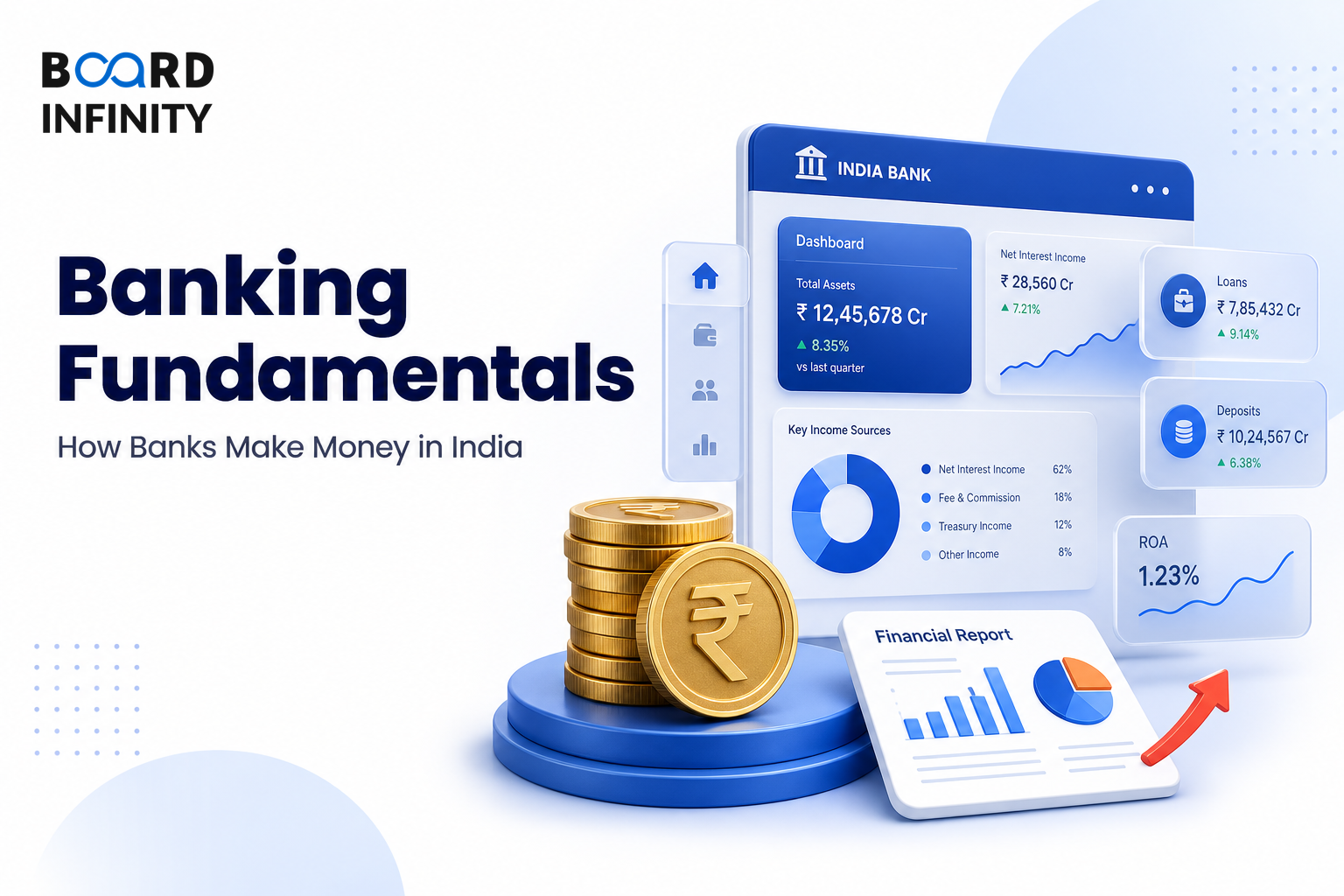
India's banking system is not one single type of bank doing one single job. It is a layered financial architecture serving 1.4 billion people, where public sector banks, private banks, small finance banks, payments banks, NBFCs, housing finance companies, and microfinance institutions each handle a different part of deposits, credit, inclusion, and payments. In interviews at banks such as HDFC Bank or ICICI Bank, the strongest answers show that you understand both the money-making engine and the regulatory structure behind it.
- Banks typically make money by accepting deposits and lending to borrowers, with profitability reflected through metrics such as Net Interest Margin, or NIM.
- India's banking system is layered: PSBs, private banks, SFBs, payments banks, NBFCs, HFCs, and MFIs serve different customer and credit needs.
- Public Sector Banks, or PSBs, have government ownership above 50 percent and carry a social banking and priority sector mandate.
- Private sector banks such as HDFC Bank, ICICI Bank, Axis Bank, and Kotak Mahindra Bank are described as tech-forward, retail-focused, and stronger on asset quality, NIM, and ROE than PSBs.
- Payments Banks can accept deposits up to ₹2 lakh but cannot lend, so they do not follow the same lending-led model as regular banks.
- NBFCs, HFCs, and MFIs fill specialised credit gaps such as SME loans, vehicle finance, housing finance, and very small unsecured loans.
- The Reserve Bank of India, or RBI, is the primary banking regulator and oversees monetary policy, banking supervision, foreign exchange, government banking, currency, and payment systems.
At a high level, India’s financial system can be understood as a stack of institutions, where each layer has a different permission set, customer base, and role in money movement or credit creation.
The Core Money-Making Logic
The simplest way to understand how banks make money is to separate the liability side and the asset side. Deposits are a liability for a bank because the bank owes money to depositors, while loans are assets because borrowers owe money to the bank. When a bank lends effectively, the difference between what it earns on loans and what it pays or manages on funding shows up through Net Interest Margin, or NIM.
NIM matters because the source explicitly compares private sector banks with PSBs on this metric: private banks are described as having better asset quality, NIM, and Return on Equity, or ROE, than PSBs. ROE means profit generated relative to shareholders’ equity. In a banking interview, mentioning NIM and ROE shows that you are not just saying "banks give loans"; you are connecting lending, risk, and profitability.
Asset quality refers to how healthy a lender’s loan book is. In interview language, a bank with better asset quality is typically understood as having a stronger borrower base and lower stress in its loans, which supports better profitability metrics such as NIM and ROE.
Public Sector Banks: Scale, Mandate, and Priority Sector Role
Public Sector Banks, or PSBs, are banks where government ownership is above 50 percent. They are regulated by the RBI and the Ministry of Finance, and they carry a social banking mandate along with priority sector responsibilities. The source notes that India has 12 PSBs post-consolidation.
The money-making model of PSBs still depends on banking fundamentals such as deposits, lending, and asset quality, but their role is not only commercial. They also serve policy and inclusion objectives, which is why an interview answer should avoid judging them only on profitability metrics. SBI is the most important example from the source: it is the largest PSB and has ₹62 Lakh Cr assets. Other examples include PNB, Bank of Baroda, Canara Bank, and Union Bank.
The nuance is that a PSB’s business model must be read with its mandate. A candidate who says "PSBs are less efficient than private banks" without mentioning priority sector and social banking will sound superficial. A stronger answer says that PSBs balance scale, public ownership, inclusion, and credit delivery under RBI and Ministry of Finance oversight.
Private Sector Banks: Retail Focus, Technology, and Profitability Metrics
Private sector banks are regulated by the RBI and are described in the source as tech-forward, aggressive in retail, and stronger than PSBs on asset quality, NIM, and ROE. Examples include HDFC Bank, ICICI Bank, Axis Bank, and Kotak Mahindra Bank. HDFC Bank is identified as India’s largest by market cap.
For "how banks make money" questions, private banks are often the cleanest case to discuss because the source directly links them to better NIM and ROE. Their retail focus means they compete strongly in customer acquisition, digital banking, and loan products. However, the source does not say that every private bank is automatically superior in every situation, so the right phrasing is: private banks are generally described here as having better asset quality, NIM, and ROE than PSBs.
In interviews, use private banks to show the commercial logic of banking. A bank earns when it can originate loans, maintain asset quality, and manage its margin effectively. HDFC Bank and ICICI Bank are useful named examples because they represent large private sector banks operating under the RBI framework.
Small Finance Banks and Payments Banks: Inclusion With Different Permissions
Small Finance Banks, or SFBs, promote financial inclusion by focusing on small borrowers, micro, small and medium enterprises, or MSMEs, and unserved segments. MSMEs are smaller businesses that often need formal credit but may not be served well by traditional banking channels. AU Small Finance Bank, Equitas, Jana SFB, and Suryoday SFB are examples from the source.
SFBs participate in the lending-led model, but their strategic importance comes from whom they serve. They expand formal finance to borrower groups that may be underrepresented in mainstream credit. In an interview, SFBs are useful when you want to show that financial inclusion is not only a government slogan; it is also built into the licensing and institutional structure of banking.
Payments Banks, or PBs, are very different. They can accept deposits up to ₹2 lakh, but they cannot lend. They focus on digital payments and financial inclusion. Examples include Airtel Payments Bank, India Post Payments Bank, Fino Payments Bank, and Jio Payments Bank.
This is a common interview trap. If a candidate says "all banks make money by lending", Payments Banks become the counterexample. Because they cannot lend, their role in the architecture is payments and inclusion, not credit creation. The right answer is that regular banks and SFBs can be linked to lending, while Payments Banks are deposit and payment institutions with a lending restriction.
NBFCs, HFCs, and MFIs: Credit Outside the Traditional Bank Layer
Non-Banking Financial Companies, or NBFCs, lend but cannot accept demand deposits. A demand deposit is money that can be withdrawn on demand, such as a typical bank deposit. NBFCs fill credit gaps for SMEs, vehicles, and consumer loans. Bajaj Finance is identified in the source as India’s most valued NBFC, with Mahindra Finance, Muthoot Finance, and HDFC Ltd, merged, also listed.
Housing Finance Companies, or HFCs, specialise in home loans and construction finance. Their assets are long-duration, meaning the repayment period tends to be longer than many short-term credit products. LIC Housing Finance, PNB Housing, Aavas Financiers, and Aptus Value Housing are examples. The source states that HFCs are regulated by NHB and RBI post-2019, where NHB means National Housing Bank.
Microfinance Institutions, or MFIs, provide very small unsecured loans to micro-entrepreneurs. Unsecured means the loan is not backed by specific collateral. The source highlights the joint liability group model, where repayment discipline is supported through group responsibility. Bandhan Bank is noted as an institution that converted to a bank, and examples include CreditAccess, Spandana, and ASA International India.
RBI: The Regulator That Holds the Architecture Together
The Reserve Bank of India, or RBI, was established in 1935 and is India’s central bank and primary banking regulator. For a banking fundamentals answer, the RBI is not a side note. It defines the operating environment by regulating banks, overseeing payments, managing currency, and influencing monetary conditions.
The source lists six core RBI functions. Monetary policy includes setting the repo rate, Cash Reserve Ratio, or CRR, and Statutory Liquidity Ratio, or SLR. The repo rate is the rate used in RBI liquidity operations, CRR is the cash reserve banks must maintain, and SLR is the statutory liquidity requirement. Banking supervision includes licensing, inspection, and Prompt Corrective Action, or PCA, which is supervisory intervention when a bank shows stress.
The RBI also handles Foreign Exchange Management under FEMA, the Foreign Exchange Management Act, and manages forex reserves of ~$640 Bn. It acts as government banker by managing Government Securities, or G-Sec, issuances and government accounts. It also manages currency notes and payment systems such as Unified Payments Interface, or UPI, Real Time Gross Settlement, or RTGS, and National Electronic Funds Transfer, or NEFT.
Worked Example: Comparing SBI and HDFC Bank in an Interview
This worked example is powerful because it avoids a generic comparison. It shows that SBI and HDFC Bank are both part of the banking system, but one is best read through scale, public ownership, and mandate, while the other is best read through retail focus, technology orientation, and profitability metrics stated in the source.
Structuring a Banking Fundamentals Interview Answer
"How do banks in India make money, and how does the banking system structure affect their business model?"
The best answers do not simply say "banks earn from loans." They explain which institutions can lend, which cannot, who they serve, and how RBI-led regulation shapes their business model.
The most frequent error is treating PSBs, private banks, Payments Banks, NBFCs, HFCs, and MFIs as if they are all the same type of bank. That costs points because Payments Banks cannot lend, NBFCs cannot accept demand deposits, and PSBs carry a public mandate that changes how their performance should be interpreted.
Conclusion
India’s banking system makes sense when seen as a regulated financial architecture rather than a single industry template. The final takeaway for interviews is simple: explain the money-making logic through lending, deposits, NIM, and asset quality, then adapt it to each institution’s mandate, permissions, customer segment, and RBI-led regulatory role.