
Indian Banking Landscape: RBI, PSBs, Private Banks and NBFCs
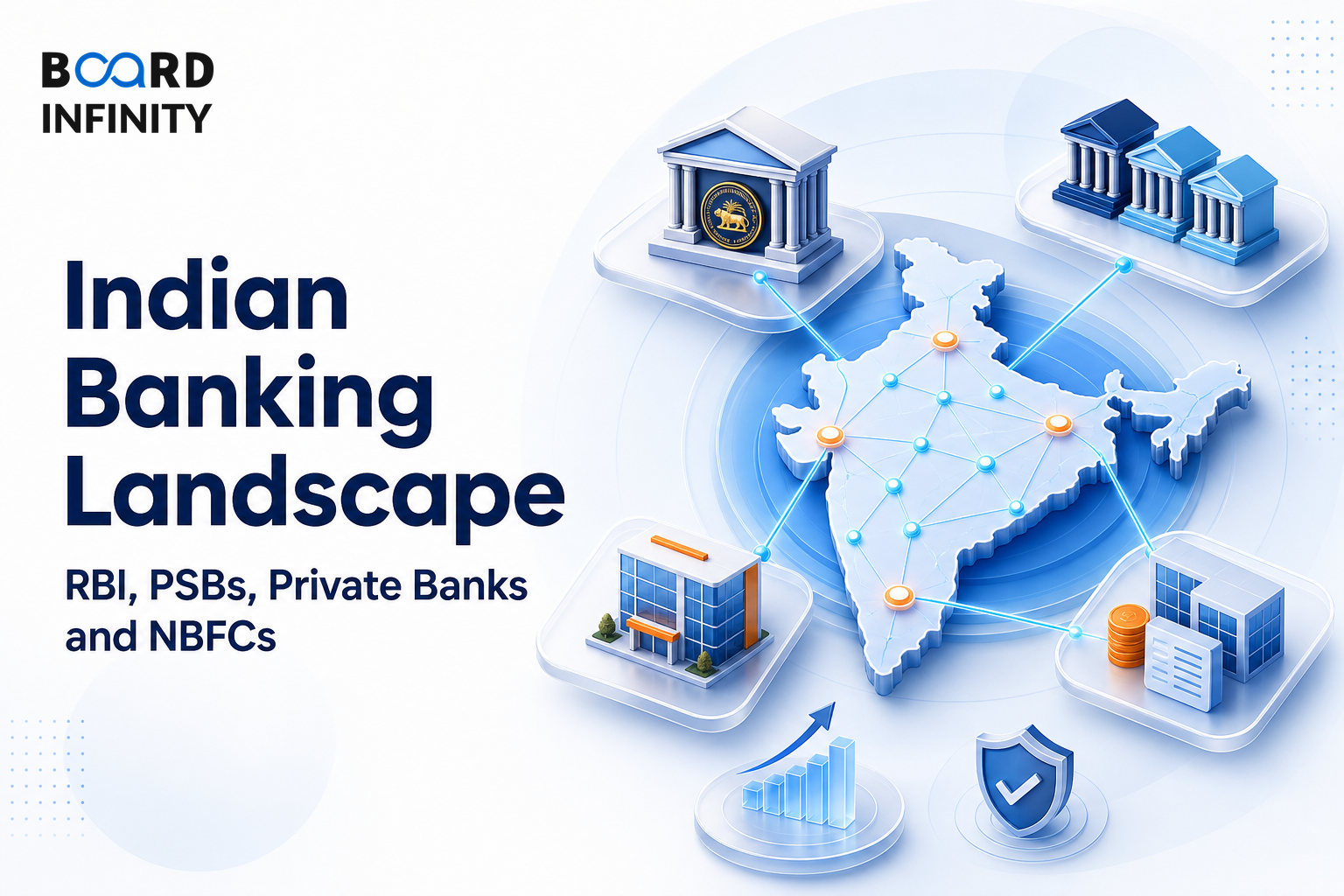
In Banking Fundamentals - How Banks Make Money, you saw that banks earn through lending, deposits, spreads and fees. The next interview question is broader: who exactly operates inside India’s financial system, who regulates them, and why do SBI, HDFC Bank, Bajaj Finance and Airtel Payments Bank not all do the same thing? This matters because banking interview answers are tested not only on definitions, but on whether you can map ownership, lending powers, inclusion mandate and regulatory oversight correctly.
- India’s banking and financial system serves 1.4 billion people through a layered architecture of institutions regulated by multiple bodies, primarily the Reserve Bank of India.
- The Reserve Bank of India, established in 1935, is India’s central bank and primary banking regulator, handling monetary policy, supervision, forex, government banking, currency and payment systems.
- Public Sector Banks have government ownership above 50 percent, a priority sector and social banking mandate, and are overseen by the RBI plus the Ministry of Finance.
- Private Sector Banks are RBI-regulated, tech-forward and retail-focused, with better asset quality, Net Interest Margin and Return on Equity than Public Sector Banks as per the source.
- Payments Banks can accept deposits up to ₹2 lakh but cannot lend, while Non-Banking Financial Companies can lend but cannot accept demand deposits.
- Small Finance Banks, Microfinance Institutions and Housing Finance Companies exist because India’s financial system must serve small borrowers, unserved segments, micro-entrepreneurs, housing and construction finance.
The Layered Architecture at a Glance
Think of India’s financial system as a stack rather than a single category called “banks”. The top layer is the Reserve Bank of India, followed by different types of banks and specialist lenders that differ by ownership, deposits, lending powers, target customers and regulator.
RBI: The Anchor Regulator
The Reserve Bank of India is India’s central bank and primary banking regulator. It was established in 1935 and sits at the center of the system because it influences monetary conditions, supervises banks, manages foreign exchange responsibilities and oversees payment systems.
In interviews, define the RBI through its functions rather than only saying “it regulates banks”. Monetary policy includes setting the repo rate, Cash Reserve Ratio (CRR) and Statutory Liquidity Ratio (SLR). Banking supervision includes licensing, inspection and Prompt Corrective Action (PCA), while foreign exchange management includes the Foreign Exchange Management Act (FEMA) and management of forex reserves of approximately $640 Bn.
RBI means Reserve Bank of India. In this topic, it is best understood as the institution that sets monetary policy, supervises banks, manages currency and foreign exchange responsibilities, acts as government banker and oversees payment systems such as UPI, RTGS and NEFT.
Public Sector Banks: Ownership Plus Inclusion Mandate
Public Sector Banks, or PSBs, are banks where government ownership is above 50 percent. Their role is not limited to commercial lending; they also serve priority sectors and carry a social banking mandate.
The source notes that India has 12 PSBs post-consolidation. Key examples include SBI, PNB, Bank of Baroda, Canara Bank and Union Bank. SBI is the largest among the named examples, with ₹62 Lakh Cr assets.
The practical nuance is that PSBs should not be evaluated only like purely retail-focused private banks. In interviews, mention that they are regulated by the RBI plus the Ministry of Finance, and that their mandate includes public policy objectives such as priority sector and social banking.
Private Sector Banks: Retail, Technology and Performance Metrics
Private Sector Banks are RBI-regulated banks with a tech-forward and aggressive retail focus. The source states that they have better asset quality, Net Interest Margin and Return on Equity than Public Sector Banks.
Net Interest Margin, or NIM, is the margin a bank earns between interest income and interest cost. Return on Equity, or ROE, measures profit generated on shareholders’ equity. In a case interview, these terms help you compare business models rather than merely listing bank names.
Examples from the source include HDFC Bank, ICICI Bank, Axis Bank and Kotak Mahindra Bank. HDFC Bank is described as India’s largest by market capitalisation, while ICICI Bank and Axis Bank are also major private sector examples.
Inclusion-Led Banks: Small Finance Banks and Payments Banks
Small Finance Banks, or SFBs, are designed to promote financial inclusion. They focus on small borrowers, small business borrowers and unserved segments. Examples include AU Small Finance Bank, Equitas, Jana SFB and Suryoday SFB.
Payments Banks, or PBs, have a much narrower role. They can accept deposits up to ₹2 lakh, cannot lend, and focus on digital payments and financial inclusion. Examples include Airtel Payments Bank, India Post Payments Bank, Fino Payments Bank and Jio Payments Bank.
The most important interview nuance is not to treat every entity with “bank” in its name as a full lending bank. A Payments Bank is useful for deposits and payments within the stated limit, but it is structurally different from a Small Finance Bank because it has no lending powers.
Specialist Credit Institutions: NBFCs, HFCs and MFIs
Non-Banking Financial Companies, or NBFCs, lend but cannot accept demand deposits. They fill credit gaps for small enterprises, vehicles and consumer loans. Bajaj Finance is described in the source as India’s most valued NBFC, with Mahindra Finance, Muthoot Finance and HDFC Ltd, merged, also listed as examples.
Housing Finance Companies, or HFCs, specialize in home loans and construction finance. They deal with long-duration assets and are regulated by NHB plus RBI post-2019. Examples include LIC Housing Finance, PNB Housing, Aavas Financiers and Aptus Value Housing.
Microfinance Institutions, or MFIs, provide very small unsecured loans to micro-entrepreneurs using the joint liability group model. They sit under the RBI NBFC-MFI category. Examples include Bandhan Bank, which converted to a bank, CreditAccess, Spandana and ASA International India.
Worked Example: Choosing the Right Institution Type
This worked example shows why a layered view is stronger than a list-based answer. The same customer need can map to different institutions depending on whether the requirement is deposit access, lending, digital payments, priority sector reach or specialist credit.
Structuring an Indian Banking Landscape Interview Answer
"How would you explain India’s banking architecture and the difference between PSBs, private banks, Payments Banks and NBFCs?"
The best answers classify institutions by four lenses: ownership, deposit powers, lending powers and mandate. Candidates lose depth when they only list examples without explaining why the entities are structurally different.
Conclusion
India’s banking landscape is best understood as a layered institutional architecture led by the RBI, with PSBs, private banks, inclusion-led banks and specialist lenders serving different needs. For interviews, the winning approach is to compare mandate and powers first, then support the answer with named examples.
The most frequent error is saying that all RBI-regulated financial institutions are “banks” in the same sense. That costs points because Payments Banks cannot lend, NBFCs cannot accept demand deposits, PSBs have a social banking mandate, and private banks are evaluated differently on retail focus, asset quality, NIM and ROE.