
How the Chemicals, Metals & Industrials Value Chain Works
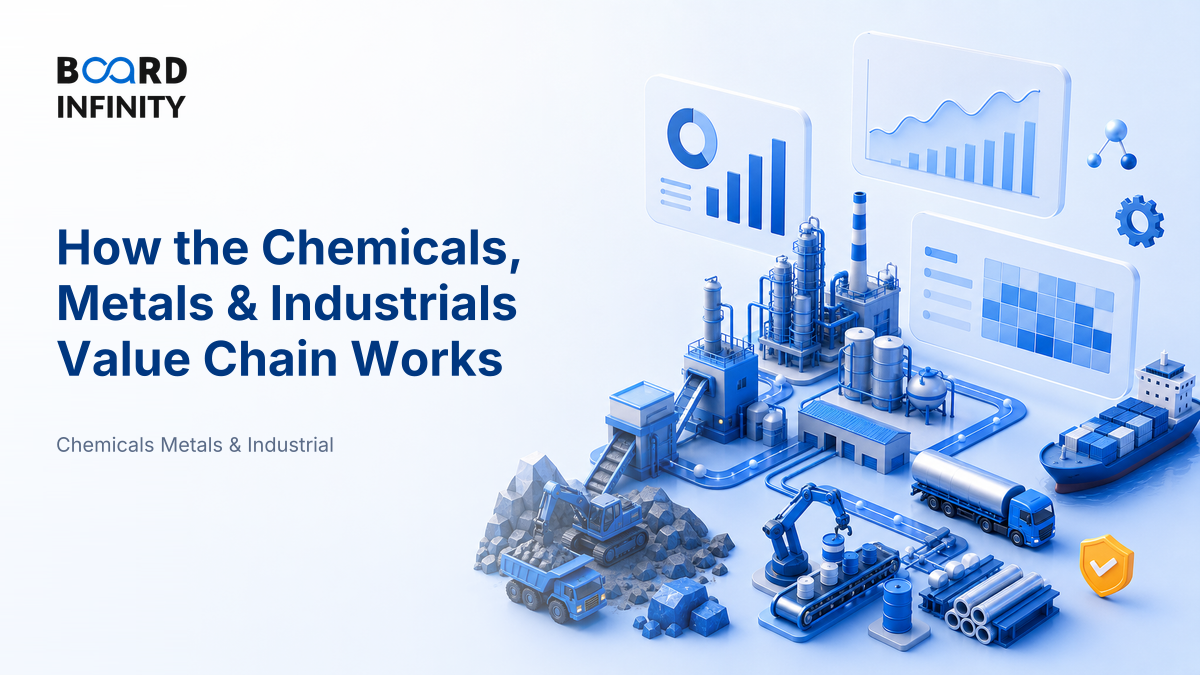
A black rock, a barrel of crude oil, and a sheet of steel do not look like strategy. But move them through the right plants, contracts, specifications, logistics lanes and customer approvals, and they become EV batteries, aircraft parts, pipes, paints, packaging films and factory equipment.
The big contrast in chemicals, metals and industrials is simple: the product often looks boring, but the value chain behind it decides margins, cyclicality and bargaining power.
- CMI value chain means the sequence from raw material or feedstock to processing, conversion, fabrication, distribution, customer application and recycling.
- Upstream players control resources and feedstock; downstream players get closer to customer specifications, brands, service and application know-how.
- Commodity products compete on cost, scale and cycle timing; specialty products compete on formulation, qualification, reliability and switching costs.
- Margins usually come from five levers: feedstock advantage, process efficiency, capacity utilisation, product mix and customer stickiness.
- In interviews, do not describe only “manufacturing.” Map the full chain and then say where profit pools and risks sit.
- The best way to analyse a company is: input position - conversion economics - product differentiation - customer industry - cyclicality - regulation.
Big Picture: The Chain Is Not One Industry, It Is Three Linked Economies
Chemicals, metals and industrials look like one “core sector” bucket, but the value chain has three linked economies: resource economics upstream, process economics in the middle, and application economics downstream. A steel coil, epoxy resin or industrial pump becomes more valuable when it moves from raw material to a customer-specific use case.
Core Explanation: Where Value Is Created and Captured
The value chain works because each stage changes either the physical form, commercial risk or customer usefulness of the product. Interviewers expect you to see all three.
1. Feedstock and resource access
This is the starting point: iron ore, bauxite, limestone, crude oil, natural gas, specialty intermediates, scrap, imported chemicals or purchased components. A player with secure, low-cost or reliable feedstock has a major advantage, especially when prices are volatile.
In metals, this may mean captive mines, scrap sourcing or long-term raw material contracts. In chemicals, it may mean access to petrochemical derivatives, fluorochemicals, solvents, gases or imported intermediates. In industrials, it may mean reliable steel, castings, electronics, motors and precision parts.
2. Primary processing
Primary processing converts raw material into industrial base products: crude oil into petrochemical streams, iron ore into steel, bauxite into aluminium, limestone into cement clinker, or gas into chemical intermediates. This stage is usually capital-intensive, energy-intensive and scale-driven.
The key question is: can the company produce at lower cost, higher consistency or better uptime than peers?
3. Conversion, formulation and fabrication
This is where many students under-explain the sector. The middle of the chain is not just “manufacturing.” It includes blending, compounding, coating, rolling, casting, machining, forging, extrusion, packaging, testing and quality control.
For example, base chemicals become adhesives, paints, polymers, agrochemical ingredients or performance materials. Steel becomes tubes, rails, auto-grade sheets or structural components. Industrial components become pumps, compressors, bearings, turbines or machine tools.
4. Distribution, technical sales and qualification
CMI products are often sold through B2B relationships, dealers, distributors, EPC contractors, OEM approvals and technical trials. A supplier may need to qualify with an auto OEM, pharma customer, aerospace buyer or infrastructure contractor before it gets repeat business.
This creates switching costs. Once a customer has tested and approved a material, component or process input, it may not change suppliers easily unless there is a strong cost or reliability reason.
5. End-use industries and recycling loop
Final demand comes from construction, automotive, packaging, electronics, agriculture, energy, railways, defence, consumer durables and exports. The chain increasingly loops back through scrap, recycling, waste recovery and circular-economy compliance.
The Most Useful Split: Commodity Versus Specialty
If you remember only one comparison, remember this: CMI companies either fight mainly on cost and scale, or they fight on specification and customer stickiness. Many large companies operate in both, but the economics are very different.
Profit Pools: Where the Money Usually Sits
Profit pools shift across the cycle. In an upcycle, upstream resource owners and large commodity producers may earn strong spreads. In a tighter market with demanding customers, downstream specialty players can command better margins because they solve a specific application problem.
Use this 2x2 to diagnose any CMI company quickly. If it is upstream and commodity, ask about cost curve and resource access. If it is downstream and specialty, ask about product approvals, technical service and customer concentration.
Definitions You Can Say in One Breath
- Value chain: The linked activities that convert inputs into products, deliver them to customers and capture margin.
- Feedstock: The raw input used to make an industrial material, chemical, metal or component.
- Conversion spread: The difference between selling price of output and cost of key input materials.
- Backward integration: Moving upstream to secure inputs, reduce supply risk or capture input-stage margin.
- Forward integration: Moving downstream toward fabrication, distribution, customer applications or branded solutions.
- Capacity utilisation: Actual production divided by installed production capacity over a period.
Metrics That Reveal Whether the Chain Is Healthy
Do not judge CMI companies only by revenue growth. A company can grow revenue because commodity prices rose, not because it sold more or improved its position. Track operating and value-chain metrics together.
For deeper company preparation, pair this metric view with reading an annual report for sector insight, because segment notes, capacity additions and working-capital commentary often reveal more than the headline profit number.
Mini Case Study: Pidilite Shows How a Chemical Chain Becomes a Customer Franchise
Pidilite is a strong Indian example of moving beyond chemical inputs into branded, application-led products where trust, distribution and usage habits protect the business.

Situation: Adhesives and construction chemicals start with chemical inputs, formulations and manufacturing discipline. But if a company remains only an input processor, it is exposed to raw material volatility and price competition.
The strategic move: Pidilite built its advantage downstream: branded adhesive and construction-chemical solutions, strong retail reach, product formats suited to Indian users, and deep engagement with carpenters, contractors and applicators. The primary driver was ownership of the customer interface. Supporting drivers included formulation know-how, wide distribution, category education, trusted product performance and a portfolio that extended across related home-improvement and industrial-use occasions.
The lesson: The company did not escape chemistry; it moved up the value chain from chemistry as an input to chemistry as a trusted solution. That is exactly the shift interviewers want you to spot: the same material base can produce very different economics depending on where the company sits in the chain.
So what: In CMI, downstream control can convert a material business into a franchise-like business. But the full explanation needs all drivers: customer interface as the primary driver, supported by formulation capability, channel depth and usage education.
How AI Changes Chemicals, Metals & Industrials Value Chain
AI is changing the CMI value chain in practical, plant-level and commercial ways. The impact is not “AI will automate everything.” It is more specific.
Student workflow: Load a company annual report, investor presentation and one peer report into NotebookLM. Ask it to create a value-chain map with “inputs, process, products, customers, risks, metrics and likely interview questions.” Then verify every number against the original file before using it. For safer AI-based sector work, use this guide on using AI to research a sector without importing its errors.
Interview Relevance
“Walk me through the value chain of chemicals, metals and industrials. Where do companies actually make money, and what risks should we track?”
If you are asked to compare this sector with another, use the same chain logic - inputs, conversion, go-to-market, margin levers and risks. This is the cleanest way to structure a sector comparison; revise comparing two sectors on the same framework if you want a reusable answer format.
Common Mistake
The biggest mistake is saying “these are commodity businesses, so margins depend only on raw material prices.” That misses downstream value addition, customer approvals, product mix, capacity utilisation and working capital. Fix: always map the company to its exact value-chain position before judging its economics.