
Emerging Trends Reshaping Chemicals, Metals & Industrials
A steel plant that once competed mainly on cost per tonne is now being asked a harder question: what is the carbon footprint of that tonne, where did the raw material come from, and can the customer trace it? That single shift explains why chemicals, metals and industrials are no longer just cyclical commodity sectors - they are being rewired by climate policy, supply-chain security, digital operations and customer specifications.
- The sector is moving from volume-led competition to specification-led competition: low carbon, high purity, reliable supply, traceability and technical service matter more.
- Four trend clusters dominate: decarbonisation, circularity, supply-chain reconfiguration and digital/AI-led operations.
- Do not treat ESG as charity: in this sector it affects market access, cost of capital, customer contracts and export competitiveness.
- China+1 is not just relocation: it requires feedstock security, power availability, logistics, environmental permits and skilled plant operations.
- AI is landing inside plants: predictive maintenance, process optimisation, quality analytics and demand sensing are becoming operating levers.
- Best interview answer: name the trend, locate it in the value chain, show which metric changes, then explain who captures value.
Big Picture: The Sector Is Being Repriced Around Resilience
Chemicals, metals and industrials used to be explained mainly through capacity cycles, input costs and demand from construction, autos, packaging and manufacturing. Those still matter. The new layer is that customers, regulators and investors are rewarding companies that can prove cleaner production, secure supply and higher process control.
Core Explanation: The Six Trends That Matter Most
Use this sector as a value-chain story, not a buzzword list. A trend matters only if it changes feedstock, energy, manufacturing, logistics, customer qualification or capital allocation.
1. Decarbonisation Becomes a Commercial Requirement
High-temperature industrial processes, steam, furnaces and electrolysis make this sector energy-intensive. The trend is not simply “going green”; it is the shift from carbon as an externality to carbon as a cost, customer filter and export risk.
The European Union’s Carbon Border Adjustment Mechanism covers sectors including cement, iron and steel, aluminium, fertilisers, electricity and hydrogen during its transitional phase (European Commission, Carbon Border Adjustment Mechanism). For an Indian metals or chemicals exporter, this means carbon accounting and process emissions can directly affect competitiveness.
2. Circularity Moves from Waste Management to Feedstock Strategy
Circularity means using scrap, recycled inputs, by-products or recovered materials to reduce virgin resource dependence. In metals, scrap quality and segregation become strategic. In chemicals, circularity may appear as recycling polymers, using bio-based feedstock, or valorising process by-products.
3. China+1 and Supply-Chain Security Reshape Capacity Decisions
For specialty chemicals, industrial components and engineered materials, buyers increasingly want supply continuity and geographic diversification. India can benefit, but only where it has credible chemistry capability, utilities, compliance discipline, port access and customer qualification.
This is why a good sector answer must go beyond “companies will shift to India.” The real question is: can India supply at the required purity, batch consistency, delivery reliability and environmental standard?
4. Specialty and Performance Materials Gain Share
Commodity products compete heavily on scale and input cost. Specialty chemicals, engineered materials and application-specific industrial products compete more on formulation, qualification cycles, technical support and switching cost.
That is why companies try to move downstream - from raw material to value-added products such as advanced polymers, coated metals, precision components, battery materials, adhesives, water treatment chemicals or lightweight automotive materials.
5. Digital Plants Improve Yield, Reliability and Quality
Industrial digitisation is not just dashboards. It is sensors, process control, predictive maintenance, advanced planning and quality analytics working together. The business case is simple: reduce unplanned downtime, improve yield, stabilise quality and lower energy intensity.
6. Regulation and Traceability Become Competitive Filters
Industrial buyers increasingly ask for documentation - emissions data, source of materials, compliance certificates, safety records and product traceability. For regulated export markets, documentation can decide whether a supplier is even shortlisted. If you are weak on sector regulation, revise how to locate the regulator and what it controls before attempting sector interviews.
Definitions You Can Say in One Breath
- Emerging trend: A structural shift in technology, regulation, demand or capital allocation that changes how an industry creates value.
- Industrial decarbonisation: Reducing emissions from production, energy use and supply chains while preserving output, quality and competitiveness.
- Circularity: Designing materials and processes so resources are recovered, reused or recycled instead of becoming waste.
- Industry 4.0: The integration of sensors, automation, analytics and connected systems into manufacturing operations.
- Specialty chemicals: Chemicals sold for performance in specific applications, not merely for bulk composition or volume.
What to Track: Metrics That Prove a Trend Is Real
In interviews, metrics make your answer sharper. The exact benchmark varies by product and plant, so compare against peer disclosures, customer thresholds and the company’s own multi-year trend. For annual-report practice, use reading an annual report for sector insight as your base method.
Mini Worked Example: Why Energy Intensity Matters
Assume a plant produces 100,000 tonnes a year and consumes 5 GJ per tonne. If process optimisation reduces consumption to 4.7 GJ per tonne, annual energy use falls from 500,000 GJ to 470,000 GJ. The commercial story is not “AI saved energy” - it is that a 6% energy-intensity improvement can improve cost competitiveness and reduce emissions intensity at the same time.
Case Study: Hindalco-Novelis and the Circular Aluminium Play
Hindalco’s Novelis business shows how an Indian industrial group can compete beyond commodity metal by combining downstream aluminium, recycling capability and customer-specific applications.
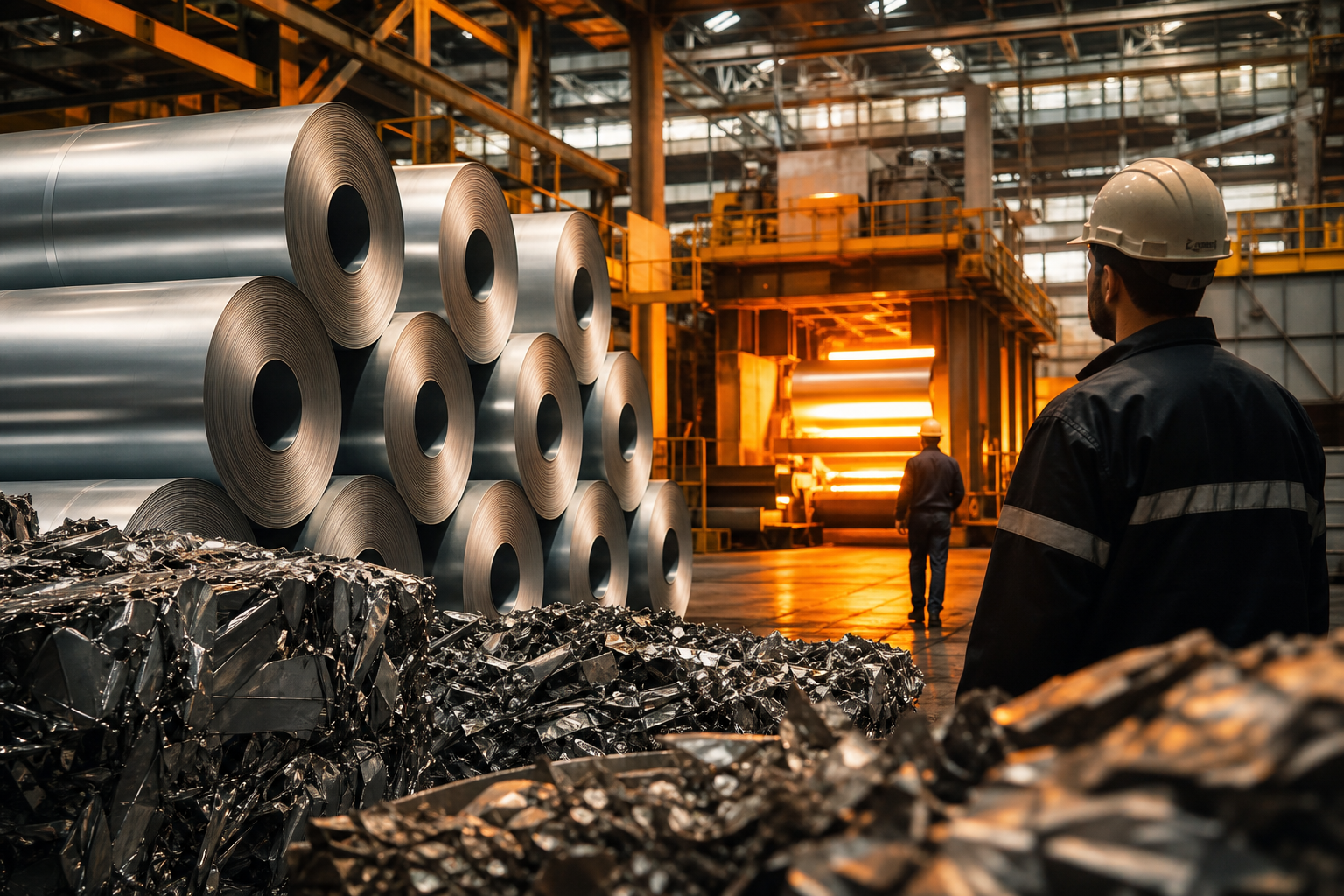
Situation. Aluminium demand is linked to packaging, automotive lightweighting, construction and clean-energy infrastructure. At the same time, customers want lower-carbon materials, reliable supply and more recycled content. Commodity aluminium producers face pressure from power costs, emissions scrutiny and price cycles.
The move. Hindalco’s Novelis is positioned in aluminium rolling and recycling, with customer applications across beverage cans, automotive and specialties; Novelis describes itself as a leading sustainable aluminium solutions provider focused on flat-rolled aluminium products and recycling (Novelis, About Us). The strategic logic is to move closer to customers, increase recycled content where feasible, and build technical relationships rather than compete only on primary metal tonnage.
Why it matters. The primary driver is downstream, circular aluminium capability. Supporting drivers are customer qualification, recycling know-how, product application expertise, supply reliability and parent-company integration. That combination is stronger than a one-factor explanation like “recycling is good for ESG.”
Outcome and lesson. The case shows the direction of the sector: future winners will not simply be the lowest-cost producers. They will combine scale with traceability, process control, recycled or cleaner inputs, and application-specific customer relationships.
How AI Changes Emerging Trends Reshaping Chemicals, Metals & Industrials
AI matters here only when it enters the plant, the lab or the supply chain. Treat it as an operating system for better decisions, not as a generic technology label.
Use NotebookLM or Claude like a sector analyst: upload a company annual report, sustainability report and one regulator page, then ask, “Map the top three trends to the company’s value chain, metrics affected and risks.” Cross-check every specific claim before using it. For safer prompting habits, revise using AI to research a sector without importing its errors.
Interview Relevance
“What are the emerging trends reshaping chemicals, metals and industrials, and which of them are most relevant for India?”
If the interviewer asks “which trend is biggest,” do not choose the flashiest one. Say decarbonisation is the broadest structural pressure, but the biggest profit impact may come from specialty migration, circular feedstock or digital yield improvement depending on the company’s product mix.
Common Mistake
The mistake is listing buzzwords - “AI, ESG, China+1, green hydrogen” - without showing how they change economics. That sounds shallow because industrial sectors are judged on cost, yield, capacity, quality, compliance and customer qualification. Fix: for every trend, say where it hits the value chain, which metric moves, and who captures the value.