
Coaching versus Mentoring: Choosing the Intervention
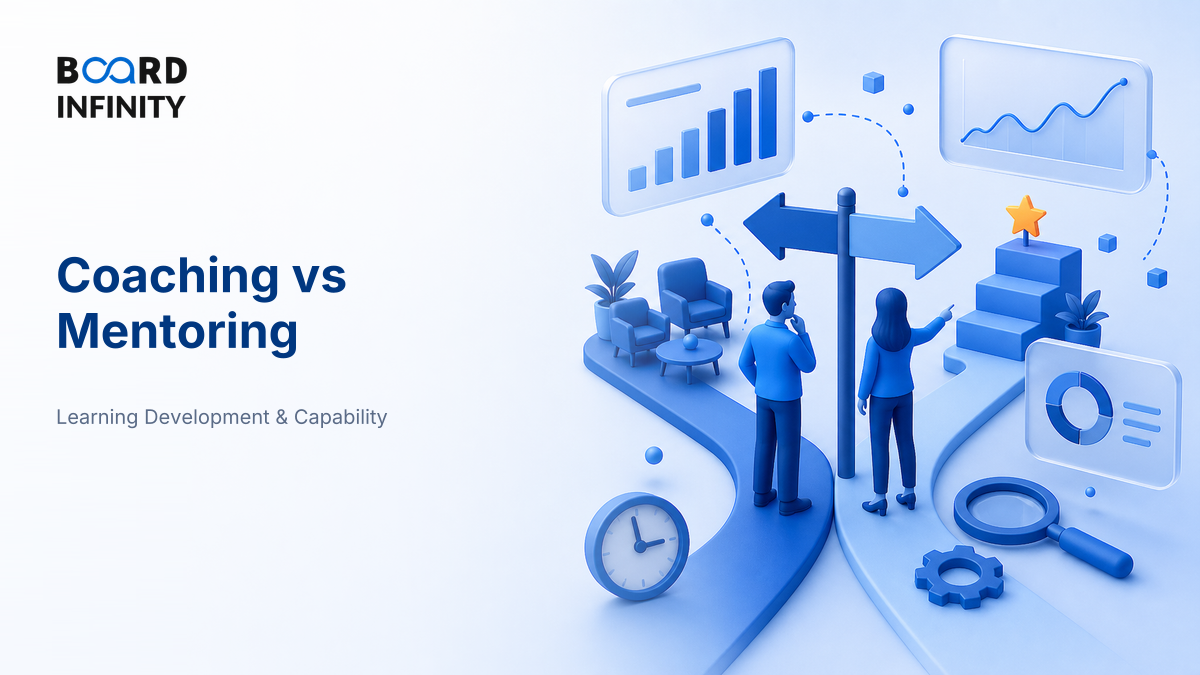
Two employees walk into the same development meeting. One needs to handle client objections better before next month’s pitch; the other is quietly asking, “What kind of leader do I want to become over the next five years?” Treat both with the same intervention and you either over-engineer a skill problem or under-serve a career problem.
- Coaching is best for a specific, observable performance or skill gap in the current role.
- Mentoring is best for long-term growth, career judgement, networks and leadership identity.
- Use coaching when the outcome can be defined as a behaviour: “run better reviews”, “improve negotiation”, “delegate more clearly”.
- Use mentoring when the question is broader: “which path should I choose?”, “how do I navigate the organisation?”, “how do senior leaders think?”
- The strongest answer is not “coaching is short term, mentoring is long term”; it is “match the intervention to the development need”.
- For role transitions, combine both: coaching for immediate performance and mentoring for strategic context.
Big Picture: Same Development Family, Different Jobs
Coaching and mentoring both develop people, but they solve different problems. Coaching is a focused performance intervention; mentoring is a broader developmental relationship. Think of coaching as improving the swing before the tournament, and mentoring as learning how to build a long career in the sport.
Core Explanation: How to Choose the Right Intervention
The practical rule is simple: diagnose the development need before choosing the method. A coaching intervention becomes powerful when the learner needs feedback, practice and behaviour change. A mentoring intervention becomes powerful when the learner needs perspective, confidence, access and sense-making.
Use this decision flow when you are asked to recommend an intervention for an employee, manager or leadership development program.
The Interview-Safe Decision Matrix
A useful way to decide is to map the employee’s need on two axes: how specific the development goal is, and how much organisational context the person needs. This prevents the common mistake of treating every people-development problem as “mentoring”.
Read the matrix like this:
- Clear goal + behaviour gap: choose coaching. Example: a product manager must improve stakeholder storytelling before quarterly business reviews.
- Broad goal + high context need: choose mentoring. Example: a first-time manager wants to understand how leadership decisions are really made.
- Clear goal + high access need: coaching alone may not be enough; the employee may need sponsorship, exposure or stretch assignments.
- Low clarity + low context: start with reflection, assessment or career conversations before assigning a coach or mentor.
Metrics: How to Track Whether the Intervention Worked
Do not stop at “participants liked it”. Coaching and mentoring must be evaluated through behaviour, movement and business relevance. Use a small scorecard rather than one vanity metric.
Infosys is a useful Indian reference because large campus-to-corporate transitions require more than classroom training. New employees need structured skill development for role readiness, but they also benefit from managers, buddies or seniors who help them understand project norms, client expectations and career paths. The strategic so what: in high-scale talent models, coaching builds near-term productivity while mentoring reduces the uncertainty of entering a complex organisation.
Definitions You Can Say in One Breath
Coaching, according to the International Coaching Federation: “partnering with clients in a thought-provoking and creative process that inspires them to maximize their personal and professional potential.”
Mentoring: a longer-term developmental relationship where an experienced person helps a less experienced person build career judgement, networks and identity.
In interviews, immediately add your distinction: coaching is outcome-led; mentoring is relationship-led. That one line shows you understand the managerial choice, not just the dictionary difference.
Adobe: Turning Performance Management into Coaching Conversations
Adobe replaced traditional annual review-heavy performance management with more frequent Check-In conversations, making coaching part of everyday management rather than a once-a-year event.

Situation: Like many knowledge-work companies, Adobe faced the limits of annual appraisals: delayed feedback, heavy process time and conversations that often became evaluative rather than developmental. In creative and technology roles, waiting months to correct priorities or behaviours can weaken both motivation and output.
The move: Adobe shifted emphasis toward ongoing manager-employee Check-In conversations. The primary driver was frequent, goal-linked dialogue: employees and managers discussed expectations, feedback and growth more continuously. Supporting drivers included clearer manager accountability, less dependence on forced annual rituals and a culture that encouraged timely course correction.
Outcome and lesson: The case is not “Adobe succeeded because it removed reviews.” That would be too simplistic. The deeper lesson is that coaching works when the organisation redesigns the management rhythm around feedback, goals and behaviour change. Removing a form is not the intervention; building a coaching habit is.
How AI Changes Coaching versus Mentoring
AI does not replace human trust in coaching or mentoring, but it changes how these interventions are designed, matched and measured.
- AI-assisted coaching practice: Employees can rehearse sales calls, appraisal conversations or conflict scenarios with AI role-play tools before meeting a human coach. This makes practice cheaper and more frequent, while the human coach focuses on judgement, emotion and accountability.
- Skills intelligence for diagnosis: HR teams can use AI to analyse job descriptions, learning histories, performance comments and skills taxonomies to identify whether the gap is a skill gap, role-readiness gap or career-path ambiguity.
- Smarter mentoring matching: AI can recommend mentor-mentee matches based on function, career aspiration, location, skills and prior experience. The caveat: HR must audit for bias, privacy and over-reliance on profile data, especially under data-protection expectations such as India’s DPDP Act.
Load the company’s careers page, leadership principles and a target job description into NotebookLM or ChatGPT. Ask: “Identify three employee development situations and recommend whether coaching, mentoring or both would be appropriate. Explain the diagnosis and metrics.” This gives you company-specific interview examples without memorising generic HR theory.
Interview Relevance
“A high-performing analyst has just become a team lead but is struggling to delegate and influence stakeholders. Would you recommend coaching or mentoring?”
If the case involves a promotion, say “both, but sequenced”: coaching first for immediate role performance, mentoring alongside for leadership maturity and context.
The biggest mistake is saying “coaching is short term and mentoring is long term” and stopping there. That answer is too shallow because time horizon is only one dimension. The one-line fix: choose based on the need - coaching for defined behaviour change, mentoring for broader career judgement and context.
What to Revise Next
Once you can choose the right development intervention, move to evaluation. Revise Evaluating Training: The Four Levels and What to Measure to structure learning outcomes, then Calculating Learning Return on Investment Credibly to connect development programs with business value.