
The Consulting Career Ladder and What Each Level Owns
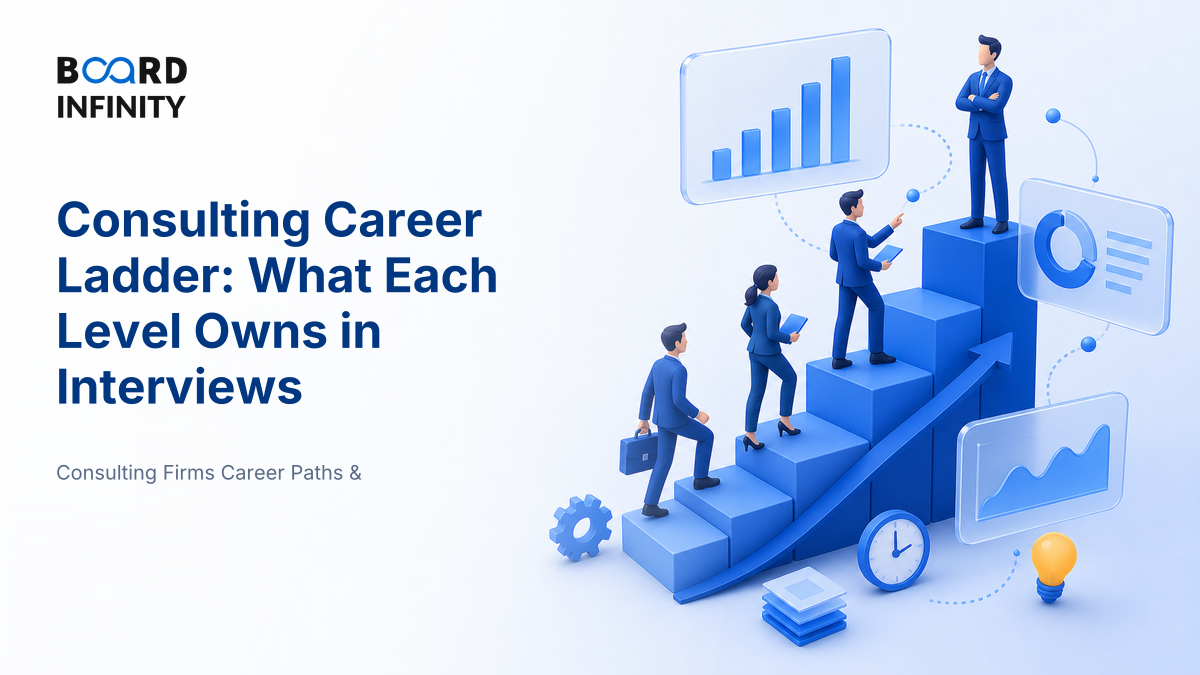
The client steering committee starts in ten minutes, and the deck still has one risky assumption. The analyst checks the model, the consultant rewrites the storyline, the manager decides what to show, and the partner prepares for the CEO question that could decide the next phase. That is the consulting career ladder in one scene: the work changes because the ownership changes.
- Analysts own analysis: clean data, build models, create pages, find facts and make the first answer reliable.
- Consultants own workstreams: frame a sub-problem, guide analysts, synthesize insights and manage day-to-day client counterparts.
- Managers own the project: plan the work, protect quality, handle senior clients and turn separate workstreams into one answer.
- Principals or associate partners own client expansion: shape proposals, deepen relationships and convert a good project into the next opportunity.
- Partners own trust and revenue: sell work, counsel executives, manage risk and carry the firm’s reputation in the market.
- The biggest shift is from doing the work to making others’ work valuable to creating demand for the work.
Big Picture: Consulting Is an Ownership Ladder, Not Just a Promotion Ladder
A consulting firm is built like an apprenticeship pyramid. Junior people create analytical horsepower, middle layers convert analysis into decisions, and senior layers create client trust and revenue. If you are still revising the base concept, first refresh what management consulting actually is, because the ladder only makes sense when you understand the work.
Core Explanation: What Each Consulting Level Actually Owns
The same slide can mean five different jobs. For an analyst, it is a page to build accurately. For a consultant, it is evidence inside a workstream. For a manager, it is part of the project answer. For a principal, it is proof of value for the client relationship. For a partner, it is a moment of executive trust.
Titles vary by firm. Some firms say Business Analyst, Associate, Engagement Manager and Associate Partner. Others say Analyst, Consultant, Manager, Director and Partner. The title changes, but the ownership logic is remarkably consistent.
The Ownership Shift: From Task to Trust
The simplest way to remember the ladder is this: juniors own inputs, managers own integration, senior leaders own demand. The higher you go, the less your value is measured by how many slides you personally create and the more it is measured by whether the client makes a better decision because your team was there.
Level-by-Level: The Practical Ownership Map
1. Analyst or Associate: Own the Facts
The analyst’s job is not “make slides.” It is to make the team’s fact base trustworthy. That means cleaning data, testing assumptions, researching competitors, preparing interview guides, building financial or operational models, and making slide pages that survive scrutiny.
Interview signal: you show comfort with ambiguity, attention to detail, structured thinking and stamina.
2. Consultant or Senior Associate: Own a Workstream
A workstream is a bounded part of a project with its own question, analyses, stakeholders and deliverable. For example, in a market-entry case, one workstream may own customer segments, another may own channel economics, and another may own competitor response.
Interview signal: you can move from analysis to synthesis. You do not just say “the market is attractive”; you say which segment is attractive, why, and what the client should do next.
3. Manager or Engagement Manager: Own the Project
The manager is the operating system of the case. They plan the work, allocate people, pressure-test logic, manage the client rhythm, unblock the team and ensure the final recommendation is coherent.
Interview signal: you understand trade-offs. The manager must decide what analysis is worth doing, what can be cut, and how to keep the client aligned without overpromising.
4. Principal or Associate Partner: Own Client Expansion
This is the bridge role between delivery and sales. A principal must see where the current project creates the next problem to solve. They often shape proposals, run senior workshops and convert project credibility into a broader relationship.
Interview signal: you understand that consulting is a relationship business, not only an intellectual exercise.
5. Partner or Managing Director: Own Trust, Revenue and Risk
The partner carries the market-facing responsibility. They sell work, sponsor talent, counsel senior executives, manage commercial risk and protect the firm’s reputation. A partner’s strongest asset is not a slide deck; it is a client’s belief that their judgment is worth paying for.
Interview signal: you can connect problem-solving with business development and long-term client value.
The Three Capabilities That Rise with Level
At every level, consulting tests three capabilities: problem-solving, client handling and commercial judgment. The mix changes sharply as you rise.
Definitions You Should Be Able to Say Clearly
A consulting career ladder is the progression of roles where ownership shifts from analysis to workstreams, projects, relationships and revenue.
A workstream is a bounded project module with its own question, analysis plan, stakeholders and deliverable.
A leverage model uses junior analytical capacity under senior judgment so the firm can deliver quality work profitably.
How Firms Judge Readiness for the Next Level
Promotion is rarely about doing your current job for longer. It is about already showing pieces of the next job. These measures are not identical across firms, but they are common signals used in performance conversations.
The hidden point: metrics are only evidence. The real promotion question is, “Can this person be trusted with a wider scope when no one is watching every detail?”
Case Study: Samagra Governance Consulting and the Ladder in Public-Sector Work
Samagra shows how consulting ownership changes when the client problem is not only strategic but also administrative, political and operational.

Public-sector consulting in India has a special tension. The answer may be analytically right, but it still has to work through government departments, field officers, citizen-facing systems and changing constraints. A polished recommendation is not enough; the operating rhythm matters.
Samagra Governance Consulting is a useful example because its work sits at the intersection of strategy, execution and stakeholder alignment. In such engagements, the analyst may own district-level data cleaning or field synthesis. The consultant may own a module such as process redesign, dashboard adoption or stakeholder interviews. The manager must integrate these modules into a plan that government counterparts can actually run. Senior leaders must maintain trust with bureaucratic and political stakeholders while keeping the mandate focused.
The lesson: the primary driver of success is not only analytical quality; it is disciplined translation of analysis into stakeholder-owned action. Supporting drivers include field understanding, senior-client trust, team cadence and the ability to adapt without losing the core objective.
How AI Changes the Consulting Career Ladder
AI does not remove the ladder. It compresses some lower-level tasks and raises the bar for judgment at every level.
For a deeper role-and-pricing view, revise How AI Is Changing Consulting Roles, Pyramids & Pricing.
Use NotebookLM before an interview: upload the firm’s role description, your resume and this lesson, then ask, “What ownership signals should I demonstrate for this consulting level?” Convert the answer into three resume stories.
Interview Relevance
“Walk me through the consulting career ladder. What does an analyst own versus a consultant, manager and partner?”
If you are interviewing for an entry-level consulting role, do not pretend you will own client strategy on day one. Say you will own analytical reliability first, then grow into workstream ownership.
Common Mistake
The mistake is describing levels as “junior people make slides, senior people talk to clients.” That sounds shallow because it misses ownership. The fix: describe each level by the decision or risk it owns - analysis risk, workstream risk, project risk, relationship risk and revenue risk.