
Exit Options After Consulting: Industry, PE, Startups and Founding
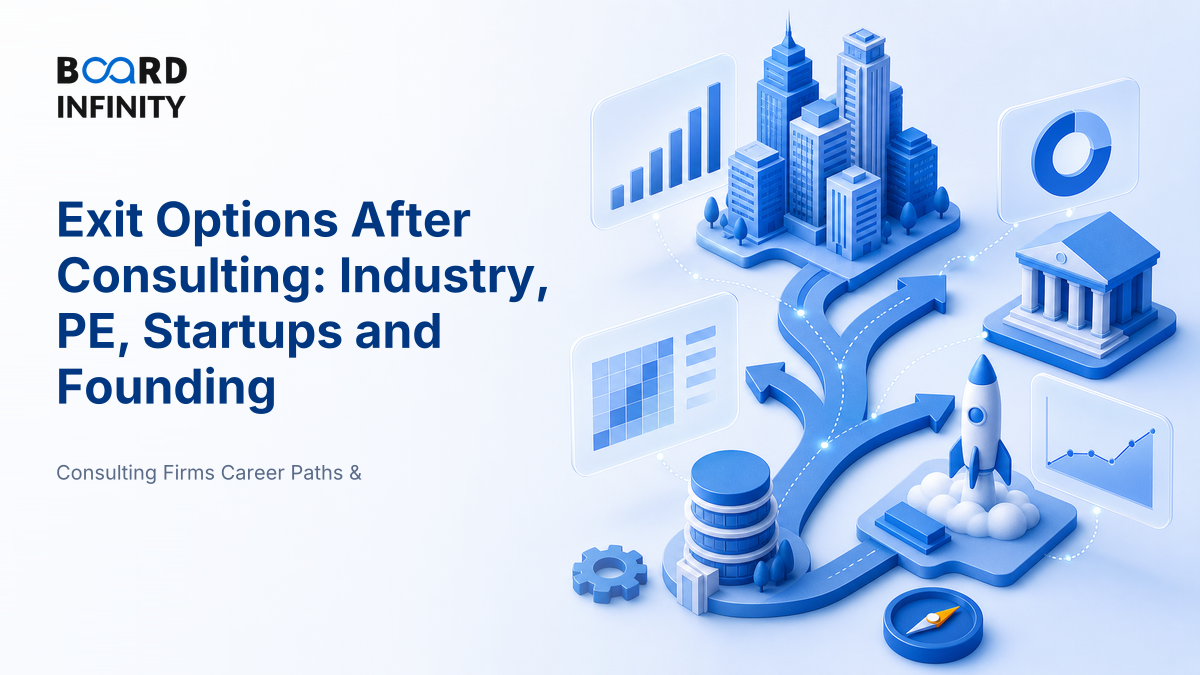
A consultant leaves a polished boardroom on Friday; by Monday, the same person may be running pricing for a consumer brand, diligence for a fund, growth for a startup, or a messy founder experiment with no playbook. The surprise is this: the exit is not a reward for surviving consulting - it is a bet on which kind of leverage you want next.
- Exit options are post-consulting career moves that convert consulting skills into operating, investing, startup, or founder roles.
- The four classic exits are industry, private equity, startup operator, and founding.
- Industry offers stability and execution depth; PE offers investor exposure and value creation; startups offer speed and ownership; founding offers maximum control with maximum risk.
- The best exit depends on four filters: skill transfer, decision rights, risk appetite, and compounding path.
- For consultants, the trap is choosing the shiniest exit brand instead of the role where your learning curve and ownership both rise.
- In interviews, never say “I want to keep my options open.” Say which option fits your spike, why, and what proof you have.
The Big Picture
Think of consulting as a skill accelerator, not a final destination. It gives you problem-solving, stakeholder management, structured communication, and industry exposure. Exit options differ in what they demand next: execution depth, investment judgment, operating speed, or founder conviction.
Core Explanation: The Four Exit Archetypes
The easiest way to understand exit options is to ask one question: after consulting, do you want to advise, operate, invest, build, or own? Most exits sit on a spectrum from lower uncertainty to higher uncertainty, and from lower personal control to higher personal control.
Definitions You Should Be Able to Say Clearly
- Exit option: A post-consulting career move that converts consulting skills into operating, investing, startup, or founder roles.
- Industry exit: A move into a company role where you own execution, decisions, and business outcomes over time.
- Private equity exit: A move into investing or portfolio value creation for privately held companies.
- Startup operator exit: A move into a high-growth company role with broad scope, ambiguity, and faster ownership.
- Founding exit: A move from employment into building and owning a new venture.
How to Choose: The Four-Filter Framework
A good exit decision is not emotional. Use four filters: skill transfer, decision rights, risk appetite, and compounding path. If an option scores well on brand but poorly on these filters, it is a vanity move.
What Each Exit Really Tests
Each path rewards a different version of the consultant. The same person who shines in a boardroom may struggle if the next role demands daily execution, fundraising, product taste, or investor judgment.
1. Industry: From Advisor to Operator
Industry exits suit consultants who want to move from “recommend” to “own.” Typical roles include corporate strategy, business transformation, CEO's office, product strategy, revenue strategy, category management, and operations leadership.
The primary driver of success is execution credibility. Supporting drivers are stakeholder patience, ability to work within company politics, and willingness to stay with a problem beyond the slide deck.
2. Private Equity: From Recommendation to Investment Logic
PE exits are attractive because they combine strategy, finance, and ownership thinking. But pure investment roles usually require comfort with financial statements, deal processes, valuation logic, and commercial due diligence. Consultants also enter through portfolio operations or value creation, where the job is to improve growth, pricing, cost, or go-to-market inside portfolio companies.
The primary driver of success is commercial judgment. Supporting drivers are finance fluency, sector pattern recognition, and the ability to translate diligence into value creation.
3. Startup Operator: From Structured Problems to Ambiguity
Startup roles offer wider ownership earlier. A founder's office role, growth role, category role, or business operations role may give a young MBA exposure to product, sales, hiring, unit economics, and execution cadence.
The primary driver of success is speed of learning. Supporting drivers are comfort with imperfect data, founder alignment, customer obsession, and willingness to do unglamorous execution.
4. Founding: From Problem-Solving to Problem Ownership
Founding is not merely “consulting plus freedom.” It is sales, hiring, rejection, capital discipline, customer discovery, and repeated iteration. Consultants may be good at structuring problems, but founders must live with the consequences of their own incomplete answers.
The primary driver of success is founder-market conviction. Supporting drivers are team quality, customer access, distribution advantage, capital discipline, and resilience.
A consultant moving into the CEO's office of an Indian consumer company may initially work on growth strategy, pricing, and channel initiatives. The role becomes valuable only when it shifts from analysis to execution - owning pilots, aligning sales teams, tracking results, and learning how decisions actually move through the organisation. The strategic so what: industry exits reward patience and operating credibility more than pure problem-solving speed.
Mensa Brands: A Consulting-Style Thesis Turned Into an Operating Platform
Mensa Brands shows how consulting-style pattern recognition can become a startup operating model when paired with e-commerce execution.

Mensa Brands is an Indian house-of-brands company built around acquiring and scaling digital-first consumer brands. The interesting part is not just that it is a startup; it is that the model resembles a consulting thesis made operational. Identify fragmented consumer categories, acquire promising brands, improve growth levers, and build shared capabilities across marketing, supply chain, technology, and marketplace management.
The primary driver was a clear platform thesis: many small digital brands had product-market pull but needed stronger scaling muscle. The supporting drivers were operating leadership, e-commerce know-how, category selection, centralised capabilities, and access to founder networks. That combination matters because consulting skills alone would not be enough - the model also needed execution discipline and operator judgment.
The takeaway for an MBA student is simple: founding or startup exits work best when your consulting toolkit meets a real operating edge. A thesis is useful; a repeatable execution engine is what creates value.
How AI Changes Exit Options
AI is changing consulting exits in a practical way: it is altering what companies, funds, and startups expect ex-consultants to do from day one.
Practical student workflow: load the target company's annual report, investor presentation, and recent job description into NotebookLM. Ask it to generate likely interview questions on growth priorities, operating risks, AI use cases, and where an ex-consultant could create measurable value in the first 180 days. Then verify every factual claim before using it.
If you want the consulting-side context behind this shift, revise How AI Is Changing Consulting Roles, Pyramids & Pricing.
Interview Relevance
“After consulting, would you prefer to move into industry, private equity, a startup, or start your own venture? Why?”
This question tests self-awareness, not just ambition. The interviewer wants to know whether you understand the trade-offs behind your preferred path.
A strong answer sounds like this: “My likely long-term path is a startup operator role in consumer or B2B commerce because I enjoy ambiguous growth problems and execution ownership. Consulting first helps me build problem-solving range, stakeholder maturity, and sector pattern recognition before I take on a P&L-linked role.”
Common Mistake
The mistake: treating exit options as a prestige ranking - PE first, startups second, industry third, founding as a fantasy. This costs candidates because it makes them sound immature and brand-driven. One-line fix: evaluate every exit by role-skill fit, decision rights, risk appetite, and compounding path.