
Data Communication: Process, Components, Types & Models for Networks
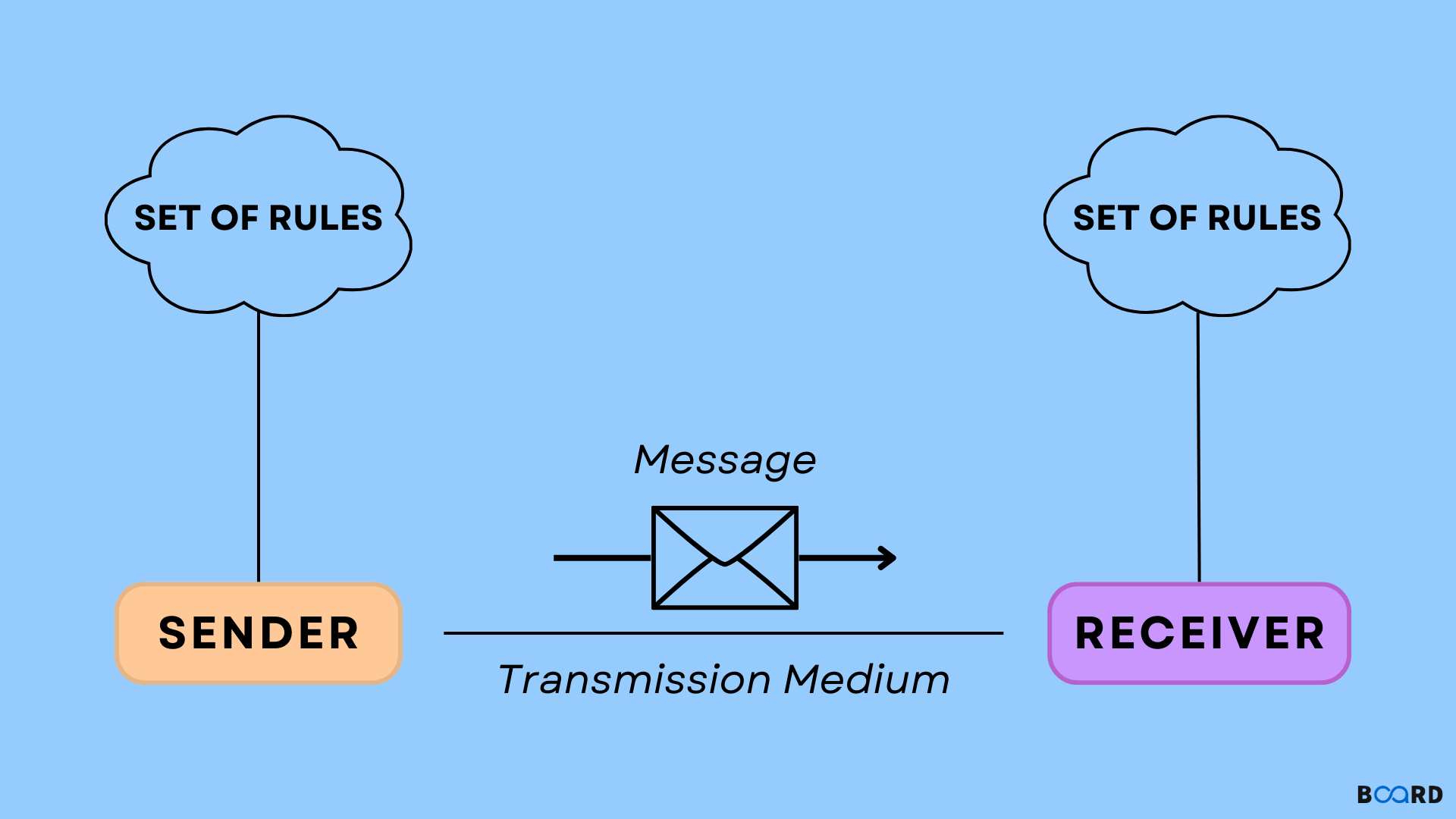
Data communication is the process of transferring data between two or more devices through a transmission medium using agreed rules called protocols. It matters because every UPI payment, Aadhaar verification, cloud API call, video meeting, and hospital monitoring system depends on accurate, timely, and secure data exchange.
In computer networks, data communication connects hardware, software, protocols, and media into one coordinated system. The same discipline also explains why technical communication needs precise rules, much like organisational communication differs by structure in Formal vs Informal Communication: Key Differences, Types & Examples.
Who This Guide Is For
This guide is specifically designed for:
Core Concepts
Data communication in computer network design is built around five foundational components, a layered data communication model, multiple transmission directions, serial timing modes, delivery patterns, switching techniques, and reliability controls. A correct answer in exams usually combines definition, components of data communication, types of data communication, and a short real-world example.
1.Communication Components
The components of data communication are the minimum elements required for any meaningful transfer: sender, receiver, message, transmission medium, and protocol. The sender creates or forwards data, the receiver consumes it, the message is the information being transferred, the medium carries signals, and the protocol defines the rules for format, timing, addressing, error handling, and response. Without all five, communication either cannot start or cannot be interpreted reliably.
A familiar example is a UPI transaction. Your mobile app is the sender, the bank or NPCI system is the receiver at different stages, the message contains transaction details, the medium may include Wi-Fi, cellular, and internet links, and protocols such as HTTPS/TLS protect the exchange. An industry-specific example is a remote ICU monitoring system where a sensor sends heart-rate readings to a hospital server; the message must be timely, the wireless medium must be stable, and the protocol must handle authentication and delivery guarantees.
Code Example
2.Communication Process
The data communication process is the ordered sequence through which information is created, prepared, transmitted, received, interpreted, and optionally acknowledged. In a layered network, an application creates data, the transport layer may divide it into segments, the network layer adds logical addressing, the data-link layer adds frames and hardware addressing, and the physical layer converts bits into electrical, optical, or radio signals. At the receiver, the same path is reversed through decapsulation.
A familiar example is IRCTC ticket booking. The browser sends passenger and payment data to the server, the data is encrypted, segmented, addressed, routed, delivered, reassembled, validated, and acknowledged with a booking response. An industry-specific example is a SaaS CRM syncing lead data to a marketing automation platform through an API; failed acknowledgements may trigger retries, while incorrect formatting may cause rejection at the application layer.
Code Example
3.Data Flow Types
Data flow describes the direction in which communicating devices can send information. There are exactly three standard types: simplex, half-duplex, and full-duplex. Simplex allows data in only one direction, half-duplex allows both directions but not at the same time, and full-duplex allows simultaneous two-way communication. This classification is frequently tested because it is simple, practical, and easy to confuse.
A familiar simplex example is a keyboard sending keystrokes to a computer; the keyboard does not receive display data from the monitor. Another familiar example is a public digital display at a railway station receiving announcement updates. An industry-specific simplex example is a temperature sensor broadcasting readings to a logging system where the sensor does not need response messages.
Half-duplex is like a walkie-talkie: one person speaks while the other listens, then they switch. Older hub-based Ethernet behaved similarly because devices shared a collision domain. A logistics warehouse using push-to-talk radios is a practical industry example. Full-duplex is like a phone call or modern switched Ethernet, where both sides can send and receive simultaneously. Banking systems, cloud databases, and video-conferencing platforms depend on full-duplex behaviour to handle requests and responses without waiting for strict turn-taking.
Code Example
4.Transmission Modes
Transmission mode explains how bits are sent over a communication path. At the broad level, transmission can be parallel or serial. Parallel transmission sends multiple bits simultaneously over multiple lines and is useful for short distances, such as internal computer buses. Serial transmission sends one bit after another over a single channel or pair and dominates modern long-distance communication because it reduces wiring complexity, interference, and synchronization problems.
Serial transmission has three standard timing variants: asynchronous, synchronous, and isochronous. Asynchronous transmission sends data in small units using start and stop bits, making it suitable for irregular communication such as UART-based embedded devices. Synchronous transmission uses a shared clock or timing agreement to send continuous blocks efficiently, common in high-speed network links. Isochronous transmission reserves timing so data arrives at regular intervals, useful for real-time audio and video where late data loses value.
A familiar example is a laptop using USB or Ethernet, both of which rely on serial signalling rather than old-style parallel printer cables. An industry-specific example is a medical imaging device transferring scan data over a high-speed serial interface, where synchronous transfer improves throughput. A live ed-tech class uses isochronous communication characteristics because audio and video frames must arrive regularly for a smooth session.
Code Example
5.Delivery Patterns
Delivery pattern describes how many receivers are intended to get a message. The four standard delivery types are unicast, broadcast, multicast, and anycast. Unicast sends data from one sender to one receiver. Broadcast sends from one sender to all devices in a broadcast domain. Multicast sends from one sender to a selected group. Anycast sends from one sender to the nearest or best receiver among multiple candidates sharing the same service address.
A familiar unicast example is opening your bank statement on a mobile banking app; the server sends your data to your device, not to everyone. An industry unicast example is a SaaS dashboard API returning one client’s analytics report. Broadcast appears when ARP requests ask “Who has this IP address?” inside a LAN, and a familiar analogy is an apartment announcement sent to every flat. Multicast is used for IPTV, live market data feeds, or enterprise video distribution where a selected group receives the same stream efficiently.
Anycast is common in large-scale internet infrastructure. Public DNS services and content delivery networks can route a request to the nearest available server advertising the same IP prefix. For example, a user in Mumbai and a user in Bengaluru may query the same DNS address but reach different nearby nodes. This improves latency and resilience without asking users to choose a server manually.
While these examples illustrate how anycast optimizes existing network functions, its role in modern network architectures continues to expand, particularly for applications that require fast, localized data processing. By directing traffic to the nearest or most efficient server, anycast supports distributed services such as content delivery networks, cloud applications, and online streaming, where low latency and reliability are essential. These capabilities also complement high-speed connections such as fiber internet, helping users get the most from bandwidth-intensive online activities.
Code Example
6.Switching Methods
Switching determines how a network moves data from source to destination through intermediate nodes. The three standard methods are circuit switching, packet switching, and message switching. Circuit switching establishes a dedicated path before communication begins, keeps resources reserved during the session, and releases them afterward. Traditional telephone networks used this approach, which gives predictable performance but can waste capacity when users are silent.
Packet switching divides data into packets that may travel independently through the network. The internet uses packet switching because it supports efficient sharing of links among many users. A familiar example is streaming a cricket highlight on a mobile phone; packets from many users share the provider’s infrastructure. An industry-specific example is an e-commerce platform sending order, inventory, and payment packets across cloud services during a sale.
Message switching stores and forwards the complete message at each intermediate node. It does not require a dedicated path, but large messages can create long delays and need enough storage at each node. A historical example is telegraph-style store-and-forward communication. A modern conceptual parallel is an enterprise queue that stores a complete business message before forwarding it, although actual implementation may combine message queuing with packet-switched networks.
Code Example
7.Network Models
A data communication model organises communication functions into layers so that complex systems become easier to design, implement, and troubleshoot. The OSI model has seven layers: physical, data link, network, transport, session, presentation, and application. The TCP/IP model commonly uses four layers: link, internet, transport, and application. OSI is often used for learning and troubleshooting vocabulary, while TCP/IP is the practical model used by the internet protocol suite.
A familiar example is browsing an Aadhaar-related government portal. The application layer handles HTTP, the presentation function includes encryption and data format handling, transport uses TCP or QUIC depending on protocol choice, the network layer uses IP addressing, and lower layers move frames and signals across Wi-Fi, fibre, and routers. An industry-specific example is a healthcare SaaS system sending encrypted lab reports from a diagnostic centre to a hospital portal; each layer contributes a separate responsibility.
Layering allows one layer to change without rewriting the entire system. For example, a web application can move from Wi-Fi to 5G without changing its HTTP request format. Similarly, an application can use TLS for encryption without manually controlling radio signals. This separation is central to scalable network engineering.
Code Example
8.Reliability Controls
Reliability controls ensure that data communication remains correct, ordered, and manageable even when networks are noisy, congested, or lossy. The major controls are error detection, error correction, acknowledgement, retransmission, sequencing, flow control, and congestion control. Error detection finds corrupted data using techniques such as parity, checksum, and cyclic redundancy check. Error correction may repair limited errors using redundant codes, while retransmission requests a fresh copy when recovery is not possible.
A familiar example is a UPI payment confirmation. If the confirmation packet is lost, the client should not blindly assume failure and repeat the payment; the system needs transaction identifiers, acknowledgements, and idempotent checks. An industry-specific example is a stock-trading platform where packets must be ordered correctly because a buy order followed by a cancel order cannot be processed randomly.
Flow control prevents a fast sender from overwhelming a slow receiver. Congestion control prevents too many senders from overloading the network. In TCP, sliding windows, acknowledgements, sequence numbers, timeouts, and retransmissions work together. In UDP-based systems, the application may need to implement reliability itself if correctness matters.
Code Example
9.Protocols and Standards
A protocol is a formal set of rules that defines how devices communicate. Protocols specify message format, sequence, timing, addressing, error handling, authentication, encryption, and expected responses. Standards make protocols interoperable so that equipment and software from different vendors can work together. Reputable standards organisations in networking include the Internet Engineering Task Force for internet protocols, IEEE for Ethernet and Wi-Fi standards, and ISO for the OSI reference model.
A familiar example is a browser opening a shopping website using HTTPS. HTTP defines request-response semantics, TLS protects confidentiality and integrity, TCP or QUIC handles transport behaviour, IP handles addressing, and Ethernet or Wi-Fi handles local delivery. An industry-specific example is a bank integrating with a payment gateway through REST APIs where JSON format, TLS certificates, rate limits, and response codes must be agreed in advance.
Protocols also matter beyond networking. When organisations exchange regulated user information, technical transfer rules and legal responsibilities must align; the privacy side is closely related to roles explained in GDPR: Key Roles of Data Controllers & Processors. A technically successful transfer can still be unacceptable if identity, consent, retention, or access-control rules are violated.
Code Example
Learning Path
A structured path helps you move from definitions to troubleshooting and interview-grade explanations. Study the layers first, then connect them to real packet movement, reliability, and security.
Frequently Asked Questions
What is Data Communication: A Process?
Data communication is the process of sending data from a source device to a destination device through a medium using protocols. It is practical because every networked action, from online banking to cloud backups, depends on correct encoding, addressing, transmission, reception, and interpretation.
What are the components of data communication?
The five standard components are sender, receiver, message, transmission medium, and protocol. For example, in an online food order, the app sends order data to a server over cellular or Wi-Fi networks using protocols such as HTTPS and TCP/IP.
What are the types of data communication?
Common classifications include data-flow types, transmission modes, delivery types, and switching types. Data flow has simplex, half-duplex, and full-duplex; serial timing has asynchronous, synchronous, and isochronous; delivery has unicast, broadcast, multicast, and anycast; switching has circuit, packet, and message switching.
What is a data communication model?
A data communication model is a structured representation of how communication functions are divided and coordinated. The OSI model explains seven conceptual layers, while the TCP/IP model groups practical internet communication into link, internet, transport, and application layers.
What is the difference between simplex and half-duplex?
Simplex communication allows data to move in only one direction, such as a keyboard sending input to a computer. Half-duplex allows both devices to send, but only one at a time, like a walkie-talkie conversation.
What is the difference between packet switching and circuit switching?
Circuit switching reserves a dedicated path before communication starts, which gives predictable capacity but may waste resources. Packet switching divides data into packets that share network links, making it efficient and scalable for internet traffic.
How do protocols help data communication?
Protocols define the rules for formatting, addressing, sequencing, timing, error handling, security, and response. Without protocols, the receiver might get signals but would not reliably know where the data begins, what it means, or how to respond.
What is the most common misconception about data communication?
A common misconception is that data communication means only physical signal transfer. Real data communication also requires representation, protocols, addressing, synchronization, error control, and receiver interpretation.
Interview Preparation
Interviewers ask data communication questions to check whether you can connect textbook definitions with real network behaviour. Strong answers define the term, list exact variants, give one example, and explain the trade-off.
Conceptual Questions
- What is data communication in computer network? Data communication in a computer network is the exchange of data between networked devices using media and protocols. It includes encoding, addressing, transmission, routing, receiving, decoding, and validation.
- Why are protocols necessary? Protocols make communication predictable and interoperable. They define message format, order, timing, error handling, and response behaviour so devices from different vendors can communicate correctly.
- What are the five components of data communication? The five components are sender, receiver, message, transmission medium, and protocol. Missing any one of these prevents complete and meaningful communication.
- How does the OSI model help troubleshooting? The OSI model separates network functions into layers, so faults can be isolated systematically. For example, cable failure is physical, MAC framing is data link, IP routing is network, and port-level issues are transport.
Applied / Problem-Solving Questions
- A video call has audio breaks but the internet speed is high. What could be wrong? High bandwidth alone does not guarantee smooth communication. Packet loss, jitter, latency, congestion, weak Wi-Fi signal, or overloaded servers can still disrupt real-time isochronous traffic.
- How would you design communication for a payment confirmation system? Use secure protocols, transaction identifiers, acknowledgements, retries with timeout, idempotency, and server-side status checks. This prevents duplicate payments and avoids treating network failure as business failure.
- When would you prefer multicast over broadcast? Use multicast when only a selected group needs the same data, such as live market feeds or training webinar streams inside an enterprise. Broadcast should be limited because it sends to every device in the broadcast domain.
- How do you explain packet reordering to a non-technical stakeholder? Compare it to courier parcels sent through different routes and arriving out of order. Sequence numbers allow the receiver to arrange them correctly before presenting the complete message.
Key Takeaways
Data communication is a complete process, not just signal transfer: a sender creates a message, a medium carries encoded signals, protocols define rules, and the receiver decodes and validates the data. The core components are sender, receiver, message, transmission medium, and protocol. The major types include simplex, half-duplex, full-duplex, parallel, serial, asynchronous, synchronous, isochronous, unicast, broadcast, multicast, anycast, circuit switching, packet switching, and message switching.
For GATE and interviews, the most tested points are the five components, OSI layer order, TCP/IP mapping, differences between simplex/half-duplex/full-duplex, packet versus circuit switching, and error or flow control techniques. A strong answer always includes the exact classification and a practical example such as UPI, IRCTC, DNS, video calls, or cloud APIs.
The natural next step is ETL Process in Data Warehouse - Description and Examples, because real analytics systems depend on reliable data movement between sources, processing layers, and storage systems.
Further Reading
- ETL Process in Data Warehouse - Description and Examples, Learn how structured data movement works in analytics and warehousing pipelines.
- GDPR: Key Roles of Data Controllers & Processors, Understand privacy and responsibility when organisations transmit or process personal data.
- Formal vs Informal Communication: Key Differences, Types & Examples, Compare rule-based and flexible communication patterns from a non-networking perspective.