
The Derivatives Market in India: NSE-Led F&O and Index Options
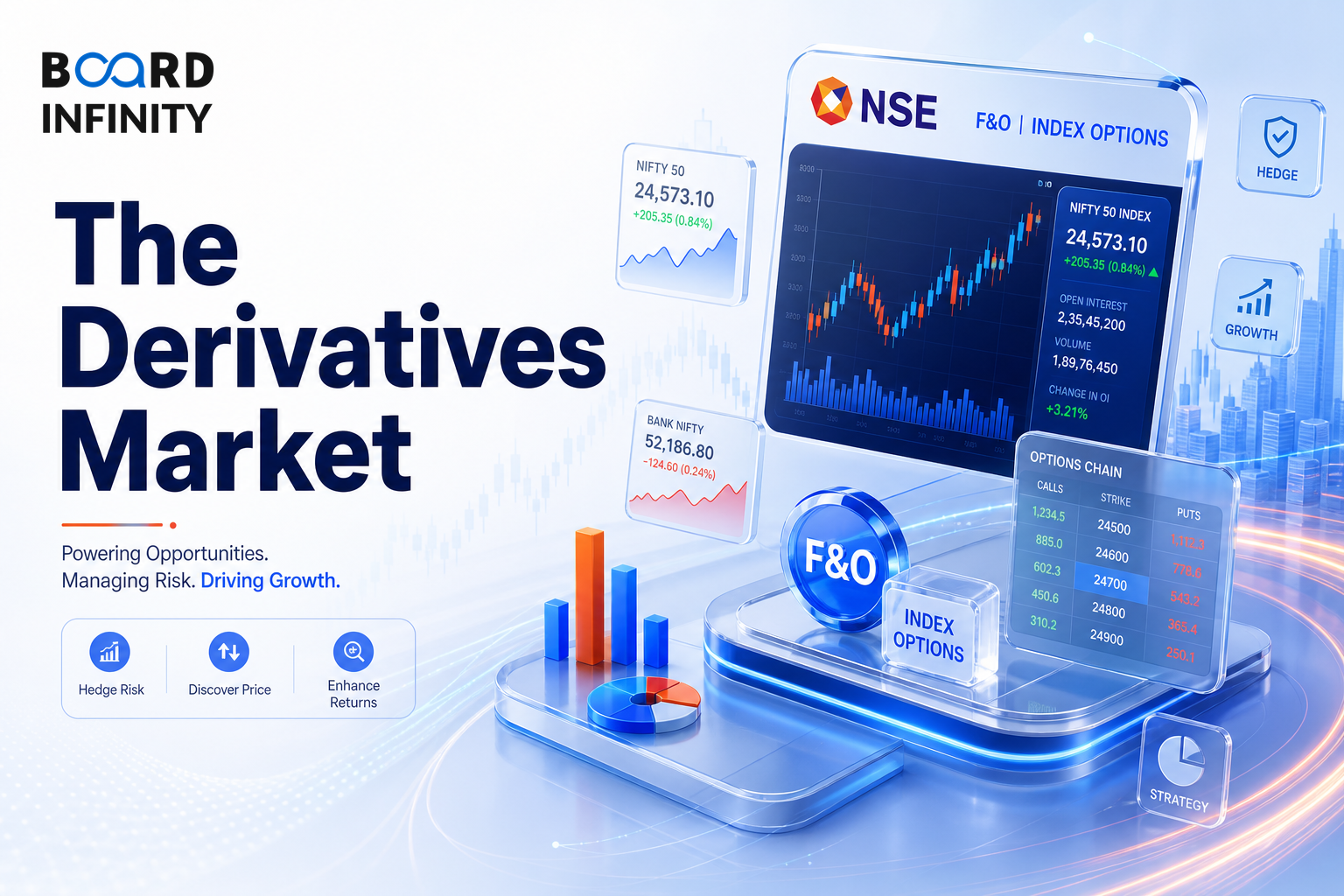
After Corporate Hedging Strategies Explained, where USD revenue, INR costs can be managed using forwards + options and a partial hedge ratio, the next question is how India's exchange-traded derivatives market actually works. India's futures and options, or F&O, ecosystem matters in interviews because it is anchored by NSE, dominated by index options, and now tightly watched by SEBI due to retail participation.
- India's derivatives market, anchored by NSE, has grown into one of the largest globally by contract volume, driven by retail participation in index options.
- NSE F&O consistently ranks as the world's largest derivatives exchange by number of contracts.
- Monthly NSE F&O turnover is ₹8,000+ lakh crore notional in FY24.
- Equity derivatives account for ~95% of volume; index options dominate.
- SEBI 2023-24 restriction on weekly expiries: Only Nifty 50 and Nifty Bank retain weekly expiries on NSE; all other index weekly contracts phased out to curb retail speculation.
- Eligible stocks for F&O are ~180+ stocks meeting SEBI criteria, including market cap, liquidity, and float.
- Lot sizes set by SEBI have a minimum contract value of ₹5-10 lakh, revised periodically.
Big Picture: India's NSE-Led F&O Market
The big picture is simple: India's derivatives market is an NSE-led, equity-derivatives-heavy, index-options-dominated ecosystem. The scale is global, the participation is heavily retail-linked, and the regulatory response focuses on weekly expiries, eligible stocks for F&O, and lot sizes.
Why NSE and Index Options Define the Market
NSE, or National Stock Exchange, is the anchor of India's F&O market. NSE F&O consistently ranks as the world's largest derivatives exchange by number of contracts, and the market's scale is reflected in monthly NSE F&O turnover of ₹8,000+ lakh crore notional in FY24.
The mix is also important: equity derivatives account for ~95% of volume; index options dominate. That is why an interview answer should not describe India derivatives as a broad, generic derivatives market. The core framing is NSE-led and index-options-heavy.
Nifty 50 and Nifty Bank in Weekly Expiries
The SEBI 2023-24 restriction on weekly expiries is the clearest regulatory signal in this market. Only Nifty 50 and Nifty Bank retain weekly expiries on NSE; all other index weekly contracts phased out to curb retail speculation.
Nifty 50 is the primary equity benchmark; futures & options are widely traded. Nifty Bank is bank-specific F&O and the most traded derivative contract in India.
SEBI Controls: Eligibility, Lot Sizes and Retail Speculation
SEBI, the Securities and Exchange Board of India, shapes the market through eligibility rules and contract design. Eligible stocks for F&O are ~180+ stocks meeting SEBI criteria such as market cap, liquidity, and float.
Lot sizes are also set by SEBI, with minimum contract value ₹5-10 lakh, revised periodically. This matters because the contract size directly affects who can participate and how much capital is needed to take positions.
SEBI released a landmark study showing 91% of individual F&O traders lost money in FY22, with aggregate loss of ₹1.8 Lakh Cr. Only top 1% of traders were consistently profitable. SEBI responded with curbs on weekly expiries, higher contract sizes, and upfront premium requirements.
Worked Example: Weekly Expiry Restriction
- Situation: India's derivatives market, anchored by NSE, has grown into one of the largest globally by contract volume, driven by retail participation in index options.
- Problem: Retail speculation became a regulatory concern in weekly index contracts.
- Framework: SEBI used controls around weekly expiries, eligible stocks for F&O, and lot sizes.
- Decision: Only Nifty 50 and Nifty Bank retain weekly expiries on NSE.
- Outcome: All other index weekly contracts were phased out to curb retail speculation.
- Learning: In interviews, connect market scale with product mix and regulation, not just headline turnover.
Structuring a The Derivatives Market in India Interview Answer
"India's derivatives market has become one of the largest globally by contract volume. What explains this growth, and how has SEBI responded to retail speculation?"
Do not answer this as a generic derivatives-market question. The strongest answer frames India as an NSE-led, index-options-heavy F&O ecosystem where retail participation has directly shaped SEBI controls.
The most frequent error is assuming high contract volume automatically means broad-based institutional hedging. It costs points because the key driver named here is retail participation in index options, and the key regulatory response is SEBI's restriction on weekly expiries, higher contract sizes, and upfront premium requirements.
Conclusion
India's derivatives market is best understood as an NSE-led F&O ecosystem where equity derivatives account for ~95% of volume and index options dominate. For interviews, the final takeaway is to connect scale, Nifty 50 and Nifty Bank weekly expiries, retail participation, and SEBI controls in one clear story.