
Forwards vs Futures Explained: Pricing, Margins and Indian Index Futures
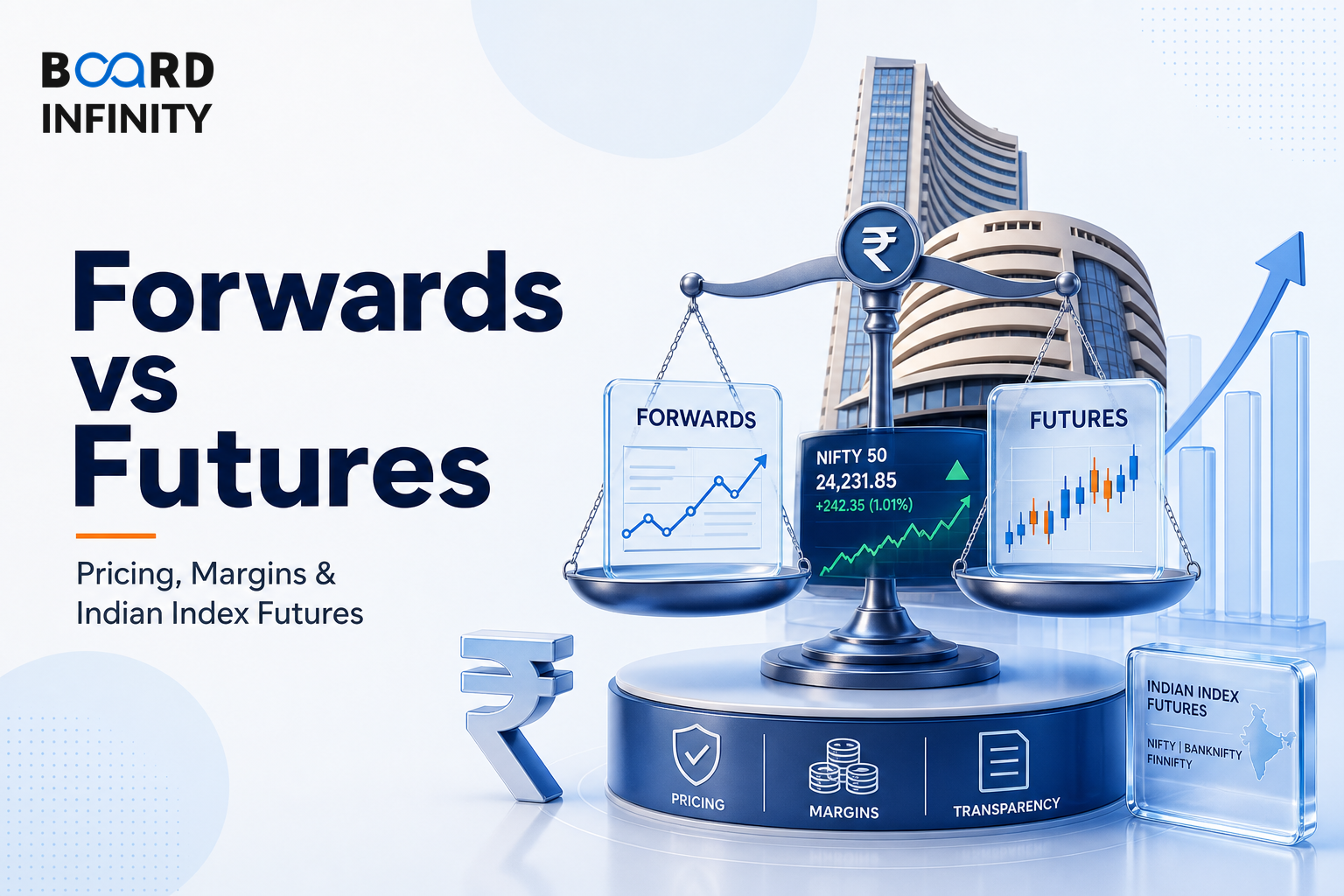
A forward contract is a customised, OTC agreement to buy or sell an asset at a pre-determined price on a future date. A futures contract is the exchange-traded equivalent, and the practical difference matters in trading, hedging, pricing, margining, and Indian index futures markets.
- A forward contract is a customised, OTC agreement to buy or sell an asset at a pre-determined price on a future date.
- A futures contract is a standardised, exchange-traded equivalent with daily mark-to-market settlement, margin requirements, and near-zero counterparty risk due to the central clearing house.
- Futures Pricing Formula: F = S × erT using continuous compounding or F = S × (1 + r)T using discrete compounding.
- Basis = Spot price - Futures price. Basis risk arises when the asset being hedged differs from the futures contract's underlying, or when hedge is lifted before expiry.
- Futures require posting of margin to the exchange via broker to guarantee performance.
- Initial Margin is the deposit required to open a position, typically 5-15% of contract value. On NSE, Nifty 50 futures initial margin is around 8-12% of notional.
- NSE Nifty 50 and Bank Nifty, now Nifty Bank, futures are among the most actively traded equity futures globally.
Big Picture: Forwards and Futures
Forwards and futures both lock in a price today for a transaction on a future date. The core practical difference is that forwards are OTC, bilateral, customised contracts, while futures are exchange-traded, standardised contracts with daily mark-to-market settlement, margins, and central clearing.
F = S × erT using continuous compounding or F = S × (1 + r)T using discrete compounding. Where: F = Futures price, S = Spot price, r = Risk-free rate, T = Time to expiry in years. For assets with dividends/carrying costs: F = (S - I) × erT, where I = PV of income.
Forward Contract
A forward contract is a customised, OTC agreement to buy or sell an asset at a pre-determined price on a future date. OTC means over-the-counter: a bilateral derivative contract that is not exchange-traded, less transparent, and has counterparty risk present.
The important interview point is customisation. In a forward contract, size, date, and asset can be customised, settlement happens at maturity only, and counterparty risk is high because the arrangement is bilateral.
Futures Contract
A futures contract is a standardised, exchange-traded equivalent with daily mark-to-market settlement, margin requirements, and near-zero counterparty risk due to the central clearing house. Mark-to-market means daily revaluation of positions to market price.
Because futures are exchange-traded on NSE or BSE, they use standardised contracts, daily MTM plus final settlement, and initial plus maintenance margin. This is why they are commonly used by traders, hedgers, and arbitrageurs.
Basis and Basis Risk
Basis = Spot price - Futures price.
Basis risk arises when the asset being hedged differs from the futures contract's underlying, or when hedge is lifted before expiry. This is a key hedging nuance because the futures contract may not perfectly match the exposure being hedged.
Margins in Futures
Futures require posting of margin to the exchange, via broker, to guarantee performance. Two key types matter in interviews: Initial Margin and Maintenance Margin.
- Initial Margin: Deposit required to open a position. Typically 5-15% of contract value. On NSE, Nifty 50 futures initial margin is around 8-12% of notional.
- Maintenance Margin: Minimum balance that must be maintained. If MTM losses erode the account below this level, a margin call is triggered and additional funds must be deposited.
Indian Context - Index Futures
NSE Nifty 50 and Bank Nifty, now Nifty Bank, futures are among the most actively traded equity futures globally. Lot size for Nifty 50 = 25 units; Nifty Bank = 15 units.
Contracts expire on the last Thursday of each month: near, mid, far month. Settlement is cash-settled based on the final settlement price = closing value of the index on expiry day.
Structuring a Forwards vs Futures Explained Interview Answer
"Can you explain the difference between a forward contract and a futures contract, including pricing, margins, and the Indian index futures context?"
Do not describe futures as merely standardised forwards. The interview score comes from adding daily MTM, initial and maintenance margin, central clearing house, basis risk, and the Indian index futures context.
The most frequent error is ignoring settlement and margining. Forwards settle at maturity only, while futures use daily MTM plus final settlement, and MTM losses can trigger a margin call if the account falls below maintenance margin.
Conclusion
Forwards and futures both lock in a future transaction price, but their practical mechanics are very different. A strong answer compares customisation, venue, settlement, counterparty risk, margins, pricing, basis risk, and the Indian index futures market in one clear structure.