
Emerging Trends Reshaping Real Estate & Infrastructure
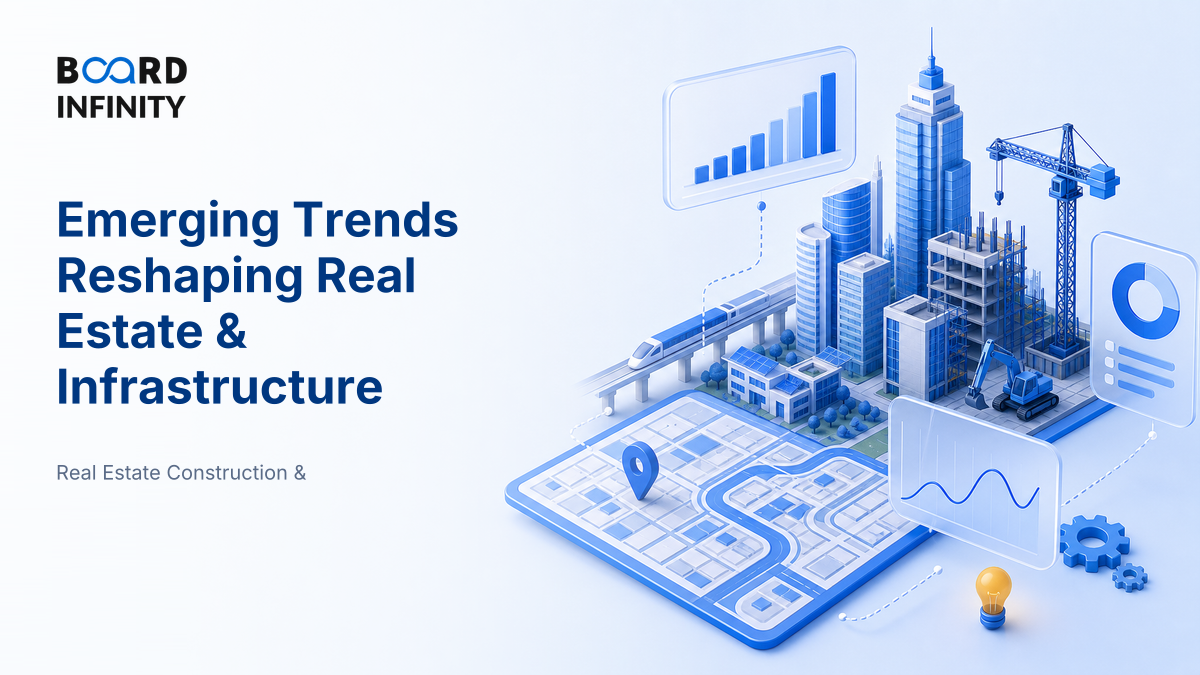
A new office campus on Bengaluru’s Outer Ring Road is no longer just concrete, lifts and parking. It has EV charging in the basement, rooftop solar, app-based visitor access, flexible floors for hybrid teams, a nearby metro story, and tenants asking whether the building can help them meet carbon goals.
That is the visible edge of the shift: real estate and infrastructure are moving from “build and sell” assets to technology-enabled, financeable, sustainable operating platforms.
- The big shift: real estate and infrastructure are becoming operating businesses, not just physical assets.
- Seven trends to remember: urban premiumization, logistics and warehousing, digital infrastructure, green buildings, REITs and InvITs, PPP and asset monetization, and PropTech/AI.
- Follow the money: trends matter only if they change demand, rentals, utilization, cost of capital, risk, or exit value.
- India angle: office demand, logistics parks, metro-led development, data centres, highways, renewables and regulated yield vehicles are the high-relevance interview zones.
- Best answer structure: start with macro drivers, map them to asset classes, explain the winning business model, then name 2-3 metrics.
- Common trap: listing buzzwords like “smart cities” and “green buildings” without explaining the economics behind them.
Big Picture: The Trend Funnel
Do not revise this topic as a loose list of trends. Think like an investor, developer or consultant: a macro force creates a demand shift, the demand shift favours certain assets, and those assets need a business model and metrics to prove value.
The Seven Trends, Explained Like a Deal Team Would See Them
The cleanest way to remember the sector is to track five flows: people, products, data, capital and carbon. Every serious trend changes at least one of these flows.
1. Urban premiumization and mixed-use development
Urban customers increasingly pay for convenience: shorter commutes, better amenities, walkable retail, reliable utilities and flexible workspaces. This favours mixed-use developments, transit-linked projects and Grade-A offices over isolated, poorly connected assets.
So what: the winner is not simply “a bigger building”. It is a better-located, better-serviced asset with stronger absorption, tenant retention and pricing power.
2. Logistics and warehousing move from back-end to boardroom
E-commerce, quick commerce, manufacturing supply chains and omnichannel retail have made warehousing a strategic asset class. Companies now care about warehouse location, throughput, cold-chain capability, last-mile access and automation readiness.
So what: industrial and logistics real estate benefits when products need to move faster, closer to the customer and with tighter inventory discipline.
3. Digital infrastructure becomes real estate’s new demand engine
Data centres, fibre networks, telecom towers and edge infrastructure are now tied to cloud adoption, streaming, AI workloads, digital payments and enterprise digitization. This sits at the intersection of real estate, power, cooling, connectivity and infrastructure finance.
If you want the adjacent sector lens, revise telecom and digital infrastructure size, growth and structure because data centres are best understood as power-intensive real estate plus connectivity.
4. Green buildings and climate-resilient infrastructure
Green design is no longer only about image. It affects power cost, water efficiency, tenant preference, financing access, compliance risk and long-term asset value. For infrastructure, resilience matters because floods, heat, water stress and extreme weather can break project assumptions.
So what: sustainability is becoming a commercial underwriting variable, not a CSR slide.
5. Financialization through REITs and InvITs
Real estate and infrastructure used to be locked inside large, illiquid projects. REITs and InvITs convert income-producing assets into tradable, regulated yield vehicles for investors.
So what: financialization helps asset owners recycle capital, gives investors access to yield-generating assets, and pushes the sector toward better disclosure and professional asset management.
6. PPP, asset monetization and user-pay infrastructure
Infrastructure increasingly relies on public-private partnership models, tolling, annuity structures, concession agreements and asset monetization. The government may create the policy pipeline, but private capital evaluates traffic risk, construction risk, payment certainty and regulatory stability.
So what: infrastructure strategy is a risk-allocation problem. The party best able to manage a risk should carry it.
7. PropTech, smart operations and AI-led asset management
PropTech includes digital leasing, virtual walkthroughs, tenant apps, smart access, automated facility management, construction monitoring and data-led valuation. The deeper trend is that buildings are becoming measurable operating systems.
So what: managers who can improve utilization, reduce energy cost, predict maintenance and improve tenant experience can create value after construction is complete.
Definitions You Can Say in One Breath
- Real estate: Land, permanent improvements on it, and the ownership rights attached to them.
- Infrastructure: Long-life physical systems that enable economic activity and public services.
- PropTech: Technology that improves how property is searched, financed, built, operated, leased or managed.
- REIT: A vehicle that owns income-generating real estate and distributes returns to investors.
- InvIT: A vehicle that owns operating infrastructure assets and passes project cash flows to investors.
Which Trends Create Value: A Simple 2x2
Not every trend deserves equal weight in an answer. Use this matrix to separate fashionable themes from investable opportunities.
For example, a premium warehouse near a consumption cluster may be more attractive than a speculative township because the demand signal, tenant use case and operating metrics are easier to prove. A data centre can be attractive despite high capital intensity if power availability, customer demand, connectivity and uptime capability are strong.
Metrics That Prove a Trend Is Real
When an interviewer asks about trends, add numbers conceptually even if you do not know the company’s exact data. These are interview heuristics, not universal laws - always compare by city, asset class and business model.
Case Study: Brookfield India REIT and the Financialization of Offices
Brookfield India Real Estate Trust is a listed Indian office REIT that shows how commercial property can shift from developer-owned buildings to professionally managed, yield-oriented platforms (Brookfield India REIT).

Situation: Indian office real estate historically involved large capital commitments, long holding periods and limited access for ordinary investors. At the same time, large occupiers wanted high-quality campuses, reliable facilities, professional management and expansion flexibility.
The move: Brookfield India REIT pools income-producing office assets into a listed trust structure. The operating logic is simple: own high-quality commercial assets, lease them to credible occupiers, manage them professionally, distribute income, and use the platform to acquire or improve assets over time.
Outcome and lesson: The strategic lesson is not “office demand is good”. The primary driver is the conversion of rent-generating Grade-A offices into an investable yield platform. Supporting drivers include institutional sponsorship, professional asset management, tenant quality, disclosure discipline, and India’s regulated REIT framework.
Interview takeaway: Brookfield India REIT is a good example because it connects the physical asset, the tenant demand story and the capital-market vehicle in one answer.
How AI Changes Real Estate & Infrastructure Trends
AI does not replace the asset. It changes how the asset is selected, built, priced and operated.
- AI-led site selection and underwriting: Models can combine location, traffic, rent comparables, demographic signals, satellite imagery and tenant demand to shortlist sites faster. The human still validates assumptions, title risk, approvals and local micro-market nuance.
- Construction monitoring and project controls: Computer vision and schedule analytics can flag delays, safety issues, material wastage and progress mismatch. This matters because schedule variance directly affects interest cost, handover dates and project IRR.
- Smart asset operations: AI can optimize energy use, predict equipment failures, improve facility response time and personalize tenant services. This turns buildings from static assets into continuously optimized operating platforms.
Use NotebookLM for company preparation: upload a REIT annual report, investor presentation and 2-3 project news items, then ask, “What are the top five trend-linked interview questions and which metrics should I mention?”
Interview Relevance
“What are the top emerging trends reshaping real estate and infrastructure in India, and which business models are best placed to benefit?”
If the interviewer pushes you to size the opportunity without giving data, use a structured demand tree rather than guessing. The method in sizing a sector when no number exists is especially useful for warehouses, data centres, office demand or urban infrastructure.
After naming a trend, always say who benefits and why: developer, operator, financier, tenant, government or end-user. That instantly makes your answer more commercial.
The mistake: giving a buzzword list - smart cities, green buildings, AI, REITs - without linking them to cash flows, risk or asset value. The fix: for every trend, say “this changes demand, cost, utilization, financing or exit value.”