
ESG & Sustainable Finance Explained
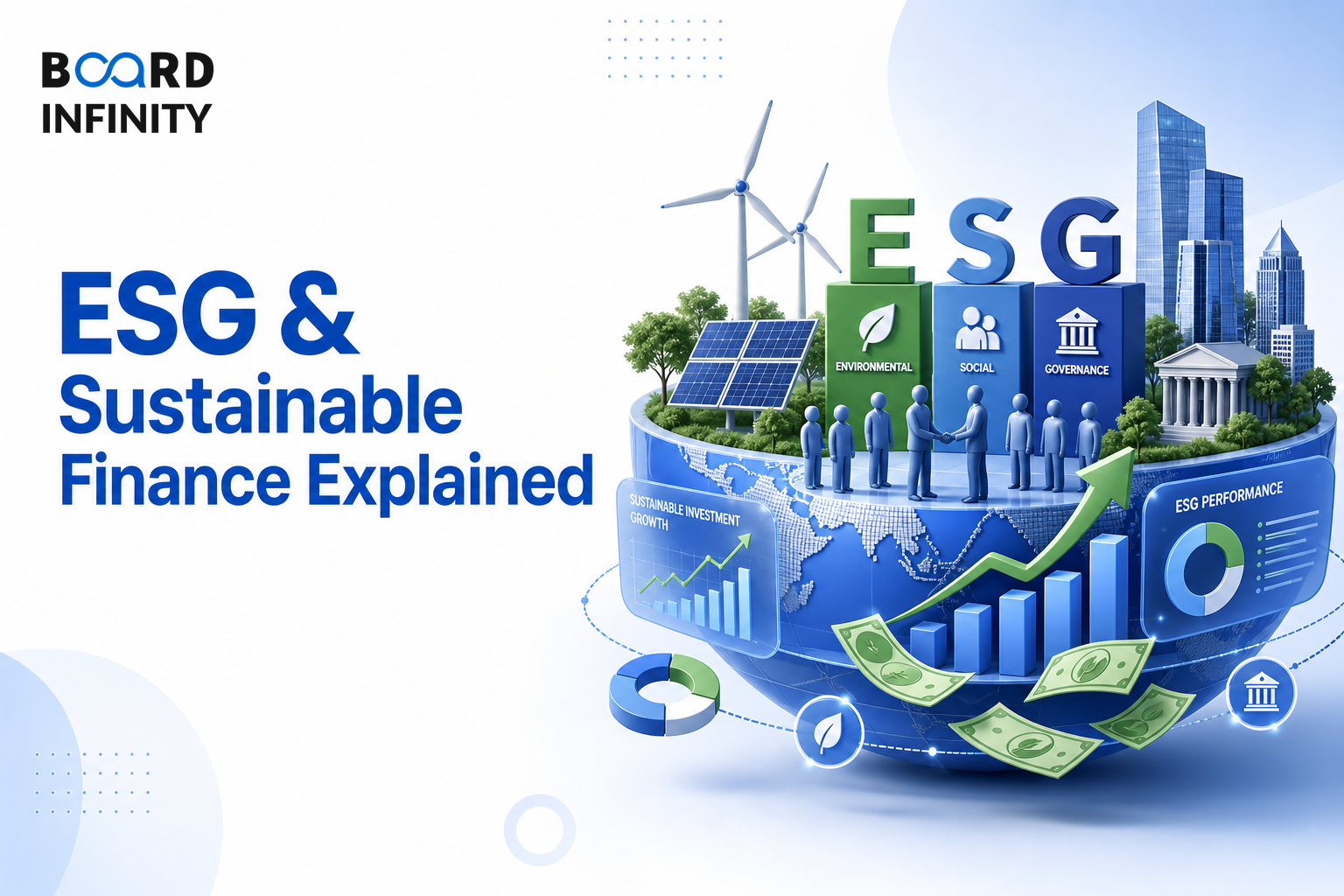
ESG investing is now a mainstream finance lens where analysts evaluate environmental, social and governance risks alongside returns. In interviews, it matters because India's regulatory push via the Securities & Exchange Board of India (SEBI) BRSR framework is accelerating adoption and creating demand for ESG analysts and sustainability managers.
- ESG (Environmental, Social, Governance) investing integrates non-financial factors into investment analysis.
- It has grown from a niche to mainstream - global ESG Assets Under Management (AUM) exceeded $35 trillion by 2024.
- In India, regulatory push via SEBI's BRSR framework is accelerating adoption.
- The three ESG pillars are Environmental (E), Social (S) and Governance (G), each tracked through specific metrics.
- BRSR (Business Responsibility & Sustainability Reporting) was mandated for the top 1,000 listed companies by market cap from FY2022-23.
- BRSR Core for the top 150 companies requires assured ESG disclosures from FY2023-24.
- Green Bonds finance green projects, while Impact Investing targets measurable positive social/environmental outcomes alongside financial returns.
ESG as a Mainstream Finance Lens
ESG investing integrates non-financial factors into investment analysis. It has grown from a niche to mainstream - global ESG AUM exceeded $35 trillion by 2024. In India, regulatory push via SEBI's BRSR framework is accelerating adoption.
ESG (Environmental, Social, Governance) investing integrates non-financial factors into investment analysis.
BRSR and India's Regulatory Push
BRSR (Business Responsibility & Sustainability Reporting): SEBI mandated BRSR reporting for the top 1,000 listed companies (by market cap) from FY2022-23. BRSR Core (top 150 companies) requires assured ESG disclosures from FY2023-24. This is creating demand for ESG analysts and sustainability managers.
Green Bonds and Impact Investing
Sustainable finance also appears through specific instruments and investing approaches.
- Green Bonds: Used to finance green projects. SEBI framework for green bonds (2023). Indian issuers: Power Finance Corporation, NTPC, Adani Green, State Bank of India.
- Impact Investing: Measurable positive social/environmental outcomes alongside financial returns. Indian examples: Aavishkaar Capital, Elevar Equity (fintech for underserved), Lok Capital (microfinance).
Structuring a ESG & Sustainable Finance Explained Interview Answer
"How does ESG investing work in India, and why is BRSR important?"
The strongest answer treats ESG as investment analysis, not as a separate CSR topic. Anchor the answer in Environmental, Social and Governance metrics, then connect it to BRSR, Green Bonds, Impact Investing and demand for ESG analysts.
The most frequent error is reducing ESG to Environmental only and ignoring Social and Governance metrics. That costs points because ESG investing integrates all three non-financial factors into investment analysis, and India's BRSR framework requires structured ESG disclosures.
Conclusion
ESG & Sustainable Finance is best understood as a mainstream finance lens: environmental, social and governance factors are evaluated alongside returns, while SEBI's BRSR framework, Green Bonds and Impact Investing are accelerating adoption in India.