
Global Capability Centres: What the Work Actually Looks Like
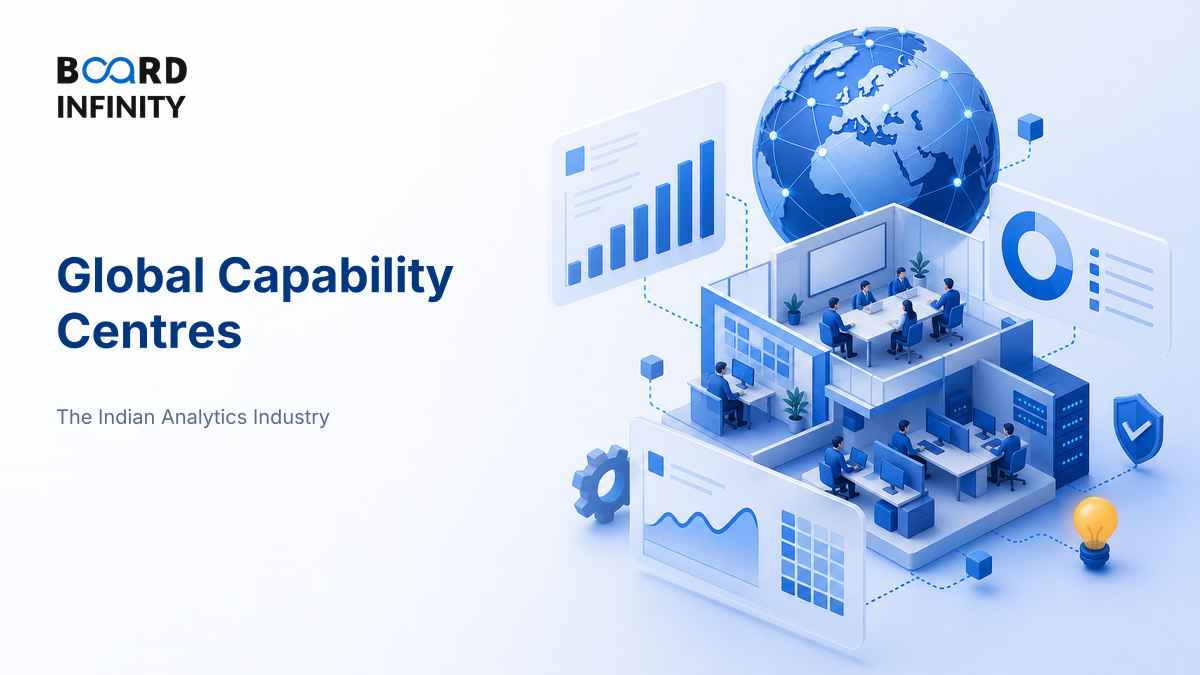
A shopper in Texas abandons a home-improvement cart at midnight; by morning, a team in Bengaluru may have inspected the funnel, tuned the recommendation logic, and flagged a supply-chain issue behind the drop-off. That is the modern Global Capability Centre: not a hidden back office, but a company-owned engine room where product, analytics, operations and business decisions meet.
- A Global Capability Centre is a company-owned offshore or nearshore unit that builds, runs and improves capabilities for the parent enterprise.
- GCC work typically spans technology, analytics, finance, HR, operations, product management, cybersecurity, supply chain and transformation.
- The best mental model: GCCs move from run the process to improve the process to own global capability.
- India is a major GCC hub because of deep digital talent, mature services ecosystems, English-language business operations and city clusters like Bengaluru, Hyderabad, Pune, Gurugram and Chennai.
- In interviews, do not call GCCs “outsourcing.” A GCC is owned by the multinational; a vendor is contracted by it.
- Strong answers connect GCC work to business outcomes: revenue growth, customer experience, risk reduction, productivity, speed and global standardisation.
- AI is pushing GCC roles from reporting and ticket execution toward AI product ownership, model governance, automation design and decision intelligence.
The Big Picture: A GCC Converts Global Business Problems into Repeatable Capabilities
Think of a GCC as the enterprise’s internal capability factory. A global business problem enters from the parent company; cross-functional teams in the GCC convert it into products, processes, analytics, controls and decisions that the global business can repeatedly use.
What the Work Actually Looks Like Inside a GCC
The easiest mistake is to imagine a GCC as one large shared-services floor. In reality, most mature GCCs are portfolios of teams. Some run stable global processes; some build enterprise technology; some create analytics products; some own transformation programs with business leaders across geographies.
1. The four work zones you will hear about
GCC work usually sits in four zones. A fresher or MBA hire may enter through any of them, depending on whether the role is operations, analytics, product, finance, HR, strategy or program management.
2. The maturity ladder: from cost centre to capability owner
Not every GCC is at the same maturity level. A new or transactional centre may focus on scale and cost efficiency. A mature GCC may own global products, analytics platforms, cyber operations or process transformation charters.
3. GCC versus vendor versus product company
This distinction matters because many candidates confuse GCCs with IT services firms. The work may look similar on the surface - agile teams, dashboards, transformation projects - but the ownership model is different.
4. How GCC work is measured
Good GCCs are not judged only on headcount or cost saved. The serious discussion is about whether the centre improves enterprise outcomes. Since benchmarks vary sharply by industry and role, read “strong” below as a directionally strong signal against the centre’s own baseline or service-level agreement.
When a global bank or retailer builds a GCC in Bengaluru, Hyderabad, Pune, Gurugram or Chennai, it is not only hiring cheaper labour. The real advantage comes from dense digital talent, mature vendor ecosystems, experienced managers who understand global delivery, and India-based teams that can overlap with both Asia-Pacific and Western business hours. The strategic “so what”: India helps GCCs combine scale with capability depth, not merely wage arbitrage.
Definitions You Can Say Cleanly
Global Capability Centre: A company-owned offshore or nearshore unit that builds, runs and improves capabilities for a multinational enterprise.
Captive centre: An offshore delivery unit owned by the parent company rather than by an external vendor.
Centre of Excellence: A specialist team that standardises expertise, tools and best practices across the enterprise.
Shared services: A model that consolidates repeatable support processes across business units to improve cost, quality and control.
Lowe's India: A Retail GCC That Shows the Shift from Support to Capability
Lowe's India shows how a global retailer can use its India GCC for technology, analytics and operational capability rather than only offshore support.

Situation: Lowe’s is a large US home-improvement retailer with complex stores, digital commerce, merchandising, inventory and customer-experience needs. For such a business, technology and analytics are not side functions; they influence search, assortment, supply availability, pricing support, store operations and fulfilment experience.
The move: Lowe’s India operates as the company’s GCC in Bengaluru. Its teams support areas such as enterprise technology, digital capabilities, data and analytics, merchandising support and supply-chain decision support. The primary driver is capability ownership: bringing product, engineering and analytics talent close enough to the business problem to improve global retail execution. Supporting drivers include India’s retail-tech and analytics talent pool, agile collaboration with US business teams, reusable platforms, and process knowledge accumulated inside the company rather than dispersed only across vendors.
Outcome or lesson: The important lesson is not “Lowe’s saves cost in India.” That is an incomplete answer. The better lesson is that a mature retail GCC can help a global enterprise build proprietary operating capability - the kind that improves customer experience, employee productivity and decision speed over time.
How AI Changes Global Capability Centres
AI is not making GCCs irrelevant; it is changing what “capability” means. Routine reporting and ticket handling are easier to automate, while higher-value roles move toward AI product design, governance and business adoption.
Use NotebookLM before a GCC interview: upload the company’s annual report, India careers page, two job descriptions and recent news. Ask: “What business capabilities does this GCC seem to own, what roles are MBA-relevant, and what interview questions could test my understanding?” Then convert the answer into a 60-second company-specific pitch.
Interview Relevance
“What is a Global Capability Centre, and how is working in a GCC different from working in an IT services company or a startup?”
If the role is in a GCC, ask yourself: “Which global business capability will I help build or improve?” That question makes your answer sharper than generic lines about learning and exposure.
The most common mistake is calling a GCC a “back office” or “outsourcing unit.” It costs candidates because it signals that they do not understand ownership, maturity or business impact. One-line fix: describe the GCC as an owned enterprise capability centre and then name the business outcome it supports.
What to Revise Next
Now place GCCs in the broader employer landscape. Revise Startups, Unicorns & Product Companies as Analytics Employers to understand product-led analytics roles, then revise Consulting, Services & Analytics Vendors to compare client-service delivery with owned-enterprise capability building.