
Growth Loops vs Funnels Explained
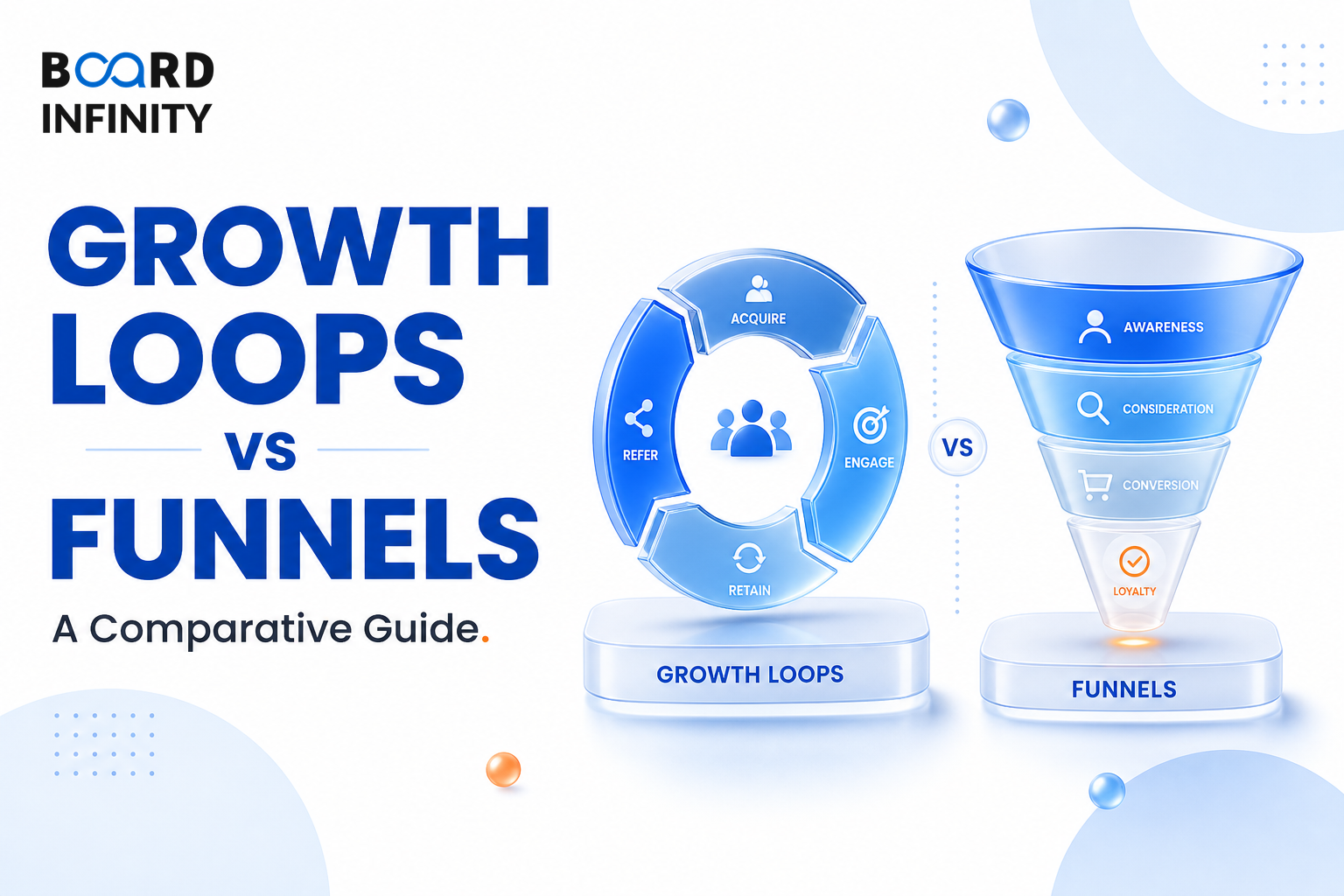
After Product-Market Fit (PMF), the marketing implication shifts from learning to scaling - pour fuel on what's working. Growth loops answer the next question: whether growth is a linear funnel or a self-reinforcing cycle where the output of one step feeds the input of another. In interviews, don't just describe a funnel - describe the self-reinforcing loops that compound growth.
- Traditional funnels are linear: spend money → get customers → hope they stay.
- Growth loops are self-reinforcing cycles where the output of one step feeds the input of another.
- Viral Loop: user invites other users; each new user invites more.
- Content Loop: users create content → content gets indexed → new users discover it.
- Paid Loop: revenue from customers funds acquisition of more customers.
- Data Loop: more users = more data = better product = attracts more users.
- The best growth strategies use multiple loops stacked together.
Funnels vs Growth Loops: The Big Picture
Traditional funnels are linear: spend money → get customers → hope they stay. Growth loops are self-reinforcing cycles where the output of one step feeds the input of another.
Growth loops are self-reinforcing cycles where the output of one step feeds the input of another.
Types of Growth Loops
How a Growth Loop Works
Growth Loop Design Principle
The best growth strategies use multiple loops stacked together. Instead of relying on one linear path, the strongest growth systems combine loops where revenue, content, supply, demand, data, or user sharing feeds the next source of acquisition.
Zomato uses a paid loop (performance ads) + a content loop (restaurant reviews/photos) + a marketplace loop (more restaurants attract more users). In interviews, don't just describe a funnel - describe the self-reinforcing loops that compound growth.
Structuring a Growth Loops vs Funnels Explained Interview Answer
"How is a growth loop different from a funnel, and how would Zomato or Swiggy use loops to compound growth?"
Do not stop at acquisition. A strong interview answer connects the loop type, how it works, a named example, and the key metric that shows whether the loop is working.
The most frequent error is describing a funnel when the question is really about loops. Funnels explain spend money → get customers → hope they stay, but growth loops explain the self-reinforcing cycles that compound growth.
Conclusion
Growth loops shift the growth conversation from linear acquisition to self-reinforcing systems. The core takeaway is simple: describe how the output of one step becomes the input of another, then show how multiple loops can be stacked together.