
How to Set Prices: The Pricing Decision Framework
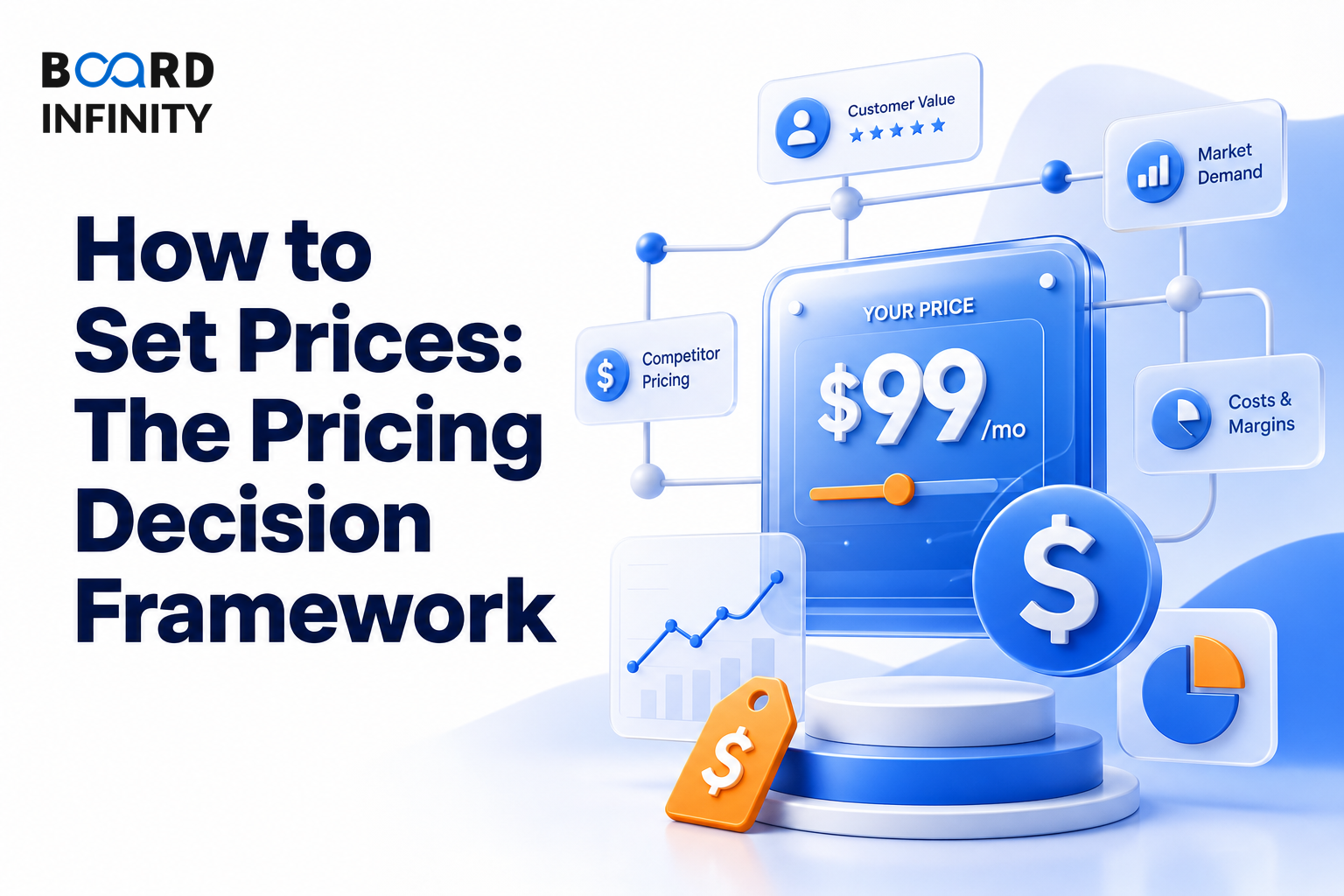
After learning the 12 Pricing Strategies Every Marketer Should Know, the next interview challenge is deciding which pricing approach actually fits the situation. Pricing strategy must align with business objectives, cost structure, competitive landscape, consumer willingness to pay, and channel margins. In interviews, this matters because a strong answer shows structured thinking - never just throwing out a number.
- Start by defining the pricing objective: profit maximization, market share, survival, premium positioning, or competitive response.
- Analyze costs by identifying fixed costs, variable costs, break-even volume, and margin targets.
- Understand demand by checking price elasticity, willingness to pay, and demand at different price points.
- Study competition by reviewing competitor prices, their cost structure, and their positioning.
- Select the pricing method from cost-plus, value-based, competition-based, or auction based on objectives, data availability, and market dynamics.
- Set the final price after factoring in channel margins, taxes (GST), discounts, and geographic variations.
- Monitor and adapt using sales dashboards, price tracking, A/B testing, and sentiment analysis.
The Big Picture: Pricing as a Seven-Step Decision Process
Price is the only element of the marketing mix that generates revenue - all others represent costs. Getting pricing wrong can destroy even the best product, so pricing should move from objective and economics to demand, competition, method selection, final price setting, and continuous adaptation.
How the Pricing Decision Framework Works
The framework starts with strategic business goals and management guidance, then moves into cost accounting, demand research, competitive intelligence, and final price modeling. This sequence matters because the pricing method should be chosen only after the objective, cost floor, demand ceiling, and competitor context are clear.
Define pricing objective means clarifying whether the goal is profit maximization, market share, survival, premium positioning, or competitive response. Without this step, the same product could be priced in completely different ways depending on what the business is trying to achieve.
Analyze costs focuses on fixed costs, variable costs, break-even volume, and margin targets. Cost accounting, CVP analysis, and break-even analysis help establish the economics before the business commits to a price.
Understand demand asks how price elasticity, willingness to pay, and demand at different price points will affect the decision. Van Westendorp, Gabor-Granger, conjoint analysis, and surveys are the tools and methods used to understand demand.
Study competition looks at competitor prices, their cost structure, and their positioning. Competitive intelligence, mystery shopping, and web scraping help compare where the product should sit in the market.
Select pricing method means choosing between cost-plus, value-based, competition-based, or auction pricing. The choice should be based on objectives, data availability, and market dynamics.
Set the final price requires factoring in channel margins, taxes (GST), discounts, and geographic variations. Trade margin analysis, MRP calculation, P&L, and modeling help translate the method into a practical final price.
Monitor and adapt closes the loop by tracking how sales are responding, competitor reactions, and customer feedback. Sales dashboards, price tracking, A/B testing, and sentiment analysis help adjust pricing over time.
Selecting the Pricing Method
The pricing decision framework does not ask candidates to memorize one universal answer. It asks them to choose the right method after checking objectives, costs, demand, competition, channel margins, and market dynamics.
Worked Example: SaaS Product for India
A US-based SaaS company wants to launch its project management tool in India. The US price is $12/user/month. The pricing question is how to price it for the Indian market.
Step 1: Market Context starts with customer willingness to pay, competition, and company economics. Indian SMBs are extremely price-sensitive. ₹1,000/user/month ($12) is prohibitive for most. Key reference: Zoho's India pricing is ~₹200-600/user/month for comparable tools.
- Competition: Zoho Projects (~₹250/user/month), ClickUp (freemium), Monday.com (~₹700/user/month), plus local alternatives like Orangescrum.
- Company economics: Marginal cost of serving one more user is near-zero (SaaS). India is a volume market, not a margin market.
The learning from this example is that pricing should not simply copy the US price. The decision should reflect customer willingness to pay, competition, company economics, and the role of India as a volume market.
Structuring a How to Set Prices Interview Answer
"How would you price X?"
Show this structured thinking - never just throw out a number.
The most frequent error is jumping directly to a price without clarifying the objective, cost floor, demand ceiling, competition, channel margins, method, and final price factors. It costs points because it skips the structured approach interviewers expect and makes the recommendation look arbitrary.
Conclusion
The pricing decision framework turns a pricing question into a disciplined seven-step process: define the objective, analyze costs, understand demand, study competition, select the method, set the final price, and monitor and adapt. In interviews, the strongest answer is structured, evidence-led, and never just a number.