
Jio Pricing Strategy: A Penetration Pricing Case Study
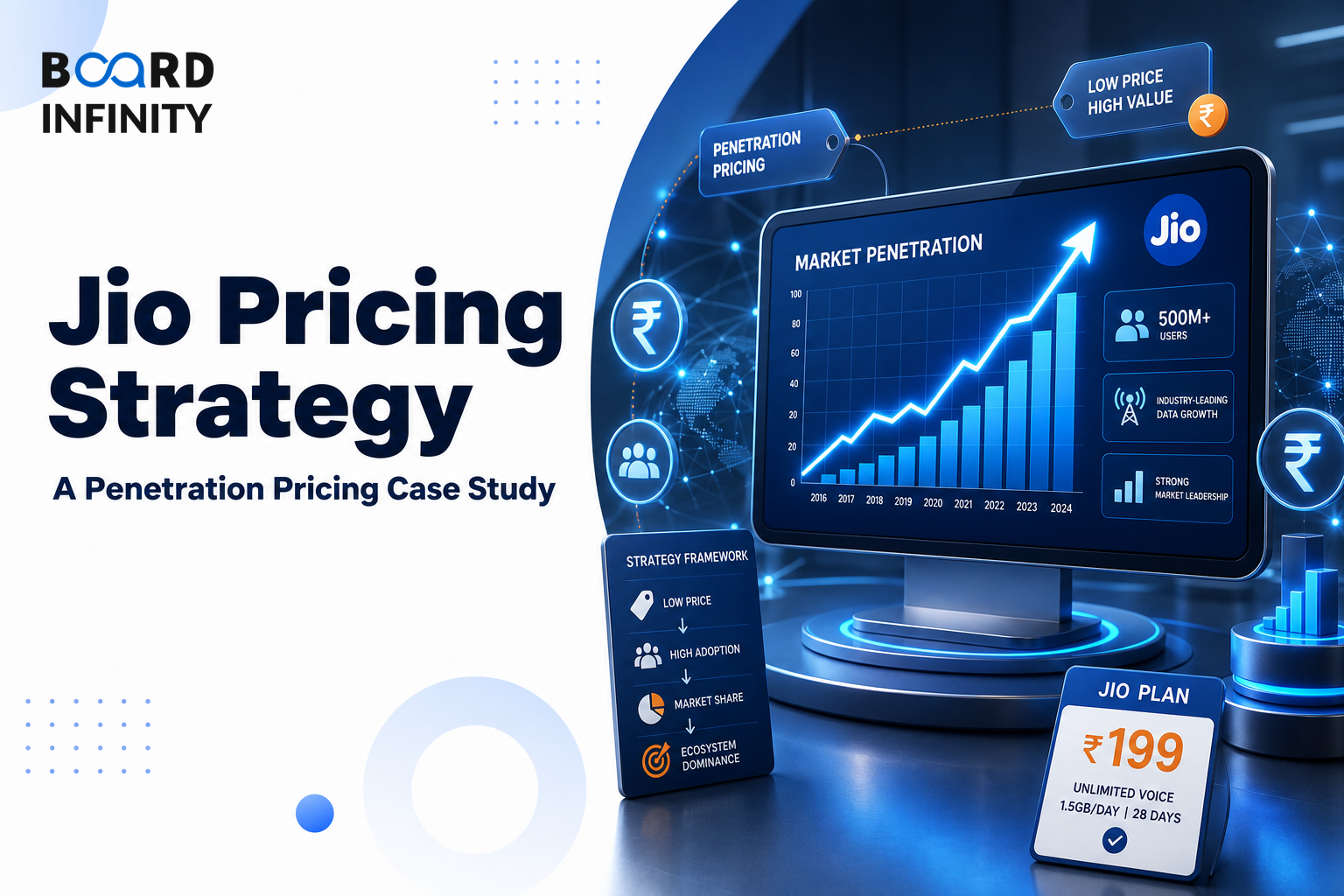
After Pricing Strategy in India: MRP, GST & Value Buyers, Reliance Jio answers a sharper pricing question: what happens when a company prices far below the market to change an entire category? Jio's 2016 launch is a textbook penetration pricing case because deep discounts were used to rapidly acquire users, reshape consumer behavior, and force industry-wide consolidation. In interviews, this case matters because it connects pricing strategy, market disruption, and platform economics in one business.
- Reliance Jio (2016) is the most aggressive penetration pricing in Indian history.
- The context was an Indian telecom market dominated by Airtel, Vodafone, Idea with high data prices (₹250/GB).
- The strategy was FREE voice and data for 6 months ("Jio Welcome Offer"), then ultra-low pricing at ₹149 for 1GB/day.
- The objective was to acquire maximum subscribers to build ecosystem (Jio Cinema, JioMart, JioSaavn).
- The result was 100M+ subscribers in 170 days, competitors forced to match pricing, market consolidated from 12 operators to 3, data prices fell 95%, and India became world's #1 data consumer.
- Penetration pricing works when you have deep pockets to sustain losses, network effects / ecosystem to monetize later, and ability to change consumer behavior permanently.
- The product was not telecom - it was a digital ecosystem (JioCinema, JioMart, JioSaavn) with telecom as the entry point.
Jio's Penetration Pricing Big Picture
Penetration Pricing means price far below market to capture maximum share. In 2016, mobile data in India cost ~₹250/GB, less than 5% of Indians used 4G, and internet was a luxury, not a utility.
Jio used free access and ultra-low pricing to remove the trial barrier, acquire maximum subscribers, and build a digital ecosystem. The complete case is best understood as Context - Strategy - Objective - Result - Lesson.
Reliance Jio: The Full Framework in One Business
Reliance Jio demonstrates the full penetration pricing framework because the pricing move was not only a discount. It changed access, usage, competition, and the role of telecom as the entry point into a wider ecosystem.
A shallow answer says Jio made data cheap. A complete answer explains how Jio subsidised connectivity to build India's largest digital platform.
When Penetration Pricing Works
Jio's case shows that penetration pricing is not simply about charging less. It works when the business can absorb losses, create later monetization through ecosystem value, and permanently shift consumer behavior.
The Strategy
Jio's pricing strategy removed the biggest barriers to trial and usage. It did not merely undercut incumbents - it reset what customers expected from telecom pricing.
- Free voice calls forever - eliminated the single biggest telecom revenue stream
- Data at ₹1.5/GB - 99% cheaper than incumbents
- 6-month free trial (Jio Welcome Offer) - zero barrier to entry
- ₹1,500 JioPhone for feature phone users (effectively free with deposit)
Results and Industry Impact
The results were immediate and structural. Jio did not only gain subscribers; it forced competitors to respond and changed the economics of the Indian telecom market.
- 100 million users in 170 days - fastest ramp in telecom history globally
- 100M+ subscribers in 170 days (world record)
- Competitors forced to match pricing
- Market consolidated from 12 operators to 3
- Aircel shut down. Vodafone and Idea merged (survival merger). Reliance Communications exited.
- Data prices fell 95%
- India went from 150M to 950M+ internet users in under 8 years
- India became the world's largest mobile data consumer (~19GB/user/month)
- India became world's #1 data consumer
Frameworks Applied
Jio is a strong interview case because it can be used across multiple strategy frameworks, while still staying anchored in pricing.
- Penetration Pricing: Price far below market to capture maximum share.
- Blue Ocean Strategy: Created a new market of first-time internet users.
- Porter's 5 Forces: Jio fundamentally restructured industry competition.
The product was not telecom - it was a digital ecosystem (JioCinema, JioMart, JioSaavn) with telecom as the entry point.
Placement Takeaway
Jio is the definitive pricing and market entry case. The insight: the product was digital ecosystem lock-in, not telecom. Jio subsidised connectivity to build India's largest digital platform. Use this case for pricing strategy, market disruption, and platform economics questions.
Structuring a Jio Pricing Strategy Interview Answer
"How would you explain Reliance Jio's 2016 launch as a penetration pricing case?"
Do not stop at cheap data. The strongest answer says the product was digital ecosystem lock-in, not telecom, and Jio subsidised connectivity to build India's largest digital platform.
The most frequent error is describing Jio only as a low-price telecom launch. That misses the objective: acquire maximum subscribers to build ecosystem (Jio Cinema, JioMart, JioSaavn) and change consumer behavior permanently.
Conclusion
Reliance Jio's 2016 launch shows penetration pricing at its most aggressive: free access, ultra-low pricing, rapid subscriber acquisition, and ecosystem-led monetization. The final takeaway is simple: Jio subsidised connectivity to build India's largest digital platform.