
How to Structure a Finance Case with MECE
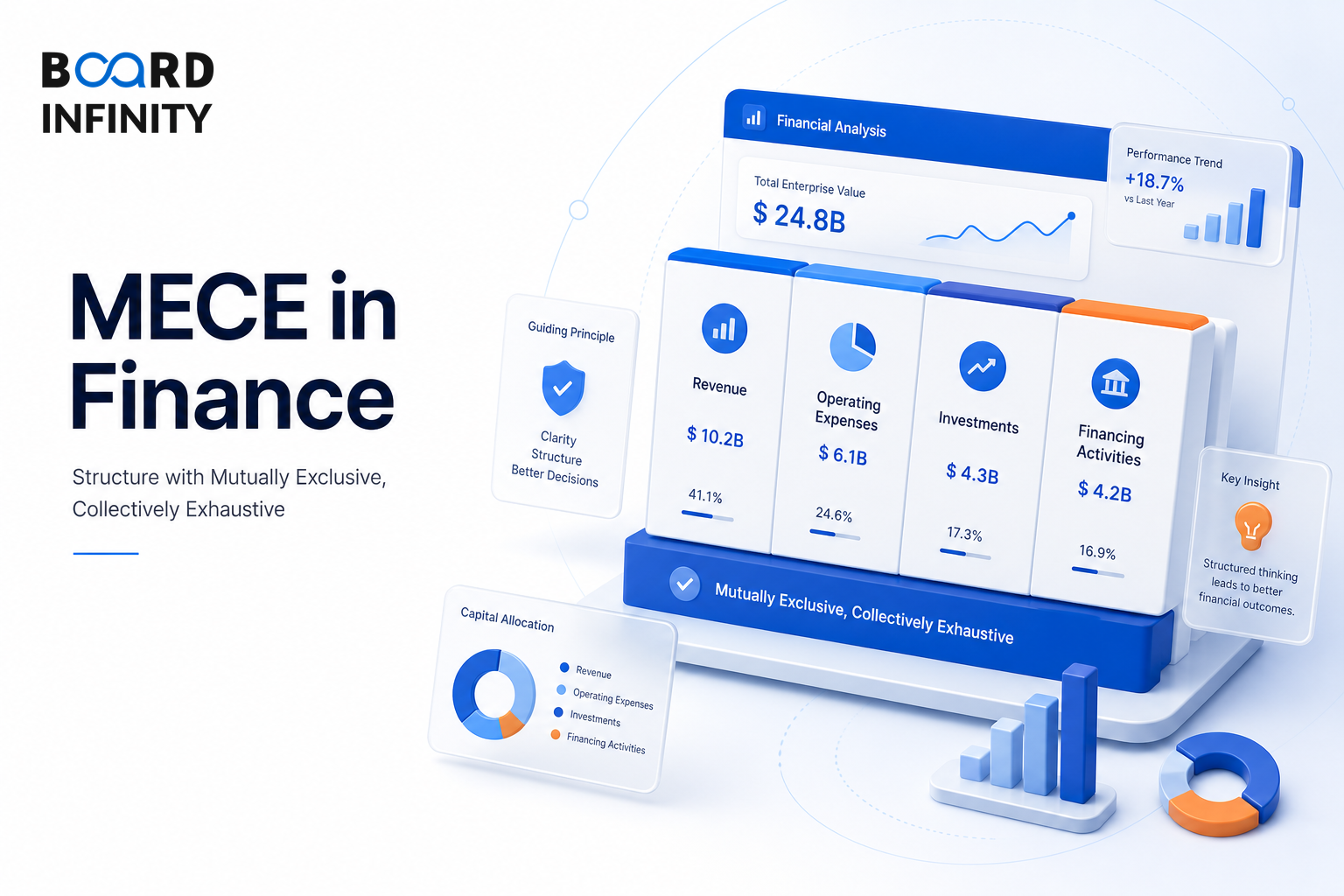
Top-tier finance interviews - Goldman, JPMorgan, McKinsey, Avendus - test your ability to structure ambiguous problems. The MECE principle, meaning Mutually Exclusive, Collectively Exhaustive, turns an unclear finance case into buckets that cover the entire problem without overlap. In interviews, this matters because interviewers reward structured thinking, numbers-backed analysis, synthesis, and a specific recommendation.
- MECE means Mutually Exclusive, Collectively Exhaustive.
- Mutually Exclusive means no overlap between buckets, such as Revenue ≠ Cost in a profitability tree.
- Collectively Exhaustive means all possibilities covered, such as Sources of value = organic + inorganic + financial engineering.
- A strong finance case is top-down: start with hypothesis, such as "Profitability is low because margins are compressed".
- A strong finance case is data-driven: back with numbers, such as Gross margin fell 300 bps YoY → why?
- A strong finance case is action-oriented: end with recommendation, such as "Divest loss-making SKUs, renegotiate supplier contracts".
- The 4-Part Finance Case Structure is Situation, Analysis, Synthesis, and Recommendation.
What MECE Means in Finance Cases
The MECE principle ensures your framework covers the entire problem without overlap. In a finance case, that means each bucket should be separate, complete, logically ordered, backed with numbers, and connected to a recommendation.
The MECE principle (Mutually Exclusive, Collectively Exhaustive) ensures your framework covers the entire problem without overlap.
The 4-Part Finance Case Structure
The 4-Part Finance Case Structure moves from understanding to analysis, then from insight to action. The goal is not to jump to the answer, but to show that you can structure ambiguous problems and move logically toward a recommendation.
- Situation (30 sec): Restate the problem. Confirm your understanding. Ask 1-2 clarifying questions.
- Analysis (3-4 min): Structure into MECE buckets. Walk through each logically. Use actual numbers.
- Synthesis (1 min): State the key insight: "The core issue is X because Y."
- Recommendation (1 min): Specific, actionable, prioritised. "I recommend A over B because…"
Worked Profitability Structure
A profitability case can be structured without overlap by separating revenue, costs, and capital efficiency. For example, you can start top-down with the hypothesis: "Profitability is low because margins are compressed."
Then make the analysis data-driven: Gross margin fell 300 bps YoY → why? The synthesis should isolate the key issue: "The core issue is X because Y." The recommendation should be specific, actionable, and prioritised: "Divest loss-making SKUs, renegotiate supplier contracts."
Structuring a How to Structure a Finance Case (MECE) Interview Answer
"Profitability is low. How would you structure this finance case?"
Never jump to the answer. Say: "Let me break this into three buckets: revenue, costs, and capital efficiency. Starting with revenue…" This signals consulting/banking readiness.
The most frequent error is jumping to the answer before framing the problem. Interviewers reward structured thinking, so skipping the MECE buckets makes the answer feel unstructured even if the final recommendation is directionally right.
Conclusion
MECE is the interview-ready way to turn an ambiguous finance problem into clear buckets, quantified analysis, synthesis, and a prioritised recommendation. In top-tier finance interviews, structure before the answer is what signals consulting/banking readiness.