
The Make vs Buy Decision Framework Explained
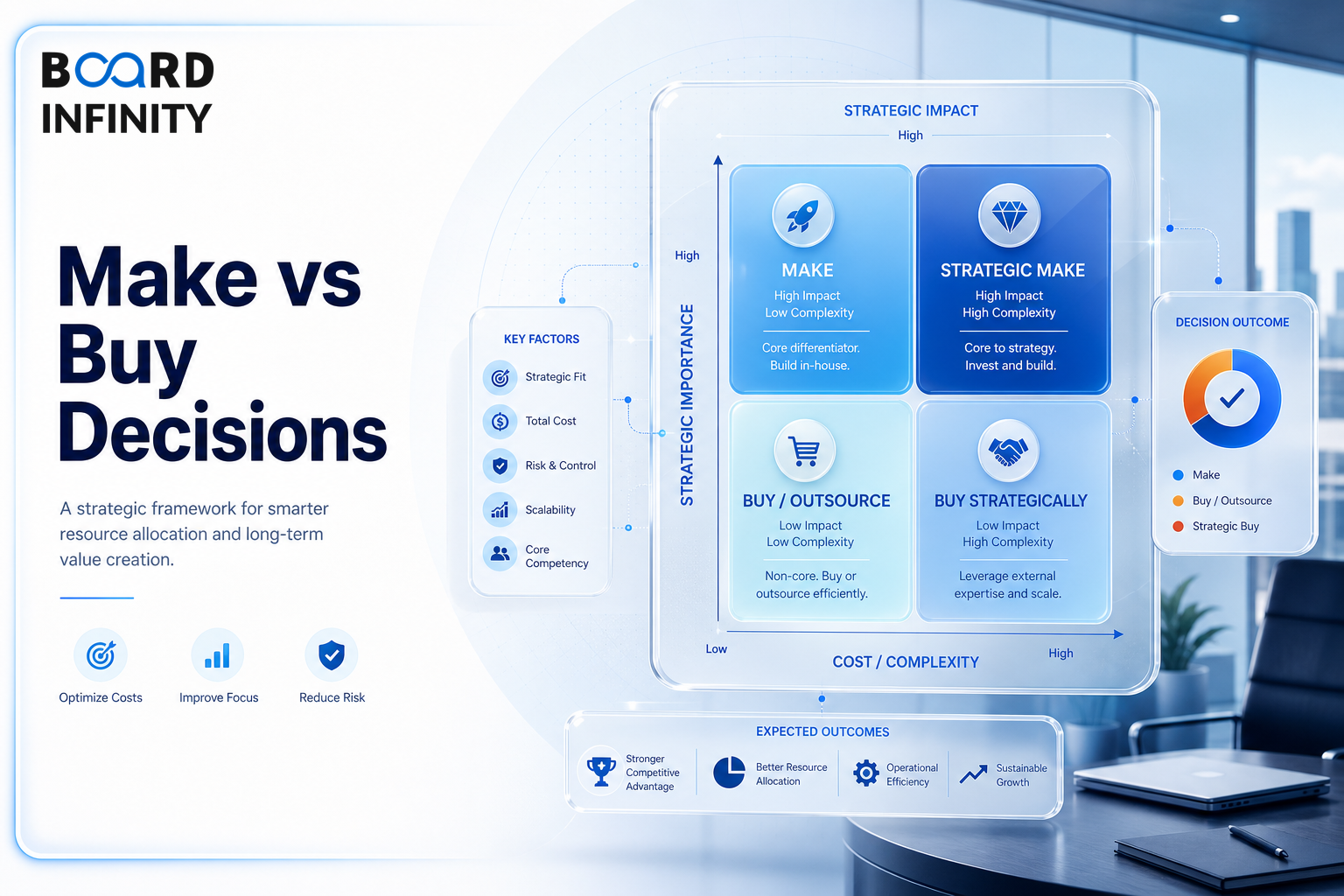
After deciding what customers treat as order qualifiers and order winners, the next operations strategy question is whether a company should build a capability internally or outsource it. The make vs buy decision matters in interviews because it tests whether you can balance strategic capability, supplier reliability, demand stability, quality risk, IP protection, and Total Cost of Ownership (TCO).
- The first question is: Is it a core competency? If yes, MAKE - protect strategic capability.
- If a reliable supplier is available, consider BUY - evaluate TCO; if not, MAKE or develop internal capability.
- If demand volume is high and stable, MAKE - economies of scale justify it; if not, BUY - avoid fixed cost for low volume.
- If the supplier can deliver quality consistently, BUY - with SLA and quality audit; if not, MAKE - quality risk too high to outsource.
- If IP/trade secret is involved, MAKE - never outsource proprietary processes.
- Total Cost of Ownership compares direct cost, setup/tooling, quality cost, logistics, risk cost, hidden costs, and total TCO.
Make vs Buy as an Operations Strategy Choice
The make vs buy decision is a decision tree that starts with strategic capability and then moves through supplier availability, demand stability, quality consistency, IP/trade secret exposure, and Total Cost of Ownership. The big picture is simple: make when the capability, quality risk, volume economics, or proprietary process demands control; buy when reliable suppliers and TCO make outsourcing cost-effective.
The Decision Tree Explained
The decision tree is designed to prevent a narrow cost-only answer. It first protects what is strategically important, then checks whether the external market can reliably supply the requirement, and finally compares the full economics through TCO.
Core competency means a strategic capability that the company should protect. If it is a core competency, the answer is MAKE - protect strategic capability. If it is not, the decision moves to the next question.
Supplier reliability is the next filter. If a reliable supplier is available, the recommendation is Consider BUY - evaluate TCO. If not, the company should MAKE or develop internal capability.
Demand volume matters because high and stable demand can justify in-house fixed cost. If demand volume is high and stable, the recommendation is MAKE - economies of scale justify it. If demand is not high and stable, BUY - avoid fixed cost for low volume.
Quality consistency determines whether outsourcing is operationally safe. If the supplier can deliver quality consistently, BUY - with SLA and quality audit. If not, MAKE - quality risk too high to outsource.
IP/trade secret exposure is a final strategic check. If IP/trade secret is involved, MAKE - never outsource proprietary processes. If not, BUY - if cost-effective.
Total Cost of Ownership Comparison
Total Cost of Ownership (TCO) is the all-in cost of a make or buy option, not just the quoted price. TCO = purchase price + logistics + quality cost + lead-time buffer + risk premium + coordination cost. Lowest price never equals lowest TCO.
How to Use the Framework in a Case
A strong answer does not jump directly to outsourcing because a supplier quote is lower. It walks through the decision tree, flags strategic and quality risks, and then compares the in-house and outsource options on Total Cost of Ownership.
Structuring a The Make vs Buy Decision Framework Explained Interview Answer
"Should the company manufacture this component in-house or outsource it to a supplier?"
Always compare on TCO, never on quoted price alone. Hidden costs such as quality, lead-time buffer, risk premium, coordination, and IP leakage can be the difference between the right and wrong supplier decision.
The most frequent error is treating buy as automatically better because the supplier quote is lower. This misses setup/tooling, quality cost, logistics, risk cost, hidden costs, and IP leakage, which can change the total TCO and the strategic recommendation.
Conclusion
The make vs buy decision is a structured operations strategy choice: protect core competency and IP, test supplier reliability and quality, check demand stability, and compare the full Total Cost of Ownership before recommending make or buy.