
Paytm: From IPO Debacle to RBI Action
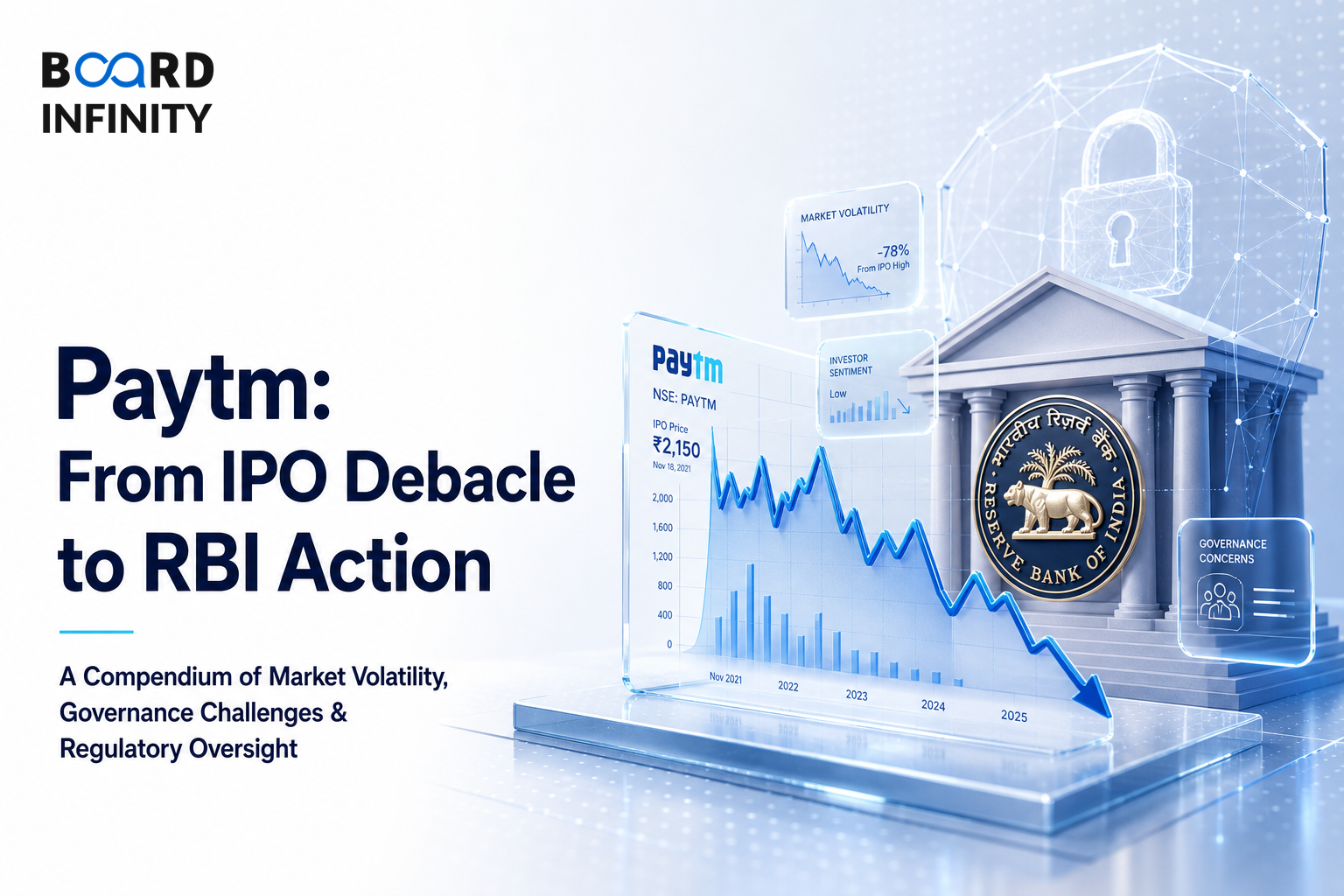
After The IL&FS Crisis: Shadow Banking Collapse, the diligence lesson was to look beneath headline scale and identify hidden risk concentration before the market does. Paytm asks the same question in a fintech IPO setting: were the stretched valuation, weak moat, negative unit economics, and regulatory risk visible before the Reserve Bank of India action? This matters in interviews because the case is not just about a stock crash - it is about whether a rigorous pre-IPO analysis would have said no.
- Paytm (One97 Communications), India's flagship fintech, raised ₹18,300 crore in November 2021 - India's largest IPO at the time.
- Issue price was ₹2,150, and within 13 months, the stock had lost 70% of its value.
- IPO valuation was priced at 26x FY22 revenue - a multiple that assumed both rapid revenue growth AND margin expansion simultaneously.
- FY22 Contribution Margin was negative, CAC was high, and only 30% of the 25 crore registered users were active monthly transacting users.
- UPI is free, open, and interoperable - no switching cost; PhonePe + Google Pay captured 83%+ UPI market share.
- In January 2024, RBI took action against Paytm Payments Bank Ltd., directing PPBL to stop accepting deposits/top-ups.
- The correct answer on IPO Day: Do not subscribe.
Big Picture: A Pre-IPO Diligence Failure
Paytm's fall can be framed as an IPO diligence failure. A rigorous pre-IPO analysis would have flagged the moat absence, negative unit economics, regulatory concentration risk, and stretched valuation before the RBI action completed the fall.
Situation / Problem
Paytm (One97 Communications), India's flagship fintech, raised ₹18,300 crore in November 2021 - India's largest IPO at the time. Issue price: ₹2,150. Within 13 months, the stock had lost 70% of its value. In January 2024, RBI took action against Paytm Payments Bank Ltd. - the regulatory blow that completed the fall.
Key Analysis
IPO Valuation Red Flags
Priced at 26x FY22 revenue - a multiple that assumed both rapid revenue growth AND margin expansion simultaneously. Comparable: PayPal at IPO was 8x revenue; Stripe's implied valuation was ~20x.
Revenue quality concern: 75% of Paytm's revenue came from financial services distribution (loans/insurance) which is high-churn and regulatory-sensitive, not from high-margin SaaS-type recurring revenue.
Unit Economics Breakdown
FY22 Contribution Margin was negative. Paytm was paying merchants and users cashbacks/incentives to acquire and retain them.
CAC was high; churn was elevated post-cashback removal. '25 crore registered users' vs '7.4 crore MTU (monthly transacting users)' - only 30% were active.
Competitive Moat Absent
UPI is free, open, and interoperable - no switching cost. PhonePe + Google Pay captured 83%+ UPI market share. Paytm's market share fell from 40% (2019) to ~10% (2023).
RBI Action
In January 2024, PPBL was directed to stop accepting deposits/top-ups. Reason: persistent KYC non-compliance + data sharing with related Chinese entities (Ant Group ownership).
PPBL had ₹20,000+ Cr of customer deposits and 3.5 crore wallet users at risk.
Case Exercise: Should You Have Subscribed to the Paytm IPO?
Framework for answering - apply this to any IPO question:
A rigorous pre-IPO analysis would have flagged the moat absence, negative unit economics, regulatory concentration risk, and stretched valuation. The correct answer on IPO Day: Do not subscribe.
Structuring a Paytm Interview Answer
"Should You Have Subscribed to the Paytm IPO?"
Do not frame the listing day drop as a market overreaction. The listing day drop was rational, not a market overreaction, because the moat absence, negative contribution margin, stretched valuation, and foreseeable RBI scrutiny were already visible.
Conclusion
Paytm's IPO story is a reminder that scale alone does not offset weak unit economics, no switching cost, regulatory concentration risk, and an aggressive valuation. In an interview, the strongest answer is to show that the RBI action completed the fall, but the pre-IPO diligence failure was visible much earlier.
The most frequent error is treating the RBI action as the whole story. That misses why the case matters: a rigorous pre-IPO analysis would already have flagged the moat absence, negative unit economics, regulatory concentration risk, and stretched valuation.