
Zerodha: Disrupting Indian Broking
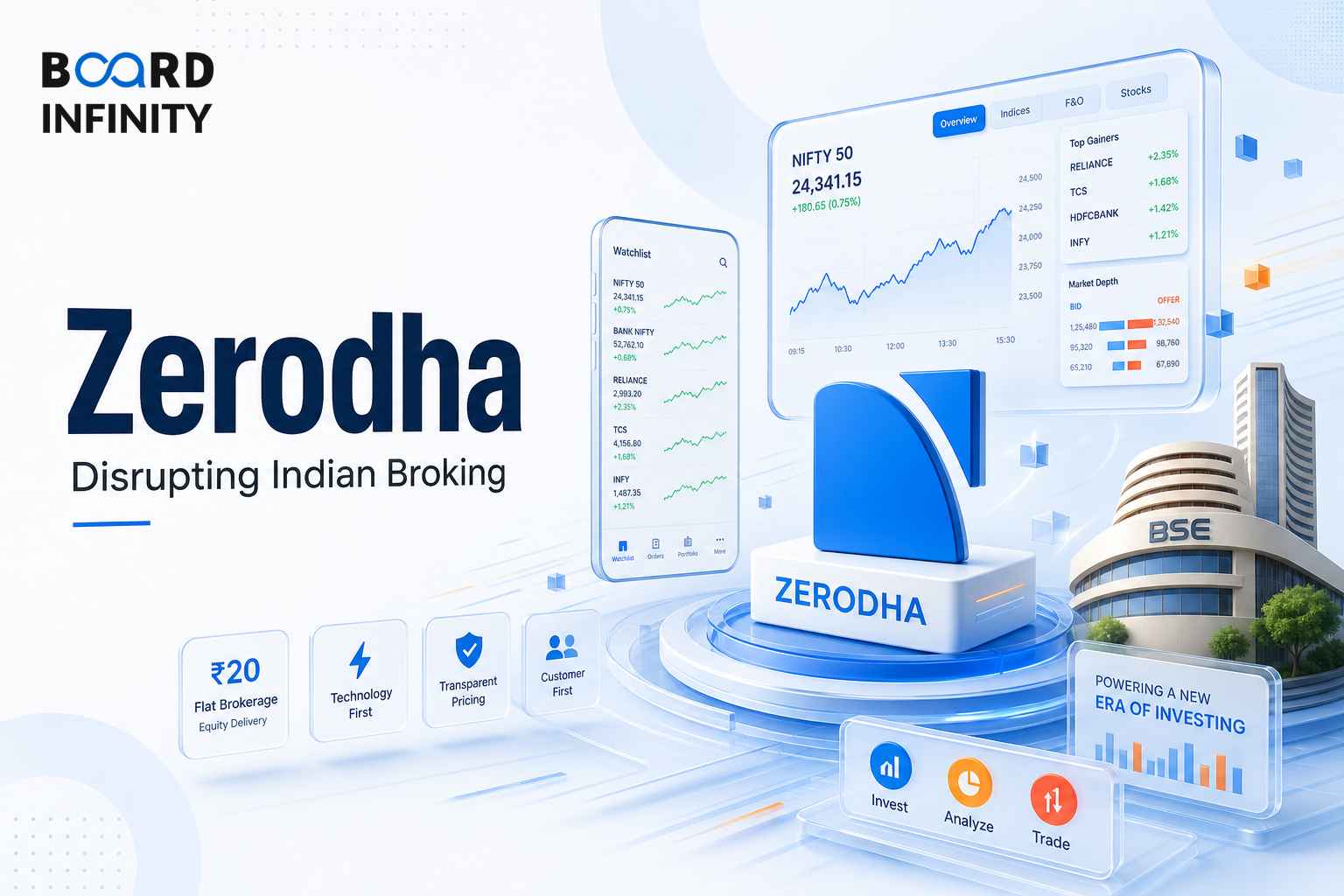
Jio Financial Services was a demerger play built around distribution optionality; Zerodha is a sharper pricing disruption story. It answers how a bootstrapped broker used a ₹20 flat fee, zero external funding, and near-zero marginal-cost technology to become India's largest and most profitable broker - a case interview favourite because the upside and the regulatory risk are both measurable.
- In 2010, Indian broking was dominated by full-service players (ICICI Direct, HDFC Securities, Kotak Securities) charging 0.3-0.5% of trade value.
- Nithin Kamath launched Zerodha with a ₹20 flat fee per order - a 99%+ price disruption.
- Without any external funding, Zerodha became India's largest and most profitable broker.
- Revenue (FY24): ₹8,320 crore | PAT: ₹4,700 crore+ | PAT Margin: 56%.
- Active Clients: 1.8 crore+ | External Funding: Zero (100% bootstrapped).
- Revenue breakdown: F&O transaction charges ~70% + margin interest + Coin MF platform + Sensibull.
- SEBI regulatory risk matters because Oct 2023 SEBI circular restricting weekly expiries led F&O volumes to drop 30-40%.
Big Picture
Zerodha is the gold standard for Indian fintech profitability because the model combines disruptive pricing with zero-marginal-cost technology. The strategic tension is equally important: concentration risk from F&O revenue requires proactive diversification into Zerodha Fund House, Sensibull, and Coin.
Zerodha - Key Numbers (FY24) - Why It Works Financially
Zerodha proves that disruptive pricing + zero-marginal-cost technology = extraordinary profitability.
Situation / Problem
In 2010, Indian broking was dominated by full-service players (ICICI Direct, HDFC Securities, Kotak Securities) charging 0.3-0.5% of trade value. Nithin Kamath launched Zerodha with a ₹20 flat fee per order - a 99%+ price disruption.
Without any external funding, Zerodha became India's largest and most profitable broker. Zerodha disrupted full-service broking with a flat-fee model: zero brokerage on equity delivery; ₹20 flat F&O and intraday trades.
Revenue Paradox: How a ₹20 Fee Still Scales
The revenue paradox is central to the case. Despite ₹20 flat fee, Zerodha generates ₹8,000+ Cr revenue.
Math: 1.8 crore clients × average 5 trades/month × ₹20/trade = ₹21,600 Cr annualised from F&O charges alone. But actual revenue lower because delivery trades are free and many clients are inactive.
The financial logic works because marginal cost per trade is near zero once the tech infrastructure is already built. Every incremental trade is approximately 100% CM.
Regulatory Risk and Diversification
The risk is concentration - 70% of revenue from F&O charges. SEBI's weekly expiry restrictions already hit volumes 30%+.
Oct 2023 SEBI circular restricting weekly expiries led F&O volumes to drop 30-40%. Revenue fell from peak levels.
Zerodha responded by diversifying into Zerodha Fund House (AMC), Sensibull (options tools), and Coin (direct MF platform). If SEBI further restricts F&O, for example raising lot sizes or banning certain expiries, Zerodha's revenue is vulnerable.
Outcome and Recommendation
Zerodha is the gold standard for Indian fintech profitability. Two key lessons for finance interviews: (1) Zero-marginal-cost technology businesses create extraordinary operating leverage; (2) Concentration risk (70% revenue from F&O) requires proactive diversification.
The AMC/MF platform diversification is the strategic response. Coin and Zerodha Fund House are the answer, but early-stage.
A strong two-minute answer is: 'Zerodha proves that disruptive pricing + zero-marginal-cost technology = extraordinary profitability. 56% PAT margin in financial services is rare globally. But the risk is concentration - 70% of revenue from F&O charges. SEBI's weekly expiry restrictions already hit volumes 30%+. The strategic question is whether Zerodha can replicate its F&O dominance in wealth management - Coin and Zerodha Fund House are the answer, but early-stage. I'd value it at 20-25x P/E on normalised earnings, applying a 20% SEBI regulatory risk discount.'
Structuring a Zerodha Interview Answer
"How did Zerodha disrupt Indian broking, and what is the key strategic risk in its model?"
Do not stop at "low brokerage." The higher-scoring answer links the ₹20 flat fee to near-zero marginal cost, exceptional operating leverage, and the risk that 70% of revenue comes from F&O charges.
The most frequent error is treating Zerodha only as a cheap broker story. That misses the real finance case: zero-marginal-cost technology created extraordinary profitability, while F&O revenue concentration creates SEBI regulatory risk and makes AMC/MF platform diversification strategically critical.
Conclusion
Zerodha shows how disruptive pricing and zero-marginal-cost technology can create exceptional profitability in financial services. The final takeaway is balanced: Zerodha is a bootstrapped fintech profitability benchmark, but its long-term resilience depends on reducing F&O concentration through Coin, Zerodha Fund House, and related diversification.