
Social Impact, Communities & Responsible Business Conduct
A factory gate opens in a small town, and the balance sheet says the project is viable. But the road outside is crowded with villagers asking about water use, jobs, safety and land - because a business does not operate only inside its P&L.
Social impact, community trust and responsible conduct are now business issues, not charity footnotes. The strongest candidates do not say “CSR activity”; they show how a company identifies impacts, engages stakeholders, reduces harm, creates shared value and proves it with evidence.
- Social impact is the net change a business creates for people, communities and society versus what would have happened anyway.
- Responsible business conduct means creating value while avoiding, mitigating and remedying adverse impacts on people, planet and governance.
- The core sequence is: map stakeholders - identify impacts - engage communities - act - measure - disclose - improve.
- Do not confuse CSR spend with impact. Money spent is an input; lives improved, risks reduced and trust built are outcomes.
- Community engagement is not PR. It is structured listening, participation, grievance handling and co-creation with affected groups.
- In India, responsible conduct increasingly connects to CSR governance, BRSR disclosure, supply-chain accountability and social licence to operate.
- The interview-safe answer always links social impact to business resilience: reputation, permissions, talent, demand, risk reduction and long-term legitimacy.
Big Picture: Responsible Business Is the Bridge Between Profit and Legitimacy
A company can be profitable and still fragile if communities distrust it, workers feel unsafe, suppliers are exploited or regulators see weak conduct. Responsible business conduct turns “doing good” into a management system: identify who is affected, understand how they are affected, act on the material issues and prove progress transparently.
Core Explanation: The Impact-to-Trust Chain
The easiest way to understand this topic is through a chain: business activity creates impacts; impacts affect stakeholders; stakeholder experience creates trust or resistance; trust affects business continuity.
That is why social impact sits at the intersection of strategy, operations, risk, HR, marketing, finance and public policy. A mining company, a quick-commerce platform, a bank and a consumer goods firm will have different impacts - but the logic is the same.
1. Social Impact: What Changed Because the Business Existed?
Social impact is not “number of beneficiaries reached” alone. It asks a sharper question: what changed, for whom, how much, how sustainably and compared with what would have happened anyway?
For example, a skilling programme should not stop at “10,000 people trained.” A better impact answer asks: how many completed the course, how many got jobs, how incomes changed, whether women and disadvantaged groups benefited, and whether the model can continue without constant subsidy.
2. Communities: The Stakeholders Closest to the Consequences
Communities are groups directly or indirectly affected by a company’s operations, products, supply chains or expansion decisions. They may include local residents, farmers, small retailers, delivery partners, informal workers, indigenous groups, customers, civil society organisations and local governments.
Community engagement becomes serious when it moves from “informing people” to “including people in decisions that affect them.”
3. Responsible Business Conduct: The Operating Discipline
Responsible business conduct, or RBC, is broader than CSR. CSR often describes formal social initiatives; RBC describes how the entire business behaves - from product design and procurement to labour practices, marketing claims, data privacy, environmental impact and grievance handling.
In India, this has become especially relevant because large listed companies disclose business responsibility and sustainability information through SEBI’s BRSR framework; SEBI’s circular introduced BRSR for the top 1000 listed entities by market capitalisation (SEBI BRSR circular, 2021).
4. The Four Lenses You Should Apply
When analysing any business initiative, use four lenses. This prevents a shallow “good for society” answer and makes your response sound managerial.
5. How to Measure Social Impact and Responsible Conduct
Strong answers use metrics carefully. The trick is to separate input, output, outcome and impact.
Notice the discipline: “we spent ₹5 crore” is not impact. “We improved school attendance in target villages versus the baseline and reduced repeat grievances” is closer to impact.
Definitions You Can Say in One Breath
- Social impact: the net change a business activity creates for people, communities or society versus the likely baseline.
- Community engagement: a structured process of involving affected stakeholders in decisions, feedback, grievance resolution and shared value creation.
- Responsible business conduct: doing business that contributes to progress while avoiding, mitigating and remedying adverse impacts, aligned with the OECD Guidelines for Multinational Enterprises.
- Human rights due diligence: identifying, preventing, mitigating and accounting for how a business addresses human rights impacts, as framed by the UN Guiding Principles on Business and Human Rights.
- Social licence to operate: ongoing acceptance from communities and stakeholders, beyond legal permission, that allows a business to function with legitimacy.
Real Example: Patagonia and Purpose Built Into Governance
Patagonia announced that “Earth is now our only shareholder,” transferring ownership into structures intended to protect the company’s purpose and fund environmental work (Patagonia ownership announcement). The strategic lesson is not “purpose marketing wins”; it is that credible responsible business requires governance, capital allocation and operating choices to reinforce the claim.
The primary driver here is governance design - the company changed who ultimately benefits from ownership. Supporting drivers include long-standing brand positioning, product repair culture, environmental advocacy and customer trust. That combination matters because responsible conduct becomes credible only when the company’s structure, incentives and behaviour point in the same direction.
Case Study: ITC e-Choupal and Community-Centred Value Creation
ITC’s e-Choupal shows how community impact and business advantage can reinforce each other when farmer needs are built into the operating model.
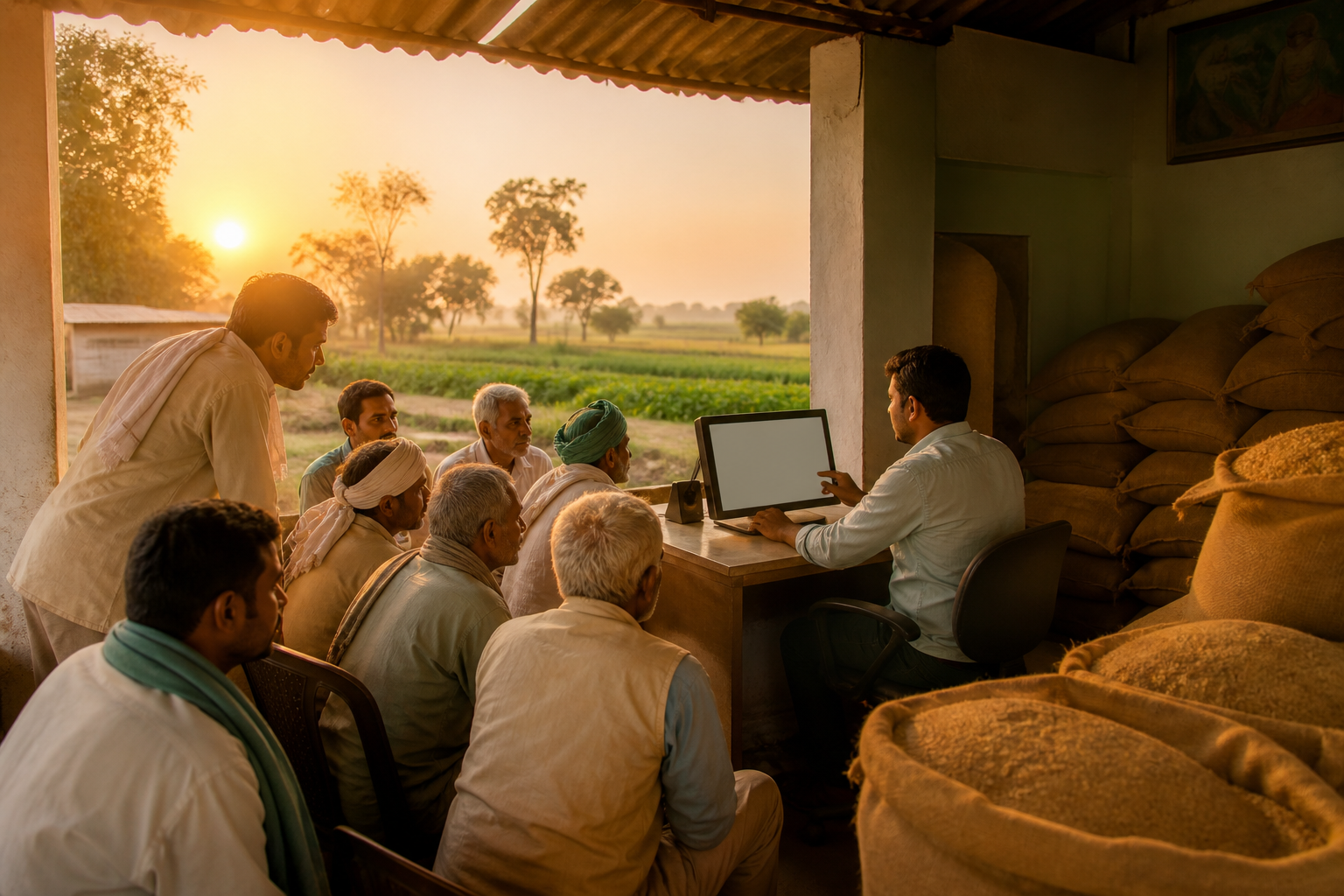
Situation: Indian farmers often face fragmented access to market prices, agronomic information, quality knowledge and reliable procurement channels. For an agri-business, this also creates sourcing inefficiency, inconsistent quality and weak farmer relationships.
The move: ITC created e-Choupal as a rural digital and physical interface that connects farmers with information and market access while strengthening ITC’s agri-sourcing network (ITC e-Choupal). The model uses local participation and trust rather than treating farmers only as suppliers.
The result and lesson: The model is memorable because it is not a donation programme attached to the side of a business. Its primary driver is direct farmer engagement around information and market linkage. Supporting drivers include local intermediaries who understand village relationships, integration with procurement, quality transparency and ITC’s ability to align community benefit with supply-chain reliability.
Interview takeaway: A shallow answer says “ITC helped farmers.” A strong answer says “ITC converted community engagement into a shared-value system where farmer information access and business sourcing efficiency improved together.”
How AI Changes Social Impact, Communities & Responsible Business Conduct
AI is changing this topic in practical ways - especially measurement, listening and reporting. But it also creates new responsibility risks around bias, privacy, transparency and exclusion.
- Community listening becomes faster and more granular. AI can cluster grievance logs, call-centre transcripts, local-language feedback and social media signals to detect recurring community concerns earlier. The risk: noisy or biased data can overrepresent digitally active groups and miss the most vulnerable.
- Impact measurement becomes more evidence-led. AI can help clean survey data, compare baseline and endline responses, detect outliers and summarise qualitative interviews. The risk: models may make weak impact claims look precise when the underlying evaluation design is poor.
- Responsible reporting becomes more automated. Companies can use AI to extract ESG, CSR, supplier and BRSR data from internal systems. The risk: automated reporting can amplify greenwashing if claims are not backed by controls, audit trails and ownership.
Use NotebookLM or ChatGPT to load a company annual report, sustainability report and BRSR section. Ask: “List the top five community and responsible-business risks, the evidence given, the missing metrics and three interview questions a consultant might ask.” Then practise the answer using AI as a mock interviewer.
Interview Relevance
“A manufacturing company wants to expand into a semi-urban district, but local communities are worried about jobs, pollution and land use. How would you design a responsible business and community engagement approach?”
This question tests whether you can connect ethics with execution. Do not jump straight to “CSR initiatives.” First define the problem clearly - if that is a weak area, revise defining the problem before solving it before your next case practice.
Use the phrase “social licence to operate” only after explaining the mechanics. Interviewers reward candidates who show how trust is earned - not those who use polished vocabulary without substance.
Common Mistake
The mistake: treating social impact as charity spend or brand image. This costs candidates because it ignores stakeholder risk, operating discipline and measurable outcomes. The one-line fix: always move from spend to stakeholders, from activities to outcomes, and from goodwill to responsible business governance.
Social Impact, Communities & Responsible Business Conduct