
Succession Planning & High Potentials: Interview-Ready Framework to Identify Future Leaders
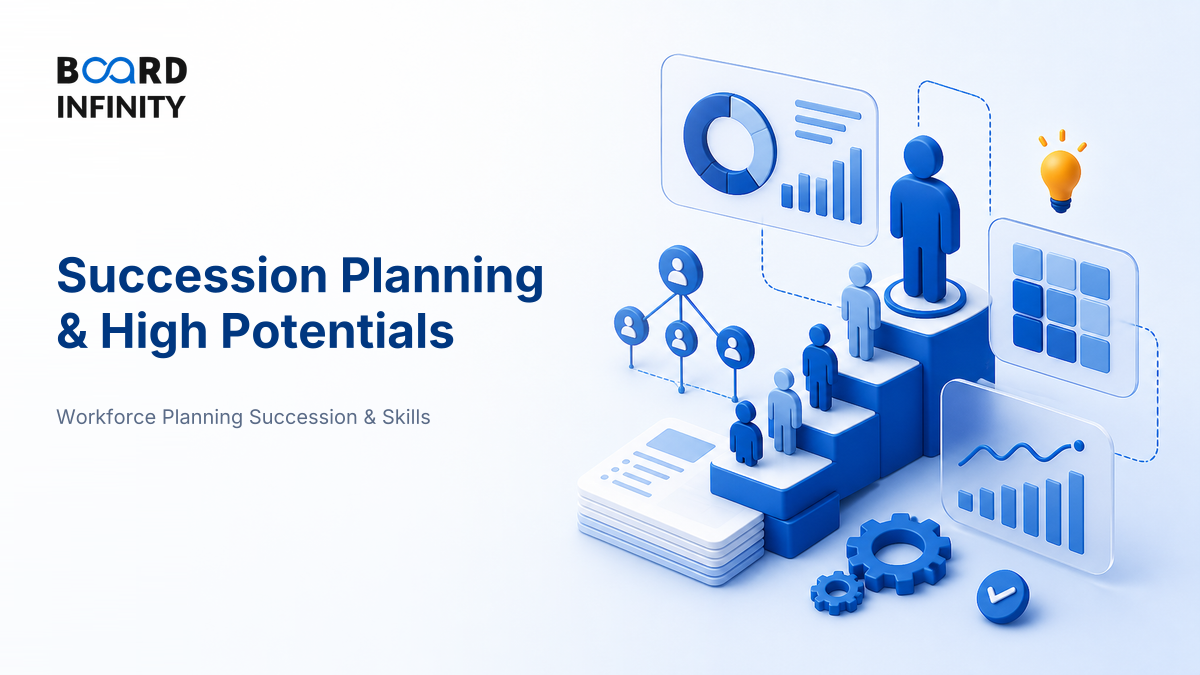
A large Indian company does not discover its next CEO on the day the current one resigns. Years earlier, someone quietly mapped the critical roles, watched who handled bigger mandates, tested successors in stretch assignments, and kept a board-ready slate warm.
That invisible discipline is succession planning. Done well, it makes leadership change look calm; done badly, one resignation can expose years of talent neglect.
- Succession planning is the systematic identification, development, and readiness tracking of successors for critical roles.
- High potentials are not just high performers; they show ability, aspiration, learning agility, values fit, and readiness for larger roles.
- The core distinction: performance is current delivery, potential is capacity for bigger roles, and readiness is timing.
- Use the 9-box logic: performance on one axis, potential on the other, then calibrate with evidence.
- Strong succession systems track coverage ratio, internal fill rate, HiPo retention, readiness depth, diversity of slates, and time to productivity.
- The biggest interview trap is calling your best current performer a successor without proving future-role fit.
Big Picture: Succession Is a Leadership Risk Funnel
Think of succession planning as a funnel that converts a broad talent pool into a small, evidence-backed bench of ready successors for roles that truly matter. The goal is not to label people permanently; it is to reduce business risk by making leadership continuity visible.
Performance, Potential and Readiness: The Three-Part Diagnosis
Most candidates mix these up. In HR language, they are different decisions:
- Performance answers: “Has this person delivered in the current role?”
- Potential answers: “Can this person handle a bigger, more ambiguous, more complex role?”
- Readiness answers: “When could this person take over, and what must change first?”
How to Identify High Potentials Without Guesswork
A strong HiPo call should be evidence-based, not a popularity contest. Look for signals across five dimensions:
In 2024, Wipro appointed Srinivas Pallia as CEO and MD after Thierry Delaporte stepped down. Pallia had spent decades within Wipro and had led major business responsibilities, including a large Americas-focused unit. The so what: internal succession works when the company has both a tested leader and enough governance discipline to make the transition credible.
Metrics That Tell You Succession Planning Is Working
No single number proves succession health. A good HR answer uses a small dashboard because succession is about coverage, readiness, movement, retention, and fairness.
Use these metrics carefully. A company can have high succession coverage on paper but weak readiness if successors have never handled scale, crisis, P&L, or stakeholder pressure.
Definitions You Can Say in One Breath
SHRM: “Succession planning is a process for identifying and developing new leaders who can replace old leaders when they leave, retire or die.”
High potential: An employee with the ability, aspiration, and learning agility to succeed in larger, more complex, critical roles.
Talent review: A structured leadership discussion that compares talent, readiness, risk, and development actions across teams.
Larsen & Toubro: A Quiet Indian Case of Planned Leadership Continuity
L&T shows how a complex Indian conglomerate can reduce leadership risk through internal grooming, phased transition, and board-level succession discipline.
Core Explanation: What Succession Planning Actually Involves
Succession planning starts with the role, not the person. A weak system asks, “Who do we like?” A strong system asks, “Which roles create maximum business risk if vacant, and what capabilities will those roles need next?”
Four terms matter in almost every interview answer:
- Critical role: A role whose vacancy would seriously affect strategy, revenue, operations, governance, or customer trust.
- Successor: A person identified as a credible future option for a critical role.
- High potential: An employee assessed as capable of growing into larger, more complex, critical roles faster than peers.
- Readiness: The estimated time and development needed before a person can perform the target role effectively.
The 5-Step Succession Planning Process
Performance, Potential and Readiness: The Three-Part Diagnosis
Most candidates mix these up. In HR language, they are different decisions:
- Performance answers: “Has this person delivered in the current role?”
- Potential answers: “Can this person handle a bigger, more ambiguous, more complex role?”
- Readiness answers: “When could this person take over, and what must change first?”
How to Identify High Potentials Without Guesswork
A strong HiPo call should be evidence-based, not a popularity contest. Look for signals across five dimensions:
In 2024, Wipro appointed Srinivas Pallia as CEO and MD after Thierry Delaporte stepped down. Pallia had spent decades within Wipro and had led major business responsibilities, including a large Americas-focused unit. The so what: internal succession works when the company has both a tested leader and enough governance discipline to make the transition credible.
Metrics That Tell You Succession Planning Is Working
No single number proves succession health. A good HR answer uses a small dashboard because succession is about coverage, readiness, movement, retention, and fairness.
Use these metrics carefully. A company can have high succession coverage on paper but weak readiness if successors have never handled scale, crisis, P&L, or stakeholder pressure.
Definitions You Can Say in One Breath
SHRM: “Succession planning is a process for identifying and developing new leaders who can replace old leaders when they leave, retire or die.”
High potential: An employee with the ability, aspiration, and learning agility to succeed in larger, more complex, critical roles.
Talent review: A structured leadership discussion that compares talent, readiness, risk, and development actions across teams.
Larsen & Toubro: A Quiet Indian Case of Planned Leadership Continuity
L&T shows how a complex Indian conglomerate can reduce leadership risk through internal grooming, phased transition, and board-level succession discipline.
Core Explanation: What Succession Planning Actually Involves
Succession planning starts with the role, not the person. A weak system asks, “Who do we like?” A strong system asks, “Which roles create maximum business risk if vacant, and what capabilities will those roles need next?”
Four terms matter in almost every interview answer:
- Critical role: A role whose vacancy would seriously affect strategy, revenue, operations, governance, or customer trust.
- Successor: A person identified as a credible future option for a critical role.
- High potential: An employee assessed as capable of growing into larger, more complex, critical roles faster than peers.
- Readiness: The estimated time and development needed before a person can perform the target role effectively.
The 5-Step Succession Planning Process
Succession planning is a cycle because roles, people, and strategy keep changing.Succession planning is a cycle because roles, people, and strategy keep changing.Role RiskWhich roles matter?TalentAssessmentEvidence, not opinionCalibrationCompare acrossteamsDevelopmentStretch and coachingRefreshUpdate slatesSuccession planning is a cycle because roles, people, and strategy keep changing.
Performance, Potential and Readiness: The Three-Part Diagnosis
Most candidates mix these up. In HR language, they are different decisions:
- Performance answers: “Has this person delivered in the current role?”
- Potential answers: “Can this person handle a bigger, more ambiguous, more complex role?”
- Readiness answers: “When could this person take over, and what must change first?”
The 9-box logic separates current performance from future leadership capacity.The 9-box logic separates current performance from future leadership capacity.Core ExpertHigh delivery, specialist pathFuture LeaderInvest and exposeMismatchFix role or skillsEmerging BetWatch and coachPotentialPerformanceThe 9-box logic separates current performance from future leadership capacity.
How to Identify High Potentials Without Guesswork
A strong HiPo call should be evidence-based, not a popularity contest. Look for signals across five dimensions:
In 2024, Wipro appointed Srinivas Pallia as CEO and MD after Thierry Delaporte stepped down. Pallia had spent decades within Wipro and had led major business responsibilities, including a large Americas-focused unit. The so what: internal succession works when the company has both a tested leader and enough governance discipline to make the transition credible.
Metrics That Tell You Succession Planning Is Working
No single number proves succession health. A good HR answer uses a small dashboard because succession is about coverage, readiness, movement, retention, and fairness.
Use these metrics carefully. A company can have high succession coverage on paper but weak readiness if successors have never handled scale, crisis, P&L, or stakeholder pressure.
Definitions You Can Say in One Breath
SHRM: “Succession planning is a process for identifying and developing new leaders who can replace old leaders when they leave, retire or die.”
High potential: An employee with the ability, aspiration, and learning agility to succeed in larger, more complex, critical roles.
Talent review: A structured leadership discussion that compares talent, readiness, risk, and development actions across teams.
Larsen & Toubro: A Quiet Indian Case of Planned Leadership Continuity
L&T shows how a complex Indian conglomerate can reduce leadership risk through internal grooming, phased transition, and board-level succession discipline.
[[GOLD-IMAGE: A Mumbai engineering project office at dusk, senior and younger managers reviewing large infrastructure blueprints on a table, deep blue accents, hard hats and steel bridge models, no logos or readable text | caption: Succession planning is most visible when a complex business keeps moving smoothly while leadership changes.
Situation: Larsen & Toubro is not a simple single-product company. It operates across engineering, construction, infrastructure, technology, and manufacturing-linked businesses. Leadership continuity matters because the CEO must understand large projects, capital allocation, government and enterprise customers, risk, and long-cycle execution.
The move: L&T managed leadership transition over time rather than through a sudden search. A.M. Naik's leadership responsibilities were gradually transitioned, and S.N. Subrahmanyan, who had deep operating experience within the group, rose through major responsibilities before taking over as CEO and MD and later becoming chairman and managing director. For a listed Indian company, this also sits within formal board governance, including nomination and remuneration committee oversight under SEBI listing expectations.
The lesson: The primary driver was deep internal grooming through operating roles. Supporting drivers included phased handover, board governance, exposure to complex businesses, and continuity of strategic priorities. This is why succession planning is not merely replacement planning; it is a risk-management system for leadership capability.
Interview takeaway: L&T proves that succession success usually comes from a system - operating exposure as the primary driver, supported by governance, calibration, and phased transition.
How AI Changes Succession Planning & Identifying High Potentials
AI does not replace leadership judgment, but it changes the evidence base behind succession decisions.
- Skills intelligence becomes sharper: Platforms such as Workday, Eightfold AI, and Gloat can infer skills from roles, projects, learning records, and career moves, helping HR identify hidden successors beyond manager nominations.
- Succession risk becomes more predictive: AI can flag critical roles with low bench strength, retirement risk, attrition risk, or overdependence on one successor, so HR can intervene earlier.
- Talent reviews become better prepared: Generative AI can summarize performance evidence, career history, learning gaps, and development actions before calibration meetings. The caution is bias: AI trained on biased past promotions can repeat the same pattern unless audited.
Load a company annual report, leadership bios, and recent news into NotebookLM. Ask: “Identify critical leadership roles, possible succession risks, and evidence of internal bench strength.” Then convert the output into a 5-point interview answer using ChatGPT or Claude.
Interview Relevance
“How would you design a succession planning process for a fast-growing Indian company, and how would you identify high-potential employees?”
If asked for an example, use L&T for planned Indian leadership continuity or Wipro's 2024 internal CEO appointment to show internal bench strength.
Common Mistake
Mistake: Equating high performance with high potential. A top salesperson, coder, or plant manager may be excellent in the current role but not ready for a broader leadership role requiring ambiguity, people leadership, governance, and strategic judgment. Fix: Always separate performance, potential, and readiness before recommending a successor.
What to Revise Next
Move next from succession planning into the tools and workforce choices that make it operational.