
Sum-of-the-Parts (SOTP) Valuation Explained
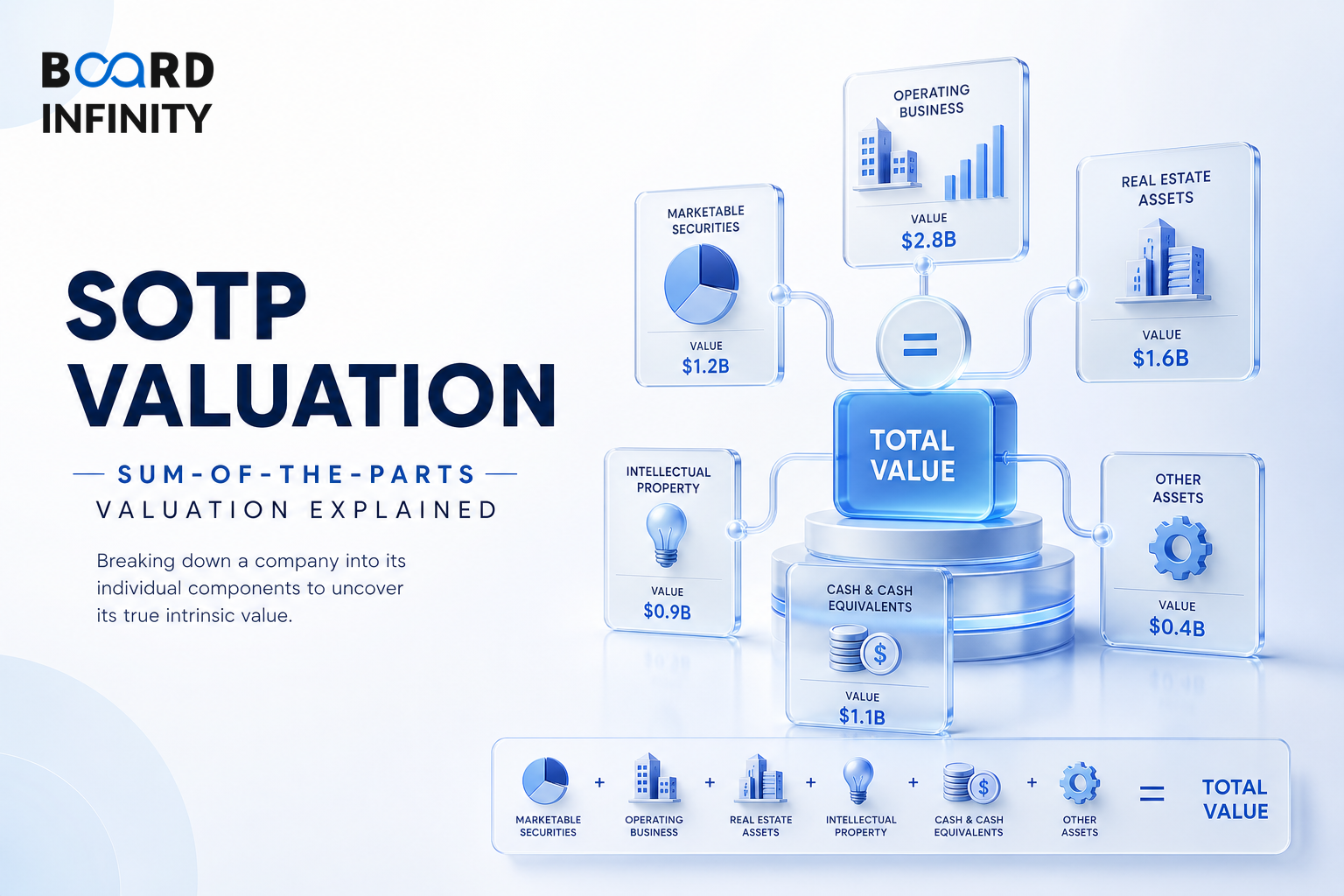
After Precedent Transaction Analysis, which values a target company based on multiples paid in past M&A deals for similar companies, SOTP answers a different valuation question: what if the company itself has diverse, non-comparable business segments? Sum-of-the-Parts valuation matters in interviews because Indian conglomerates like ITC Ltd and Reliance Industries cannot be valued cleanly using one blended multiple.
- Sum-of-the-Parts (SOTP) is used for conglomerates with diverse, non-comparable business segments.
- Each business unit is valued independently using the most appropriate method, then summed.
- ITC Ltd uses different methods across Cigarettes (FMCG), Hotels, Agribusiness/Paperboards/Others, and FMCG (Foods, Personal Care).
- Reliance Industries uses different methods across O2C (Oil-to-Chemicals), Jio (Telecom), and Retail.
- The holding company often trades at a conglomerate discount of 15-30% to the sum of parts.
- The discount is due to complexity, inter-company transactions, and minority shareholder concerns.
How SOTP Fits the Valuation Problem
SOTP is the practical approach when a company has segments that do not belong in one peer set. The big picture is simple: value each segment with the most appropriate method, add the values, and then consider whether the holding company should trade at a conglomerate discount.
SOTP is used for conglomerates with diverse, non-comparable business segments. Each business unit is valued independently using the most appropriate method, then summed.
Why One Multiple Does Not Work
A conglomerate can contain businesses with very different economics, growth profiles, and appropriate valuation methods. In SOTP, the Cigarettes (FMCG), Hotels, Agribusiness/Paperboards/Others, and FMCG (Foods, Personal Care) segments of ITC Ltd are not forced into one valuation approach.
The same logic applies to Reliance Industries. O2C (Oil-to-Chemicals), Jio (Telecom), and Retail are valued separately because each segment uses a different valuation method and has a different weight in total value.
ITC Ltd as an SOTP Example
ITC Ltd shows why SOTP is useful for diverse, non-comparable business segments. Cigarettes (FMCG) are valued using P/E 25x on segment earnings, Hotels are valued using EV/EBITDA 18x, Agribusiness/Paperboards/Others use EV/EBITDA 10-12x, and FMCG (Foods, Personal Care) uses EV/Revenue 4x with a growth premium.
The indicative EVs also show why segment weight matters. Cigarettes (FMCG) contribute ₹2,80,000 Cr and ~55% of total value, while FMCG (Foods, Personal Care) contributes ₹1,50,000 Cr and ~30%.
Reliance Industries as an SOTP Example
Reliance Industries is another case where SOTP is particularly relevant. O2C (Oil-to-Chemicals) is valued at EV/EBITDA 8x with indicative EV of ₹8,00,000 Cr, Jio (Telecom) is valued at EV/EBITDA 15x or DCF with indicative EV of ₹9,50,000 Cr, and Retail is valued at EV/EBITDA 40x with indicative EV of ₹6,50,000 Cr.
The weights in total value are also different: O2C (Oil-to-Chemicals) is ~33%, Jio (Telecom) is ~40%, and Retail is ~27%. That is exactly why SOTP values each business unit independently using the most appropriate method, then sums the parts.
Conglomerate Discount
SOTP is particularly relevant for Indian conglomerates like Reliance, Tata Group companies, and Mahindra Group. The key insight: the holding company often trades at a conglomerate discount of 15-30% to the sum of parts, due to complexity, inter-company transactions, and minority shareholder concerns.
In an interview, this nuance is important because SOTP does not stop at adding segment values. A possible conglomerate discount may be needed when the market values the holding company below the clean sum of individually valued businesses.
Structuring a Sum Interview Answer
"How would you value a conglomerate like ITC Ltd or Reliance Industries where the business segments are diverse and non-comparable?"
The strongest answers do not apply one blended multiple to the whole company. They show why each segment needs its own method before discussing the possible conglomerate discount.
The most frequent error is valuing a conglomerate as if all segments are comparable. This costs points because SOTP is specifically used when business segments are diverse and non-comparable, and each business unit should be valued independently using the most appropriate method.
Conclusion
SOTP valuation is the right approach for conglomerates where no single multiple captures the full business mix. Value each segment independently, sum the parts, and remember that the holding company may trade at a 15-30% conglomerate discount.