
Importance of Banks: Role of Banking System in Economy, Business & Development
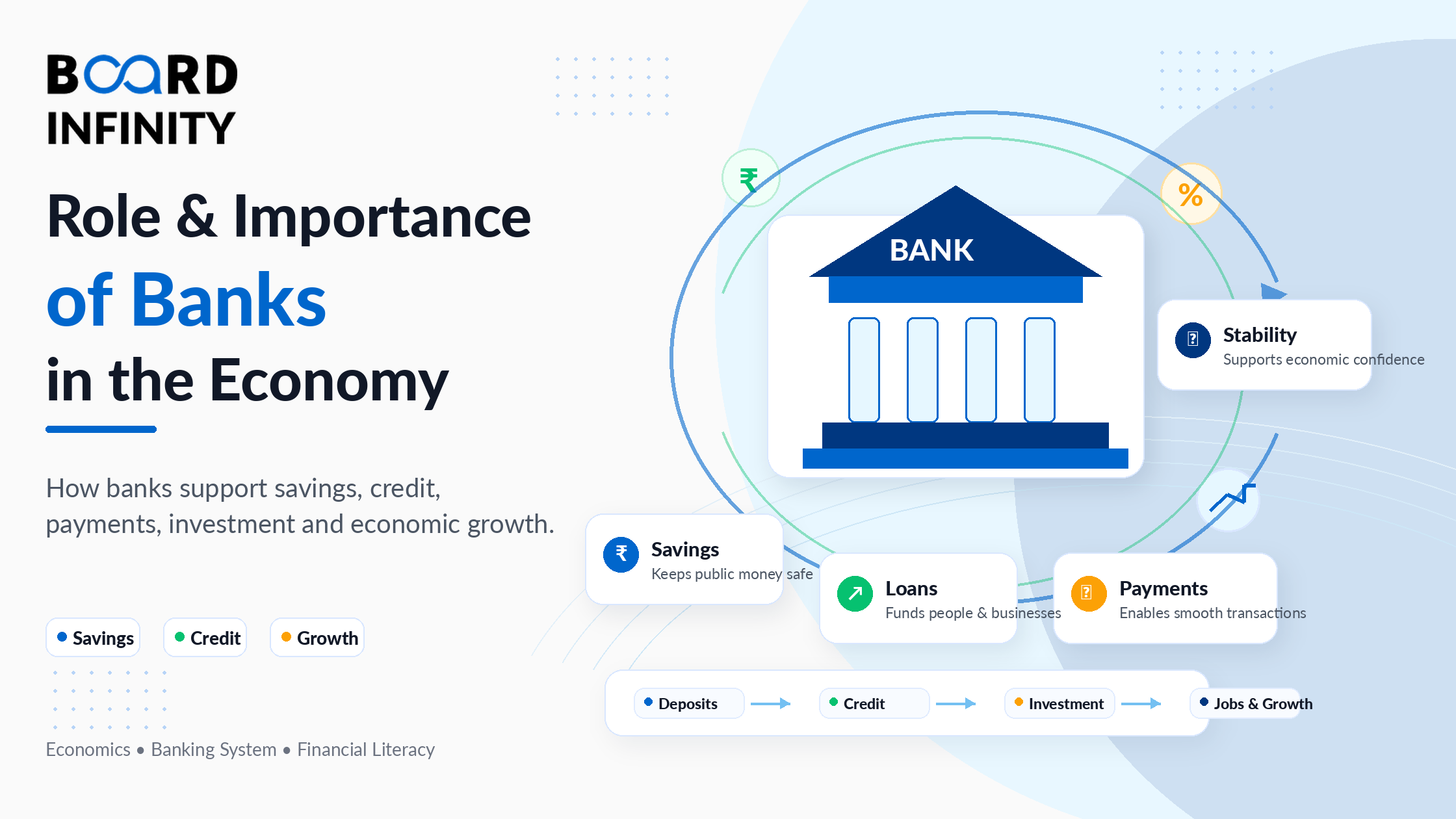
Every rupee deposited in a savings account, every home loan approved, every startup that receives working capital - none of it happens without banks. Yet most people interact with banks only at the surface level: depositing salaries, paying bills, taking loans. The deeper role that banks play in an economy goes far beyond these individual transactions.
The importance of banks in any economy is structural. Banks are the mechanism through which savings become investments, through which individuals access capital they do not yet have, and through which governments fund infrastructure that entire nations depend on. When the banking system functions well, economies grow. When it falters - as the world witnessed in 2008 - the consequences ripple across every sector.
This guide covers the complete role of the banking system in the economy: what banks actually do, why they matter for businesses, how they drive economic development in India, and why understanding banking is essential knowledge for finance professionals, students, and anyone building a career in business. If you want to start with the fundamentals before going further, Board Infinity's introduction to banking provides the foundation that underpins everything covered here.
Who This Guide Is For
What is a Bank? Core Definition and Purpose
A bank is a licensed financial institution that accepts deposits from the public, channels those deposits into loans and investments, and provides a wide range of financial services to individuals, businesses, and governments. Banks operate as financial intermediaries - the critical bridge between those who have surplus capital (depositors and savers) and those who need capital (borrowers, businesses, and governments).
This intermediation function is the single most important role a bank performs. Without it, a person with savings would have no safe, productive way to deploy them. A business with a profitable idea but no capital would have no way to fund it. A government planning infrastructure would have no mechanism to finance it. Banks solve all three problems simultaneously - and in doing so, they become the circulatory system of a modern economy.
Types of Banks in India
Understanding the importance of banks requires knowing that different types of banks serve different economic functions. India has a multi-tiered banking structure, each tier serving a distinct segment of the population and economy.
Core Functions of Banks
Before examining the role of the banking system in the economy at a macro level, it helps to understand the core functions that every bank performs. These functions are the building blocks through which banks generate their broader economic impact.
Importance of Banks in Economic Development
The role of banks in economic development operates through several distinct channels. Each channel represents a different way that banking activity translates into real economic outcomes - jobs, infrastructure, poverty reduction, and national income growth.
1. Capital Formation - Converting Savings into Investment
Capital formation is the process of converting savings into productive investment - and banks are the engine that drives it. When individuals deposit money, banks do not leave it idle. They channel it into loans to businesses that buy machinery, hire workers, and expand capacity. This flow from savings to productive investment is what economists call capital formation, and it is the foundation of long-run economic growth.
Board Infinity's guide to personal finance and investment planning explores how individuals can actively participate in this process - because every savings account opened and every mutual fund investment made contributes to the capital pool that banks deploy into the economy.
2. Credit Allocation to Priority Sectors
In India, the RBI mandates that commercial banks direct a minimum of 40% of their adjusted net bank credit to priority sectors - agriculture, micro and small enterprises, education, housing, and renewable energy. This Priority Sector Lending (PSL) requirement ensures that credit does not flow exclusively to large corporations and urban borrowers.
Through PSL, banks become instruments of inclusive economic development. Farmers access crop loans at subsidised rates. Small manufacturers access working capital to meet export orders. Students access education loans to pursue higher education without their family's savings being depleted. Each of these flows represents banks performing a development function that the market alone would not deliver.
3. Financial Inclusion - Reaching the Unbanked
One of India's most significant economic challenges has been financial exclusion - large sections of the population, particularly in rural areas, operating entirely outside the formal financial system. Without a bank account, people cannot save safely, cannot access credit, cannot receive government benefits directly, and cannot participate in the digital economy.
The Pradhan Mantri Jan Dhan Yojana (PMJDY), launched in 2014, opened over 530 million bank accounts in a decade - the world's largest financial inclusion initiative. By bringing these populations into the banking system, India dramatically expanded the base of people who could access credit, insurance, and government transfers. Banks - especially public sector banks and payments banks - were the delivery mechanism for this transformation.
4. Infrastructure Financing
Large-scale infrastructure - highways, ports, power plants, airports, metro systems - requires capital at a scale and tenure that individual investors cannot provide. Banks, particularly development banks like NABARD, NHB, and SIDBI, along with large commercial banks, provide the long-term project finance that makes these projects possible.
Public-Private Partnerships (PPPs) in India's infrastructure sector - from the Delhi Metro to national highway projects - are structured around bank-provided debt. Without long-term bank financing, these projects either do not happen or are funded entirely by government borrowing, which crowds out private investment. Banks provide the third option: structured, long-tenor project loans that match the economics of infrastructure assets.
5. Employment Generation
Banks contribute to employment in two ways. Directly, India's banking sector employs over 1.5 million people across public and private banks, making it one of the largest formal sector employers in the country. Indirectly - and far more significantly - banks create employment by funding the businesses that hire workers.
Every small business loan enables the borrower to hire staff. Every working capital facility keeps a factory running and its workers employed. Every home loan creates construction activity that employs labourers, electricians, plumbers, and contractors. The employment multiplier from bank lending is substantially larger than direct bank employment. Understanding investment banking reveals another dimension of this - how capital markets access, enabled by banks, allows large companies to expand operations and create employment at scale.
6. Monetary Policy Transmission
Central banks set interest rates and money supply targets, but these policy decisions only reach the real economy through commercial banks. When the RBI cuts the repo rate, commercial banks are expected to pass this reduction on as lower lending rates to businesses and consumers. When the RBI raises rates to control inflation, banks raise their lending rates, reducing credit demand and cooling the economy.
This transmission mechanism - from RBI policy to bank rates to real economic activity - is why the health and competitiveness of the banking sector matters so much to macroeconomic management. A banking sector with high non-performing assets (NPAs) or weak capital buffers transmits monetary policy less efficiently, reducing the RBI's ability to steer the economy.
Role of Bank in Business
For businesses, banks are not just lenders - they are financial partners that enable operations, manage risk, and facilitate growth at every stage of the business lifecycle. The role of bank in business spans from the day a startup opens its first current account to the moment a large corporation accesses international capital markets.
Role of Banking System in Economy: Summary View
The Importance of a Healthy Banking Sector
The importance of banks extends beyond their individual functions to the systemic health of the entire financial ecosystem. A well-capitalised, low-NPA banking sector transmits monetary policy efficiently, extends credit confidently, and supports economic expansion. A banking sector weakened by bad loans, governance failures, or regulatory deficiencies does the opposite - it constricts credit, raises lending rates, and becomes a drag on growth rather than an engine of it.
India's experience with the NPA crisis between 2015 and 2019 - when gross NPAs of public sector banks peaked at over 11% of total advances - demonstrated exactly how a stressed banking system can hamper economic growth. Bank recapitalisation programs like the Insolvency and Bankruptcy Code (IBC) and the Rs. 2.11 lakh crore bank recapitalisation package were necessary precisely because the importance of banks to the economy meant that allowing them to remain weak was not an option.
For professionals building careers in banking and finance, Board Infinity's guide on introduction to equity investing provides the investor perspective on how banking sector health flows through to equity valuations - a critical connection for anyone in investment analysis or portfolio management.
Conclusion
The importance of banks in any economy cannot be overstated. They are simultaneously deposit takers, credit providers, payment facilitators, monetary policy transmitters, financial inclusion vehicles, and business partners. Remove banks from the economic equation and you are left with an informal, slow, inequitable system where only the wealthy can access capital and only large players can participate in trade.
Three things to take away: first, the role of banks in economic development is not passive - banks actively shape which sectors grow, which businesses survive, and which populations access formal finance. Second, the role of bank in business is comprehensive - from day-one working capital to international capital markets access, every stage of business growth has a corresponding banking product. Third, the health of the banking system and the health of the economy are inseparable - which is why banking sector regulation, capitalisation, and governance are permanent features of economic policy.
Whether you are building a career in banking, studying for competitive exams, or running a business, understanding how the banking system works gives you a structural understanding of how economies actually function. Board Infinity's comprehensive resources on mutual funds and investment banking strategies are the natural next steps for deepening your financial knowledge.
Understanding these dynamics is crucial for students of economics who wish to grasp the intricacies of financial systems. For more detailed guidance and insights on economic principles and the role of banks, consider enrolling in specialized Economics Tuition.
Frequently Asked Questions
Q1. What is the importance of banks in the economy? Banks are the financial intermediaries that mobilise savings, allocate credit, facilitate payments, transmit monetary policy, and drive capital formation. Their importance lies in the fact that without banks, savings cannot efficiently reach productive investment, businesses cannot access working capital, and governments cannot fund infrastructure.
Q2. What is the role of banks in economic development? Banks drive economic development through capital formation, priority sector lending, financial inclusion, infrastructure finance, employment generation, and supporting SME growth. In India, the banking system is also a key tool for delivering government welfare programs like Jan Dhan, Direct Benefit Transfer, and MUDRA loans.
Q3. What is the role of the banking system in the economy? The banking system performs five core economic functions: mobilising savings, allocating credit, providing payment infrastructure, transmitting monetary policy, and enabling international trade. The stability of the banking system is directly linked to the stability of the broader economy.
Q4. What is the role of bank in business? Banks support businesses through working capital facilities, term loans for capital expenditure, trade finance (Letters of Credit and bank guarantees), foreign exchange management, cash management services, and investment banking advisory. Without banks, most businesses could not bridge cash flow gaps, fund expansion, or trade internationally.
Q5. What is Priority Sector Lending (PSL) in India? PSL is the RBI's mandate that commercial banks direct at least 40% of their adjusted net bank credit to specified priority sectors - agriculture, micro and small enterprises, education, housing, and renewable energy. PSL ensures that credit flows to sectors that the market alone might underfund, supporting inclusive economic development.
Q6. How do banks contribute to financial inclusion? Banks extend financial inclusion by opening accounts for unbanked populations, providing microfinance and small loans, operating in rural areas through branch networks and business correspondents, and enabling mobile and digital banking. India's Jan Dhan Yojana used banks as the primary vehicle to open over 530 million accounts for previously unbanked citizens.
Q7. How does the RBI use banks to implement monetary policy? The RBI uses tools like repo rate, CRR, SLR, and open market operations to control money supply and inflation. Commercial banks are the transmission channel - when the RBI changes rates, banks adjust their lending and deposit rates, which in turn affects consumer and business borrowing behaviour and the pace of economic activity.
Further Reading
Board Infinity Guides:
- Introduction to Banking
- Personal Finance and Investment Planning
- Introduction to Equity Investing
- A Deep Dive into Mutual Funds
- Mastering the Art of Investment Banking
- A Comprehensive Guide to Investing and Insurance
- Introduction to Goal Setting and Risk Profiling
External Resources:
- Reserve Bank of India - Role of Banks in Economic Development - RBI's official publications on monetary policy, priority sector lending, and financial inclusion data for India
- World Bank - Financial Inclusion Overview - authoritative global data on how banking access correlates with poverty reduction and economic growth
- IMF - Banking and the Economy - International Monetary Fund research on banking sector health and its relationship to macroeconomic stability