
Top-Down Guesstimate: India's Bottled Water Market
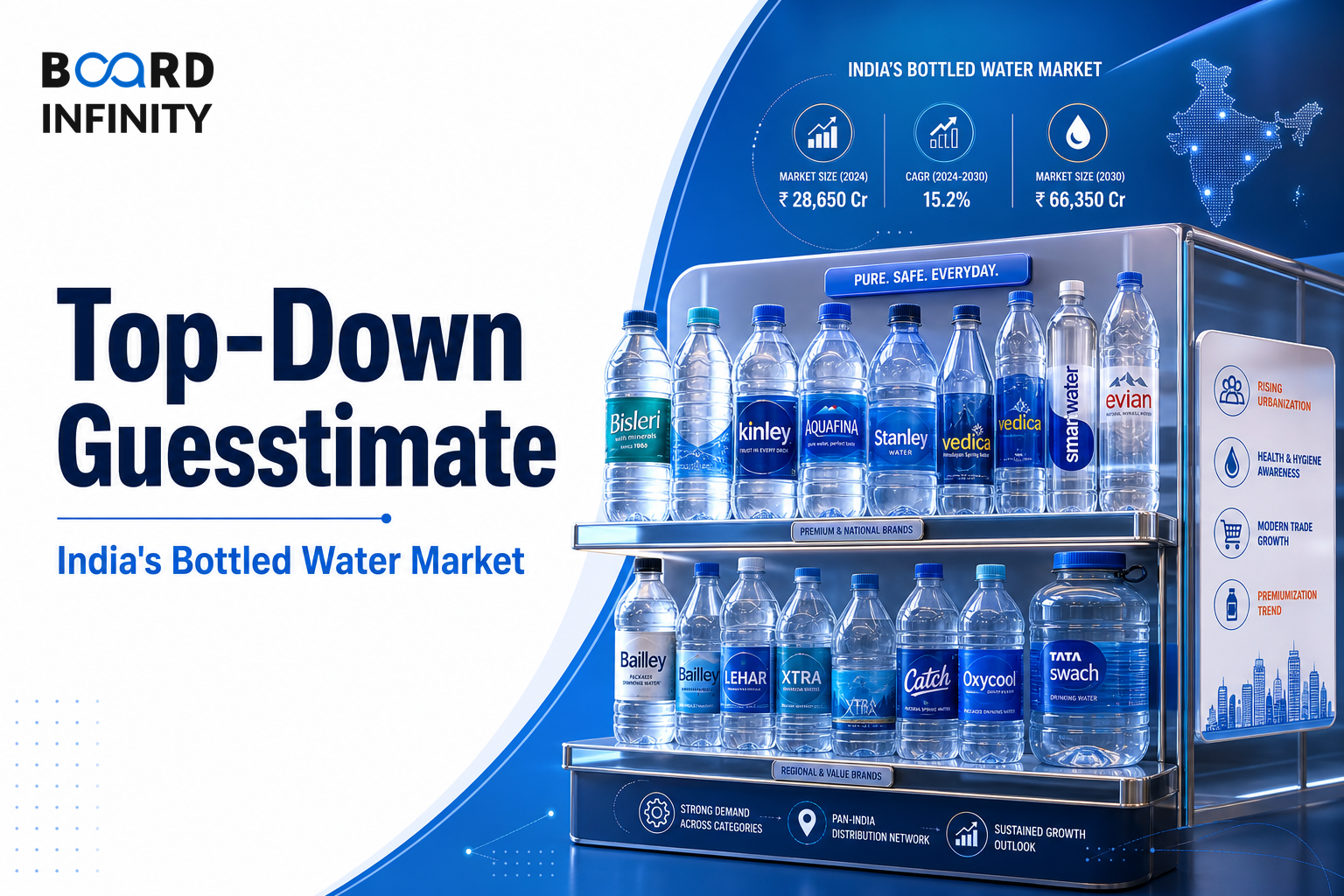
Top-down guesstimates are useful when the market can be anchored to a clean macro number and narrowed through logical filters. India's bottled water market is a strong example because the estimate can start with population, split urban and rural consumers, estimate litres consumed, and convert volume into revenue. This matters in interviews because the interviewer is not only testing arithmetic, but also whether your assumptions, scope and sanity checks are defensible.
- A top-down approach starts from a broad anchor, such as India's population, and narrows it to the relevant consumer base.
- For this case, the scope is all-India, FY26 annual revenue, retail 200ml-2L PET bottles, excluding 20L home jars and pouches.
- The demand tree is: population × active consumer share × litres per consumer × average ₹/litre realisation.
- The worked estimate uses 145 cr population, 38% urban share, 60% active urban consumers and 15% active rural consumers.
- Estimated volume is 725 cr litres: 660 cr litres from urban consumers and 65 cr litres from rural consumers.
- At ₹16/litre average realisation, the revenue estimate is about ₹11,600 cr, expressed as a final range of ₹10,000-₹13,000 cr.
- The sanity check is strong because 725 cr litres implies about 5 L/person/year, within the 4-6 L/person band cited by IBEF and industry reports.
The Big Picture: How the Top-Down Estimate Fits Together
Before calculating, show the interviewer the full logic. The top-down approach works here because population is a clean anchor and active bottled-water consumers can be estimated through simple percentage filters.
Market revenue = Population × Active consumer share × Annual litres per consumer × Average ₹/litre realisation. In this case, the formula is applied separately to urban and rural India, then added together.
Clarify the Scope Before Estimating
The situation is to size India's bottled water market for retail 200ml-2L packs in FY26 annual revenue. FY26 means financial year 2026. PET means polyethylene terephthalate, the plastic commonly used for retail water bottles.
The scope is all-India, including urban and rural demand. It excludes 20L home jars and pouches because those are different formats with different consumption patterns and price realisations. The output is in ₹ crore, where one crore equals 10 million.
This first step prevents a common interview problem: mixing retail bottles with bulk jars. A 1L bottle bought during travel and a 20L home jar used for household supply are both "water", but they are not the same market for this estimate.
What Makes This a Top-Down Case
A top-down approach begins with a broad macro base and narrows it through filters. Here, the macro base is India's total population of 145 cr, and the key filter is active bottled-water consumers.
This is appropriate because bottled water usage can be tied to people and their annual consumption. The method would be weaker for a market without a clean population anchor. The source gives industrial lubricants as an example where top-down can collapse at step 1 because the relevant base is not simply population.
The most important nuance is that top-down estimates compound errors when too many percentages are multiplied in a row. In this case, the tree stays relatively clean: population, urban-rural split, active consumer share, litres per consumer and price per litre.
Build the Demand Tree
The tree has four layers. Start with population, split it into urban and rural, estimate active consumers in each segment, then apply annual litres and price. The split matters because urban consumers are heavier users, while rural consumers are lighter users mostly during travel, weddings, events and transit.
Notice that the tree avoids assuming one national average too early. A single average could hide the difference between a metro consumer who buys bottled water repeatedly and a rural consumer who buys it only during specific occasions.
Do the Math Cleanly
The arithmetic should be simple enough to explain aloud. First estimate urban volume: 33 cr active urban consumers × 20 L/year = 660 cr litres. Then estimate rural volume: 13 cr active rural consumers × 5 L/year = 65 cr litres.
Total volume is therefore 660 + 65 = about 725 cr litres. Revenue is then 725 cr litres × ₹16/litre = about ₹11,600 cr. A defensible final answer is ₹10,000-₹13,000 cr annual revenue because guesstimates should usually be presented as a range, not a false-precision point estimate.
Use the exact calculation to anchor the answer, then present a range around it: ₹11,600 cr becomes a final estimate of ₹10,000-₹13,000 cr.
Worked Example: India Bottled Water Revenue
The decision to split urban and rural demand is the core of the case. Without it, the estimate would either overstate rural consumption or understate urban consumption. In an interview, this is where you show commercial judgement rather than just multiplication.
Sanity Check the Answer
A strong guesstimate does not stop at the first revenue number. It validates the result using a different lens. Here, the best check is per-capita volume: 725 cr litres ÷ 145 cr people = about 5 L/person/year.
The source states that real-world IBEF, or India Brand Equity Foundation, and industry reports put India at 4-6 L/person/year. The estimate sits inside that credible band. The ₹11,600 cr revenue estimate is also consistent with published estimates of ₹10,000-₹14,000 cr.
This is the difference between an answer that is merely calculated and an answer that is interview-ready. The interviewer wants to see that your estimate is not floating in isolation.
How to Cross-Check If Time Allows
Strong candidates often solve the same problem two ways, or at least explain how they would cross-check it. The source describes this as the rigour move: compare a demand-side estimate with a supply-side estimate, then use the gap as a confidence signal.
For the bottled water case, the worked solution is demand-side top-down. If there is time, you can tell the interviewer that you would cross-check it using supply-side production and trade data. Even naming the unused approach and why you did not calculate it can earn credit because it shows awareness of limitations.
When Top-Down Quietly Fails
Top-down is powerful, but it is not always the right tool. It works best when the starting base is clear and the filters are simple. It becomes risky when the segment is a tiny percentage of a huge base or when there is no clean macro anchor.
The practical lesson is not that top-down is always better. The lesson is that it is the right primary method when the market naturally maps to population, households or another macro anchor. Bottled water retail packs fit that condition well.
Structuring a Top Interview Answer
"Size India's bottled water market for retail 200ml-2L PET packs in FY26 annual revenue."
The main way candidates lose points is by jumping into math before locking scope. Say what you are excluding, especially 20L home jars and pouches, and mention how you would cross-check with a supply-side estimate if time allowed.
The most frequent error is treating all Indians as equal bottled-water consumers and applying one average consumption number to the entire 145 cr population. That hides the urban-rural usage difference, weakens the logic, and can push the final revenue outside a defensible range.
Conclusion
A strong top-down bottled water estimate starts with population, filters to active consumers, estimates litres by segment, converts volume into revenue and then validates the result. The final answer of ₹10,000-₹13,000 cr matters less than the disciplined structure that makes it defensible in an interview.