
What Supply Chain Risk Actually Looks Like
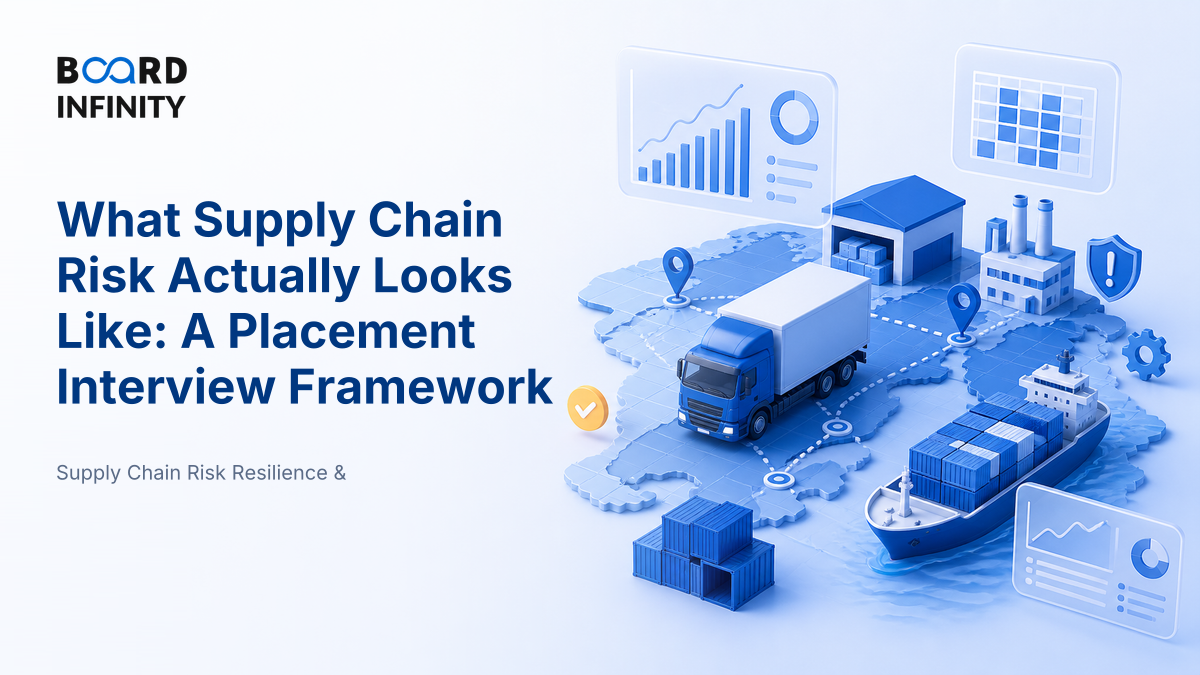
What actually breaks when a supplier says, “Dispatch is delayed”? Usually not just one purchase order. A factory schedule slips, a sales promise weakens, finance sees working capital move, and the customer experiences the risk as an empty shelf or a late delivery.
- Supply chain risk is uncertainty that disrupts material, information, cash, or compliance flows and hurts cost, service, quality, or continuity.
- Risk becomes visible through a chain: trigger - exposure - propagation - business impact - response.
- The best answers separate risk source from business consequence. “Flood” is a trigger; “line shutdown” is the impact.
- Use a 2x2 matrix: low/high likelihood vs low/high impact. High-impact risks need mitigation even if probability is low.
- Track risk with OTIF, supplier concentration, lead-time variability, TTS/TTR ratio, expedite cost, and closure time of risk actions.
- Strong candidates say how to respond: avoid, reduce, transfer, buffer, dual-source, redesign, or create a contingency plan.
- The common mistake is listing disasters without showing the exposed node, ripple path, and business decision.
Big Picture: Risk Is a Chain, Not a Headline
A news headline says “port congestion” or “supplier shutdown.” A supply chain manager asks: which node is exposed, how fast will the shock travel, what customer promise is at risk, and what response buys time?
Core Explanation: What Supply Chain Risk Actually Looks Like
Supply chain risk is the possibility that uncertainty disrupts the flow of goods, services, information, money, or compliance across the network.
That means risk is not only a supplier going bankrupt. It can be a wrong demand forecast, a quality escape, a cyberattack on a logistics partner, a port delay, a regulatory change, a shortage of skilled drivers, or a single component sourced from one region.
Think of the supply chain as a living system with three layers:
Risk appears when one of these layers is fragile and a trigger hits it. A fragile node creates capacity risk. A fragile link creates lead-time or logistics risk. A fragile rule creates decision delay.
The Five Risk Types You Should Recognise Quickly
Most interview answers become sharper when you classify the risk first. Use these five buckets.
Notice the difference between risk source and risk consequence. “Supplier concentration” is a source. “Lost revenue from stockout” is a consequence. Great answers connect both.
The 2x2 Matrix: Which Risks Deserve Management Attention?
Not every risk deserves the same response. A low-impact delay should not receive the same energy as a low-probability event that can shut down the plant. The classic first cut is likelihood versus impact.
Use the quadrants like this:
- Monitor: low likelihood, low impact. Track with basic dashboards; avoid over-engineering.
- Control: high likelihood, low impact. Standardise work, reduce errors, improve daily execution.
- Contingency: low likelihood, high impact. Prepare playbooks, insurance, alternate lanes, emergency suppliers.
- Redesign: high likelihood, high impact. Change the network, product design, sourcing model, inventory policy, or customer promise.
This is where procurement and operations meet. If a risk is supplier-led, connect it to supplier risk, compliance and responsible sourcing. If the exposure comes from supplier capability or quality, the natural next lens is supplier selection, scorecards and evaluation.
How Risk Travels: The Ripple Effect
Risk rarely stays where it begins. A late inbound shipment can become overtime cost, then premium freight, then service failure, then lost trust with the customer.
This is why “we will expedite” is not a complete answer. Expedite cost may protect service today but hide deeper structural risk. A better answer asks whether the root problem is supplier concentration, poor visibility, weak contracts, bad forecasting, or insufficient buffers.
Apple’s supplier responsibility disclosures show a large global supplier base across multiple countries and manufacturing activities (Apple Supplier Responsibility). The strategic lesson is not simply “have many suppliers”; the primary driver is qualified manufacturing depth, supported by supplier development, product-process standardisation, and visibility into upstream operations. So what: resilience comes from a designed ecosystem, not a random list of backup vendors.
Definitions You Can Say in One Breath
- Risk: “effect of uncertainty on objectives” - ISO 31000 risk management definition (ISO 31000).
- Supply chain risk: uncertainty that disrupts supply chain flows and damages cost, service, quality, compliance, or continuity.
- Exposure: the vulnerable node, link, supplier, region, process, or policy through which a trigger can hurt performance.
- Resilience: the ability of a supply chain to absorb, recover from, and adapt after disruption.
- Time to recover: the time needed to restore a disrupted node or flow to acceptable performance.
Metrics: How to Track Supply Chain Risk
Use metrics to make risk concrete. The ranges below are interview rules of thumb, not universal benchmarks; industry, category criticality, and service model matter.
Worked Example: TTS vs TTR in 90 Seconds
A plant uses 500 controller units per day. It has 4,000 usable units in stock. The only approved supplier reports a disruption and says normal supply will resume in 12 days.
The insight: the risk is not “supplier disruption” in the abstract. The risk is a four-day survival gap on a critical component.
Case Study: Blinkit and the New Shape of Quick-Commerce Risk
Blinkit shows how supply chain risk changes when the customer promise shifts from “available this week” to “available near me, now.”
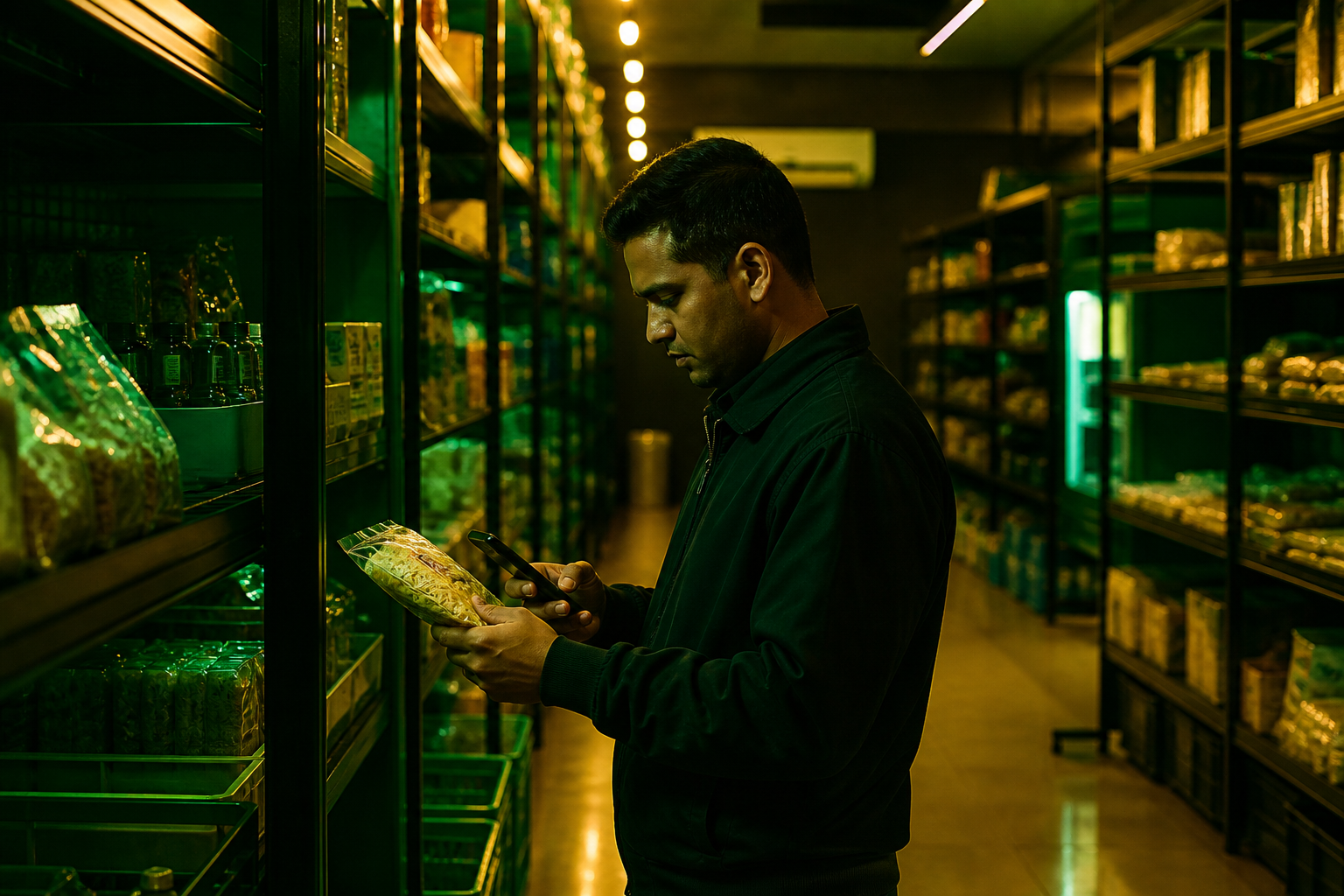
Situation. In quick commerce, the risk is not only whether inventory exists somewhere in the network. The real question is whether the right SKU is available in the right micro-market at the exact moment of demand. A stockout on a fast-moving item hurts conversion; overstock on perishables creates waste; inaccurate inventory creates a broken customer promise.
The move. Blinkit’s model uses a local dark-store network, curated assortment, frequent replenishment, real-time inventory visibility, and tight picking-dispatch routines. The primary driver of resilience is proximity inventory - stock positioned close enough to demand to protect speed. Supporting drivers include narrower assortment discipline, demand sensing by locality, replenishment cadence, substitution logic, rider availability, and store-level operating routines.
The lesson. Blinkit does not eliminate risk; it changes its shape. Traditional retail risk often sits in long replenishment cycles and store-level stockouts. Quick-commerce risk sits in micro-forecasting, inventory accuracy, dark-store execution, and last-mile capacity. A strong interview answer would say: the business model creates speed by holding inventory closer to the customer, but that increases the need for precise local planning and disciplined execution.
How AI Changes Supply Chain Risk
AI makes supply chain risk more visible, but it also creates new dependency risks. In 2026, the best managers use AI as a sensing and decision-support layer, not as a magic autopilot.
- Risk sensing becomes earlier: AI can scan supplier news, weather alerts, port conditions, shipment status, and financial signals to flag weak signals before a human dashboard turns red.
- Multi-tier mapping becomes more practical: LLMs can extract supplier names, locations, obligations, force majeure clauses, and compliance requirements from contracts and documents, helping teams see hidden Tier-2 or Tier-3 exposure.
- Scenario planning becomes faster: ML models can test what happens if lead time doubles, a lane closes, or demand spikes. This connects naturally with using AI for inventory optimisation and replenishment.
Use NotebookLM or ChatGPT with a company annual report, supplier scorecard template, and this lesson. Ask: “Identify five supply chain risks, classify each by source and impact, suggest one metric, and frame a mitigation plan.” Then verify every factual claim from the original document.
The caveat: AI can surface signals, but accountability stays with managers. Bad master data, missing supplier tiers, or hallucinated supplier facts can create false confidence.
Interview Relevance
“A critical supplier for a high-margin product is located in a flood-affected region. How would you assess and manage the supply chain risk?”
Say “I will compare TTS with TTR.” It instantly shows you understand risk as an operating exposure, not just a procurement issue.
Common Mistake
The biggest mistake is giving a disaster list: “flood, strike, delay, shortage, cyberattack.” That sounds aware but not managerial. The fix: for every risk, say the trigger, exposed node, propagation path, business impact, metric, and mitigation.