
The 8-Step Universal Guesstimate Recipe: Night-Before Cheat Card
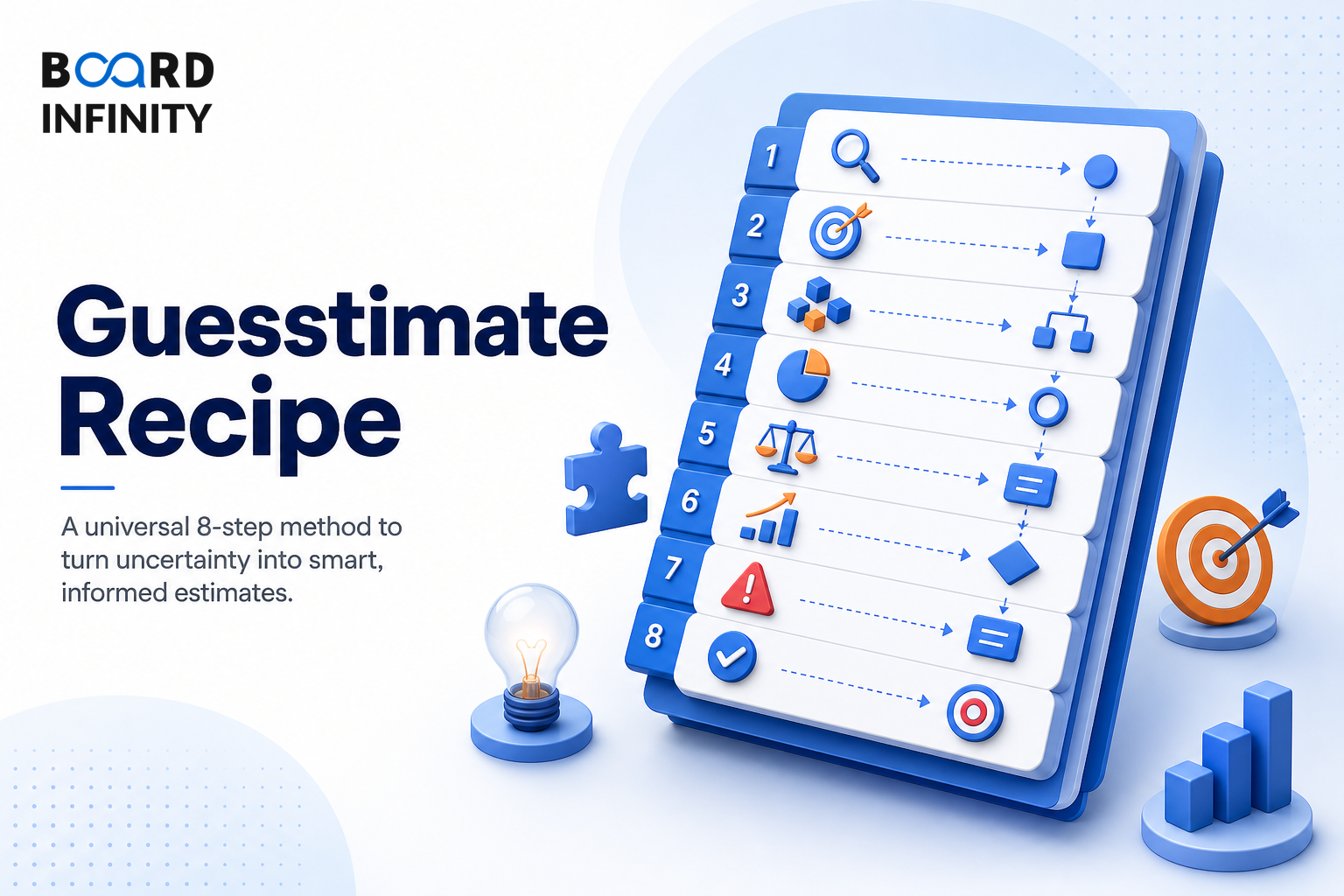
After Feature Impact Sizing - The 4-Step PM Framework, the natural next question is: how do you speak through any sizing problem when you have almost no data? This night-before cheat card gives you two things to memorize: India FY26 anchor numbers and an 8-step spoken structure that works for most guesstimates. FY26 means financial year 2026, and the anchors below are rounded so you can move quickly in interviews without pretending to be exact.
- A guesstimate is a structured order-of-magnitude estimate, not a hunt for the exact answer.
- Memorize core FY26 India anchors: population 145 cr, households 30 cr, smartphone users 80 cr, internet users 95 cr, nominal GDP ₹350 L cr, and UPI monthly transactions 2,000 cr.
- Use the same 8 steps every time: clarify scope, choose approach, sketch the tree, state anchored assumptions, calculate rounded numbers, sanity check, present a range, and invite a probe.
- Use top-down when you start from a macro base such as population or GDP, and bottom-up when you start from a unit such as one customer, one outlet, or one transaction.
- Always cross-check if time allows: solve the same problem two ways, such as demand versus supply, to validate the order of magnitude.
- Report a plausible range instead of a false-precision point estimate, and keep guesstimates to around two significant figures.
- The strongest closing signal is Step 8: explicitly invite the interviewer to challenge your assumptions.
Here is the whole recipe at a glance before we drill into the anchors and usage.
Why This Cheat Card Works
Most guesstimates are Fermi estimations: rapid order-of-magnitude estimates with little data, named after Enrico Fermi. The goal is not to know every market size; the goal is to decompose the problem, use reasonable anchors, and stay directionally consistent.
The Board Infinity compendium recommends rounded FY26 anchors because every anchor saves a minute of derivation. For example, if you know India population is 145 cr and households are 30 cr, you can quickly move between people-based and household-based demand. If you know UPI monthly transactions are 2,000 cr and UPI value per month is ₹26 L cr, you can derive average transaction value without asking for extra data.
Memorize the anchors cold, but do not memorize answers. In the interview, build the answer from scope, approach, tree, assumptions, calculation, sanity check, range, and probe.
Core Terms You Must Know
Before using the recipe, you need the vocabulary. These terms help you explain whether you are estimating revenue, users, transactions, penetration, or obtainable share.
India FY26 Anchors to Memorize
The anchors below are the fastest way to make India-context guesstimates feel grounded. Use them as starting points, then apply filters such as urban share, age group, penetration rate, frequency, average selling price, or average revenue per user.
A penetration rate is the percentage of a relevant base using a product. ARPU means Average Revenue Per User, which is useful in subscription, Software as a Service, and telecom sizing. ASP means Average Selling Price, or price per unit sold.
Sector and Service Anchors
Sector anchors are useful when the final answer is a revenue pool or when you need a sanity check against a known market. Service-density anchors are useful when the question is supply-side, such as estimating the number of doctors, ATMs, petrol pumps, pharmacies, schools, or hospital beds.
The 8-Step Spoken Recipe
The best way to use the recipe is to say each step out loud. This keeps the interviewer aligned, makes your assumptions visible, and gives them chances to correct scope before you do unnecessary math.
Step 8 is especially powerful. The compendium notes that explicitly inviting a probe can shift the dynamic because most candidates dread follow-up questions, while you signal that you welcome them.
Choosing Top-Down, Bottom-Up, and Cross-Checks
A top-down approach starts from a macro base and narrows down using filters. For example, you might begin with India population of 145 cr, then filter by urban share of 38%, smartphone users of 80 cr, or internet users of 95 cr depending on the question.
A bottom-up approach starts from one unit and multiplies up. For example, you might start with one transaction, one household, one outlet, or one vehicle, then multiply by frequency, active base, and average selling price.
Market size is typically: relevant base × penetration rate × frequency × average selling price. For marketplaces, remember that GMV is total transaction value and take rate is the percentage of GMV captured as revenue.
Worked Example: Estimating Average UPI Transaction Value
Situation: you are asked to estimate the average value of a UPI transaction in India using only the cheat-card anchors. The problem is not to size the whole UPI market from scratch; it is to convert monthly transaction value and monthly transaction count into a per-transaction number.
The learning is simple: strong guesstimates often come from clean unit conversion. You did not need extra data because the anchor pair already contained the numerator and denominator.
Digital Product Metrics You May Need
For product manager sizing, digital metrics often decide whether the answer should be user-led, revenue-led, or engagement-led. DAU means Daily Active Users and MAU means Monthly Active Users. The MAU/DAU ratio, also called stickiness, indicates how often monthly users return.
Conversions to Memorize Cold
Many candidates lose time converting Indian and Western numbering systems. Memorize these because market sizing answers often move between lakh, crore, million, billion, and trillion.
Conclusion
The core idea is to stop treating each guesstimate as a new puzzle. Memorize the FY26 India anchors, speak through the same 8-step structure, round intelligently, sanity check your answer, and close by inviting a probe.
The most frequent error is jumping into arithmetic before clarifying scope and units. It costs points because a mathematically clean answer can still be wrong if you sized the wrong geography, time period, customer base, or revenue measure.