
Feature Impact Sizing - The 4-Step PM Framework
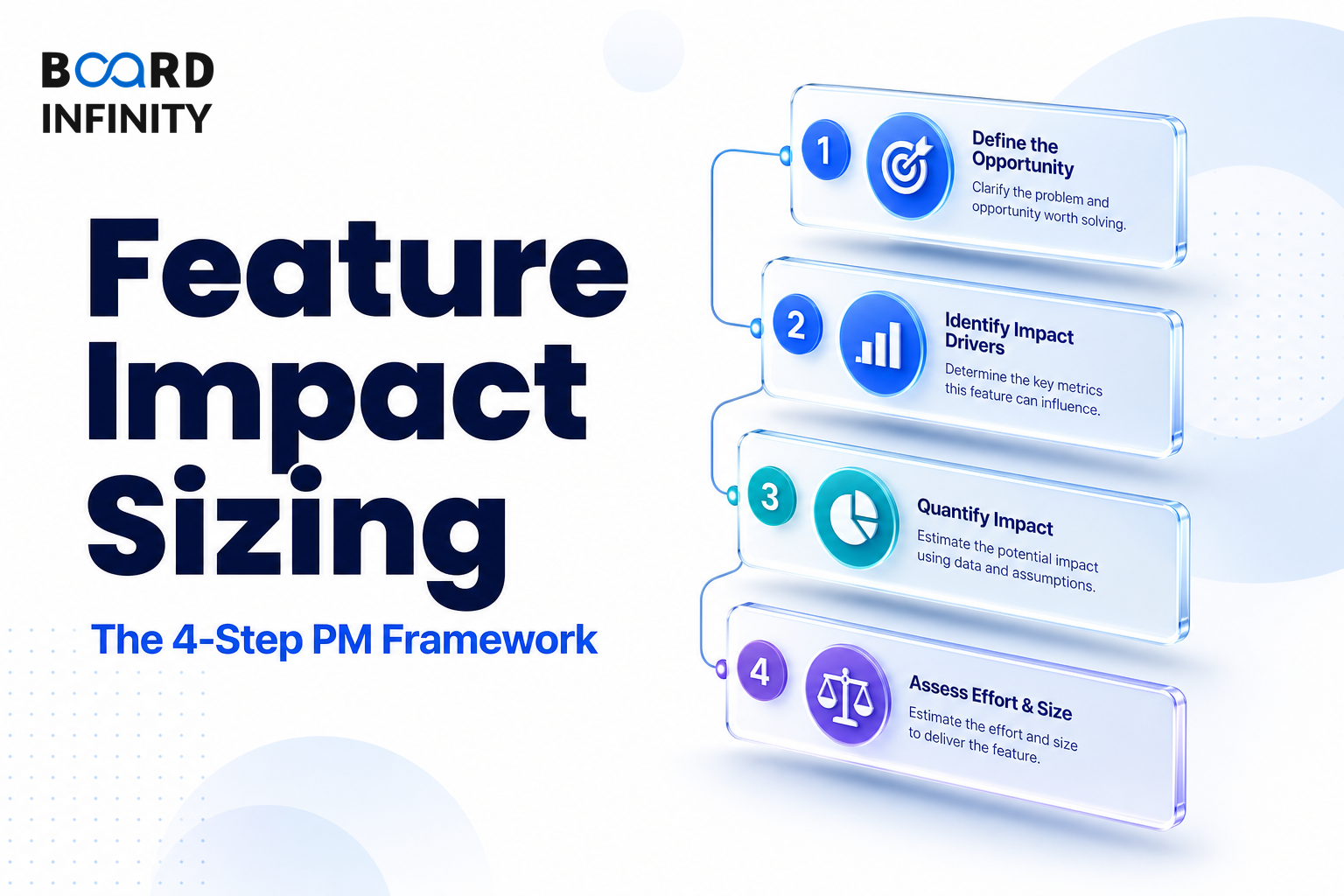
In the previous concept, Guesstimates for Product Managers - The PM-Specific Structure, the key shift was from broad market sizing to product funnels. Feature impact sizing is where that shift becomes most visible: the interviewer is not asking for a market size, but for how much a product change can move a metric inside a known product. This matters in PM interviews at companies such as Flipkart and Meesho because the strongest answers show product thinking, not just arithmetic.
- Feature impact sizing estimates how much a new feature will move a target metric, such as conversion, revenue, orders, or engagement.
- The PM framework is exposure → adoption → behavior shift → value, not a simple Daily Active Users × rupees calculation.
- Exposure asks how many users can realistically see the feature, not how many users exist in the product.
- Adoption asks what share of exposed users actually use the feature, often depending on awareness, intent, and friction.
- Behavior shift measures how adopter behavior changes versus baseline, such as a conversion rate lift.
- Value converts the shifted behavior into business impact, such as incremental Gross Merchandise Value.
- Interviewers grade the funnel shape and validation thinking more than the final number.
The Big Picture: Feature Impact as a PM Funnel
Feature impact sizing is a specific type of PM guesstimate where the question is, "If we add Z, how much will it move metric M?" The clean answer starts with the user journey and then translates the shifted behavior into value. This is the same PM signal highlighted in product guesstimates: decompose the funnel, not just the user base.
Feature impact = exposed users × adoption rate × behavior shift × value per shifted action.
At a glance, the framework has four sequential parts. Each step narrows the user base and makes the estimate more realistic.
Why the Funnel Beats a Simple DAU Calculation
DAU means Daily Active Users - the number of unique users active on a product in a day. MAU means Monthly Active Users - the number of unique users active in a month. These are useful anchors, but feature impact sizing becomes weak when candidates jump from DAU directly to revenue without estimating the intermediate funnel.
The PM interviewer is looking for the instinct to move through exposure, adoption, activation, retention, and revenue impact. In a feature-impact problem, that usually condenses into the four-step exposure → adoption → behavior shift → value chain.
What Feature Impact Sizing Means
Feature impact sizing estimates the incremental effect of a product change on a chosen metric. The metric can be a conversion rate, orders, revenue, impressions, active users, or another product outcome, depending on the question. In the source example, the feature is a saved-for-later cart on Flipkart and the metric is incremental Gross Merchandise Value.
GMV means Gross Merchandise Value - the total value of goods sold through a marketplace before deductions such as returns, cancellations, or platform fees. In an e-commerce setting like Flipkart, GMV is a natural value metric because an extra order with an average basket of ₹1,200 contributes ₹1,200 of GMV.
The main nuance is that feature impact is typically not the same as feature usage. A feature can be heavily visible but weakly adopted, or widely adopted but produce only a small behavior shift. A strong PM answer separates these layers instead of hiding them inside one large percentage.
Exposure: Who Actually Sees the Feature?
Exposure is the number of users who can realistically encounter the feature. It is not always equal to the entire user base, because a feature may live in a specific flow, screen, segment, geography, or use case. In the Flipkart saved-for-later cart example, the source uses Flipkart DAU of around 5 crore and assumes 60% are cart-aware, giving 3 crore exposed users.
This step matters because it protects the answer from the most common overestimate: assuming every Daily Active User sees every feature. A saved-for-later cart can only influence users who reach or understand the cart experience. A user who only browses and leaves before cart awareness should not be counted in the exposed base.
In an interview, say what the feature surface is before applying a percentage. For example, "I will start with Flipkart DAU, then narrow it to users aware of or entering the cart flow." That one sentence tells the interviewer you are sizing a product surface, not the entire company.
Adoption: Who Uses It After Seeing It?
Adoption is the percentage of exposed users who actually use the feature. In the Flipkart example, the source uses around 25% adoption for an opt-in cart feature. This converts 3 crore exposed users into 75 lakh adopters.
Adoption depends on friction and intent. A feature that is automatic may have high usage once exposed, while an opt-in feature requires the user to notice it, understand it, and decide it is worth using. The source also shows a related feature-adoption structure for a "Pay Later" feature: awareness × eligibility × intent-to-use × actual conversion.
The nuance is that adoption should usually be lower than exposure. Candidates often merge the two, but a PM interviewer expects a distinction between seeing a feature and changing behavior because of it.
Behavior Shift: What Changes Among Adopters?
Behavior shift measures the difference between adopter behavior and baseline behavior. In the Flipkart saved-for-later cart example, adopters have a +12% conversion rate on saved items versus the baseline. This is the product effect that the feature is supposed to create.
This step is where feature impact sizing becomes more than a usage estimate. A saved-for-later cart does not create value merely because users click it. It creates value if saved items later convert into extra orders, higher order frequency, or another measurable product outcome.
A useful interview habit is to state the baseline and the lift separately. For example, "Among adopters, I will assume saved items convert 12% better than baseline." This avoids implying that 12% of all users immediately place an order.
Value: What Is the Business Impact?
Value converts the changed behavior into the metric the business cares about. In the Flipkart case, the value per shifted behavior is the average basket size of ₹1,200. The source calculation uses 75 lakh adopters, around 3 saved-cart orders per year, and a 12% lift.
The extra orders are calculated as 75 lakh × 3 saved-cart orders per year × 12% lift, which equals 75 lakh × 0.36, or 27 lakh extra orders per year. Revenue uplift in GMV terms is then 27 lakh × ₹1,200 = ₹325 crore per year. The source gives a range of ₹250 - 450 crore per year incremental GMV.
The nuance here is to match the value unit to the question. If the interviewer asks for revenue, use a revenue metric. If the question asks for orders, stop at extra orders. If the question asks for retention, do not force a rupee conversion unless requested.
Flipkart: The Full Framework in One Business
Flipkart is a strong example because the saved-for-later cart feature touches a familiar e-commerce funnel: users browse, enter the cart, save items, return later, and convert. The worked example below shows the complete situation → problem → framework → decision → outcome → learning chain.
The complete answer is stronger than a final number because it shows why only part of the user base is affected, how adoption narrows the funnel, and where the business value actually comes from.
How Feature Impact Fits Other PM Guesstimates
Feature impact sizing is one PM guesstimate category, but the same product-first thinking appears in other categories too. KYC means Know Your Customer - identity verification used in financial products before a user can transact. CPM means Cost Per Mille - advertising cost per thousand impressions.
The lesson for interviews is simple: choose the structure that matches the product question. Feature impact needs the exposure → adoption → behavior shift → value structure because the interviewer wants to see whether you understand the path from feature availability to measurable business impact.
The PM Validation Mindset
PM interviews use guesstimates differently from MBB interviews. MBB interviews may focus more on market-sizing rigor, while PM interviews test whether you can size a feature, user segment, or revenue lever inside a known product. They also probe whether you can connect the estimate to product validation.
A/B testing means a controlled experiment where one user group sees one product variant and another group sees a different variant, so the team can compare outcomes. Instrumentation means adding analytics events to track user behavior, such as whether a user saw a feature, clicked it, or completed an action after using it.
The cleanest PM signal is moving between "size the feature" and "size the experiment that would prove it." That shows both strategic thinking and executional clarity.
Structuring a Feature Impact Sizing Interview Answer
"If Flipkart adds a saved-for-later cart, how much incremental GMV could it generate in a year?"
The number one way candidates get this wrong is by treating the feature as if every Daily Active User sees and uses it. Always narrow the funnel before calculating impact.
The most frequent error is using a simplistic DAU × revenue shortcut. It costs points because it skips the PM funnel - exposure, adoption, behavior shift, and value - which is exactly what interviewers are testing.
Conclusion
Feature impact sizing is a PM funnel problem, not a raw user-base multiplication problem. If you can move cleanly from exposed users to adopters, then to behavior shift and value, your answer will feel like a real product estimate rather than a guessed final number.