
HR, Ops & Analytics Domain Guesstimates + Drills: Indian Scale Calibration Sheet
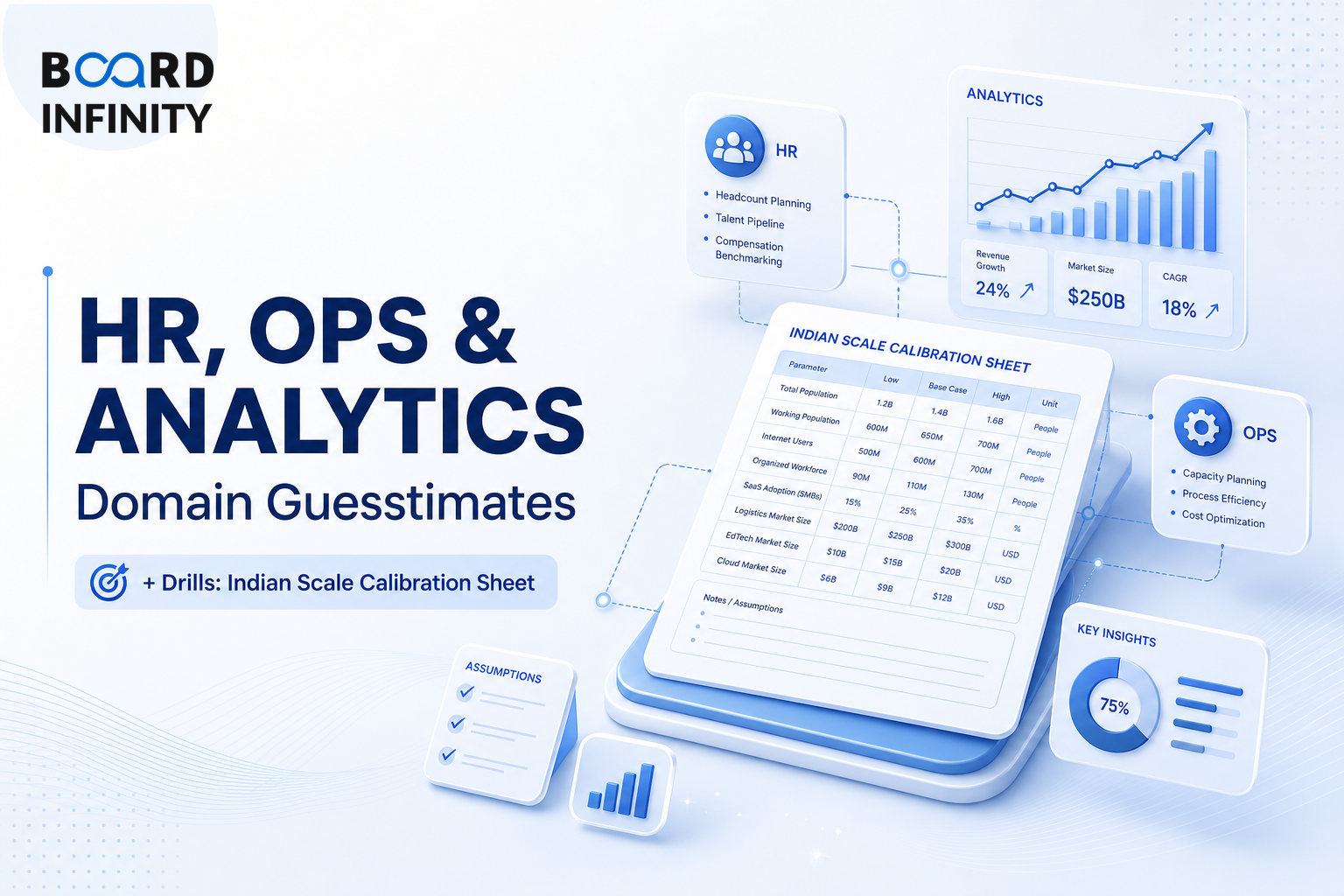
In the previous lesson on Marketing Domain Guesstimates - D2C Skincare TAM + 10 Drills, the hard part was not only the market tree. It was knowing whether the final number felt like India. This rapid calibration sheet answers that exact interview problem: how do you stop being 10× wrong before you enter a full HR, operations, or analytics guesstimate round?
- Use the 25-point rubric to grade every attempt across structure, assumptions, math, sanity-checking, and communication.
- A score of 20+ is placement-ready, 15-19 is solid but needs polish, and below 15 usually means scope-clarification or sanity-checking is missing.
- Strong candidates often lose because their Indian-scale intuition is weak, not because their case structure is weak.
- 15-second plausibility drills train whether a claim is broadly right, underestimated, overestimated, or off by 10×.
- Key Indian anchors include ~700 cr Indian Railways passenger trips/year, ~28 cr LIC policies in force, and ~2,000 cr UPI transactions/month in FY26.
- Real interview follow-ups test sensitivity, self-criticism, research instinct, projection, composure, transferability, segmentation, and humility.
- Do 10 drills/day for 3 weeks before interviews; the goal is to feel the right magnitude before reading the answer key.
Use this sheet as a calibration loop: first score the quality of your method, then train Indian-scale anchors, then rehearse the follow-up moves that interviewers use after your first number.
Why Calibration Matters Before Full Guesstimates
HR means Human Resources, the function dealing with people, hiring, workforce capacity, and employee systems. Ops means Operations, the function dealing with process, capacity, throughput, logistics, and service delivery. Analytics means using data to measure, forecast, segment, and decide. In interview guesstimates, these areas often become questions about people volume, transaction volume, service capacity, infrastructure load, or adoption.
The source pattern is clear: modern Indian guesstimates are rarely pure Fermi puzzles. A Fermi estimate is a rough, structured estimate made from assumptions when exact data is unavailable, such as estimating the annual screen-time of all Indian smartphone users. Current questions increasingly touch live business themes like electric vehicle adoption, Global Capability Centre growth, Unified Payments Interface usage, and direct-to-consumer beauty.
Fiscal Year 2026, or FY26, anchors matter because they prevent zero-count errors. If you think India sells 5 crore new cars per year when the source anchor is ~42 lakh passenger vehicles/year, the structure may look professional but the result is 10× off. That is why calibration comes before speed.
The 25-Point Grading Rubric
The grading rubric turns self-practice into something measurable. It is scored out of 25 across five dimensions, with 20+ considered placement-ready, 15-19 considered solid but needing polish, and below 15 signalling that something fundamental is missing.
After every practice attempt, score yourself on the rubric before comparing your final number to anyone else's. You will learn far more from a 22/25 with a wrong-by-30% number than from a 12/25 with the right number.
15-Second Plausibility Checks
A plausibility check is a fast yes/no instinct test: does the claim sit in the right Indian-scale range? The purpose is not to prove the number. The purpose is to avoid being off by a full zero before you build a detailed tree.
Use these as gut checks. Read the claim, decide whether it is plausible within 15 seconds, then compare with the reality anchor.
In Indian-scale guesstimates, lakh and crore are the working units: lakh means 100,000 and crore means 100 lakh. Before calculating, convert the unit mentally so that ₹, people, trips, transactions, and stores are all sitting in the same scale.
Order-of-Magnitude Anchors
Order of magnitude means the zero-count of a number. In interviews, being directionally right often means knowing whether the answer should be in thousands, lakhs, crores, or billions before doing detailed math.
These anchors are especially useful for operations and analytics-style sizing because they cover infrastructure, consumer frequency, institutional scale, and annual demand.
Worked Example: Calibrating an Indian Railways Estimate
Indian Railways is a useful operations anchor because it sits at national infrastructure scale. The lesson is simple: mass public systems can easily operate at hundreds of crores of annual passenger trips.
This is exactly the kind of correction that separates a neat but weak answer from a placement-ready answer. The tree may be unchanged, but the anchor prevents the final estimate from collapsing.
Real Interview Question Patterns
The source bank is compiled from MBB India, Big-4 consulting, Indian banking, and tech-PM interview reports from FY22-FY26. MBB refers to McKinsey, BCG, and Bain. Big-4 refers to Deloitte, EY, KPMG, and PwC. PM means Product Manager, a role that often tests market sizing, user behaviour, and product metrics.
The pattern is that interviewers are increasingly asking business-relevant estimates rather than only fun puzzles. That is why anchors around UPI, electric scooters, Global Capability Centres, direct-to-consumer markets, diagnostics, credit cards, and daily digital activity are valuable.
Follow-Up Question Bank
Real interviews rarely stop after the first number. Follow-ups are where the interviewer checks whether you understand the estimate as a decision tool, not just as arithmetic.
Every follow-up tests a different muscle: sensitivity, criticism, research instinct, projection, composure, transferability, segmentation, or humility. Strong candidates have a rehearsed response shape for each, not a memorised script.
A 5-Step Calibration Routine
Use this routine during daily practice so that calibration becomes automatic before interviews.
- State scope first. Decide the geography, time period, population, and definition before touching numbers.
- Draw the tree. Break the estimate into drivers such as population, penetration, frequency, ticket size, or capacity.
- Anchor one input. Use a known Indian-scale number such as ~28 cr LIC policies in force or ~700 cr Indian Railways passenger trips/year when relevant.
- Calculate cleanly. Round deliberately and keep units consistent across lakh, crore, ₹, tonnes, trips, and transactions.
- Sanity-check the output. Compare the final answer with a per-capita, comparable-market, or published anchor before presenting it.
Placement-ready guesstimate quality = clear scope + defensible assumptions + clean math + explicit sanity check + continuous narration.
The most frequent error is starting calculation in minute 1 and never returning to a sanity check. This costs points twice: the structure score drops, and a 10× Indian-scale error can survive until the final answer.
Conclusion
Calibration is the bridge between a well-structured guesstimate and a credible one. If you repeatedly grade your method, drill Indian-scale anchors, and rehearse follow-up moves, you will stop losing interviews on preventable zero-count errors.