
Accounting Fundamentals: Double Entry, Accrual & the Accounting Equation
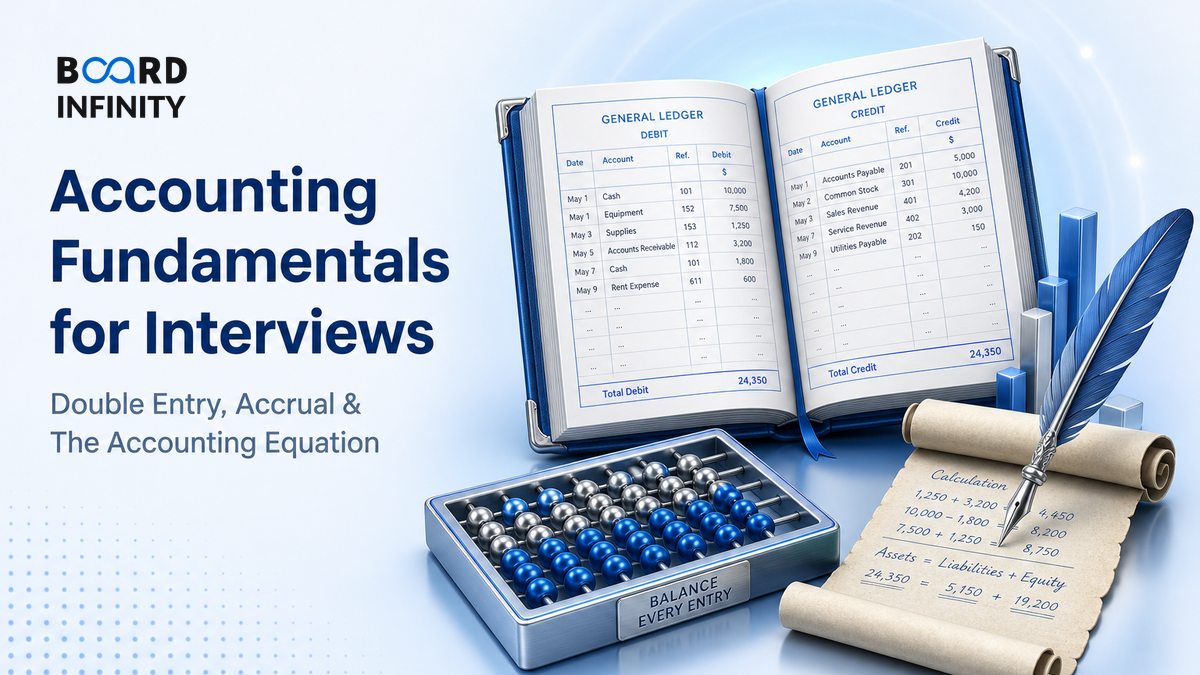
A business can show a profit and still run out of cash. That tension is exactly why accounting exists: it separates the economics of a transaction from the timing of money in the bank.
- Accounting equation: Assets = Liabilities + Equity. Every transaction must keep this equation balanced.
- Double entry: every transaction has equal debits and credits across at least two accounts.
- Debit and credit do not mean good and bad: they mean left side and right side of an account.
- Accrual accounting: recognize revenue when earned and expenses when incurred, not when cash moves.
- Profit is not cash flow: credit sales, unpaid expenses, inventory and depreciation can create big differences.
- Interview answer anchor: start with the equation, explain double entry, then show how accrual timing affects statements.
The Big Picture
Accounting is not a memory game of journal entries. It is a system that converts messy business events into comparable financial statements through one discipline: every economic event must be recorded in a balanced, time-correct way.
Core Explanation: The Three Ideas That Make Accounting Work
1. The accounting equation is the balance sheet in one line
The equation is:
Assets = Liabilities + Equity
It says every resource owned or controlled by the business is financed either by outsiders or by owners. If a company buys inventory using supplier credit, assets go up and liabilities go up. If it earns profit, assets rise or liabilities fall and equity increases through retained earnings.
2. Double entry is the balancing mechanism
Double entry means every transaction is recorded with equal debits and credits in at least two accounts. The logic is simple: if something came into the business, something financed it or went out.
The word trap: debit is not automatically good and credit is not automatically bad. Debit means left side of an account. Credit means right side of an account.
3. Accrual accounting fixes the timing problem
Accrual accounting recognizes revenue when it is earned and expenses when they are incurred, not necessarily when cash is received or paid.
Example: if a SaaS company collects an annual subscription upfront, all the cash may arrive today, but the revenue is earned over the service period. Until then, part of the cash collected is a liability called unearned revenue or deferred revenue.
A Small Worked Example: Four Transactions, One Equation
Assume a simple retailer starts operations. Ignore GST and tax to focus on the accounting mechanics.
Final check: Assets are ₹15,00,000, Liabilities are ₹4,50,000 and Equity is ₹10,50,000. The equation still balances: ₹15,00,000 = ₹4,50,000 + ₹10,50,000.
Five Numerical Checks That Catch Most Accounting Errors
Before you interpret statements, check whether the accounting system is internally consistent. In fundamentals questions, these checks are more useful than memorizing isolated entries.
Definitions You Should Be Able to Say Cleanly
- Asset - IFRS Conceptual Framework: “a present economic resource controlled by the entity as a result of past events.”
- Liability - IFRS Conceptual Framework: “a present obligation of the entity to transfer an economic resource as a result of past events.”
- Equity - IFRS Conceptual Framework: “the residual interest in the assets of the entity after deducting all its liabilities.”
- Double entry: every transaction is recorded through equal debits and credits in at least two accounts.
- Accrual basis: revenue is recognized when earned and expenses when incurred, not when cash moves.
Case Study: Nykaa and the Accounting Behind an Online Beauty Order
Nykaa shows why accrual accounting matters: one customer order can create revenue, inventory movement, receivables, payables, GST liabilities, returns and marketing accruals.

Situation: FSN E-Commerce Ventures, the company behind Nykaa, operates across online beauty retail, fashion and physical stores. In a listed-company environment under Ind AS, management cannot treat checkout cash as a simple “sale equals cash” event.
The move: Each transaction must be split into its accounting parts. If Nykaa sells owned inventory, it records revenue when control transfers to the customer, removes inventory, records cost of goods sold, tracks receivables or payment gateway settlements, and records statutory liabilities such as GST collected. If a product is likely to be returned, the accounting must reflect expected returns rather than pretending every order is final on day one.
The lesson: The primary driver of reliable reporting is transaction mapping: every commercial event is translated into the right accounts at the right time. Supporting drivers include integrated order-management systems, inventory controls, payment reconciliation, return policies, period-end accruals and audit trails. The strategic “so what” is clear: accounting quality protects investor trust because revenue growth without correct accruals can misstate both profit and working capital.
A shallow answer says “Nykaa records sales when customers pay.” A complete answer says “Nykaa separates cash collection from revenue recognition, inventory cost, taxes, returns and accruals.”
How AI Changes Accounting Fundamentals
AI does not remove double entry or accrual logic. It changes how quickly transactions are captured, classified, checked and explained.
- Automated transaction coding: AI-enabled accounting systems can read invoices, purchase orders and receipts, then suggest journal entries. The accountant still owns judgment, especially for revenue recognition, capitalization and provisions.
- Continuous anomaly detection: machine learning can flag unusual journal entries, duplicate invoices, round-number postings, late manual entries or vendor-payment patterns that look inconsistent with normal controls.
- Faster close and reconciliation: AI can match bank statements, payment gateway settlements, customer orders and ledger entries, reducing manual reconciliation time and surfacing exceptions earlier.
Use NotebookLM before an interview: upload this lesson and the company's latest annual report, then ask, “Explain three places where accrual accounting affects this company's profit versus cash flow.”
Interview Relevance
“A company makes a sale of ₹1,00,000 on credit. The product cost was ₹60,000. Explain the journal entries and impact on the three financial statements.”
When stuck, ask yourself two questions: “What account increased or decreased?” and “Was cash involved now, later or never?” That usually leads to the correct entry.
Common Mistake
The single biggest error is treating profit as cash. It costs candidates because they miss receivables, payables, inventory and accruals - exactly the items interviewers use to test business understanding. Fix: always separate performance recognition from cash movement.
What to Revise Next
Now that the mechanics are clear, move from “how books are built” to “which rules govern them” and “why managers care.” Revise Indian, International & American Accounting Standards Compared next, then connect accounting to decisions through How Finance Connects with Strategy, Operations, Marketing & Product.