
How Finance Connects with Strategy, Operations, Marketing & Product - Interview-Ready Framework
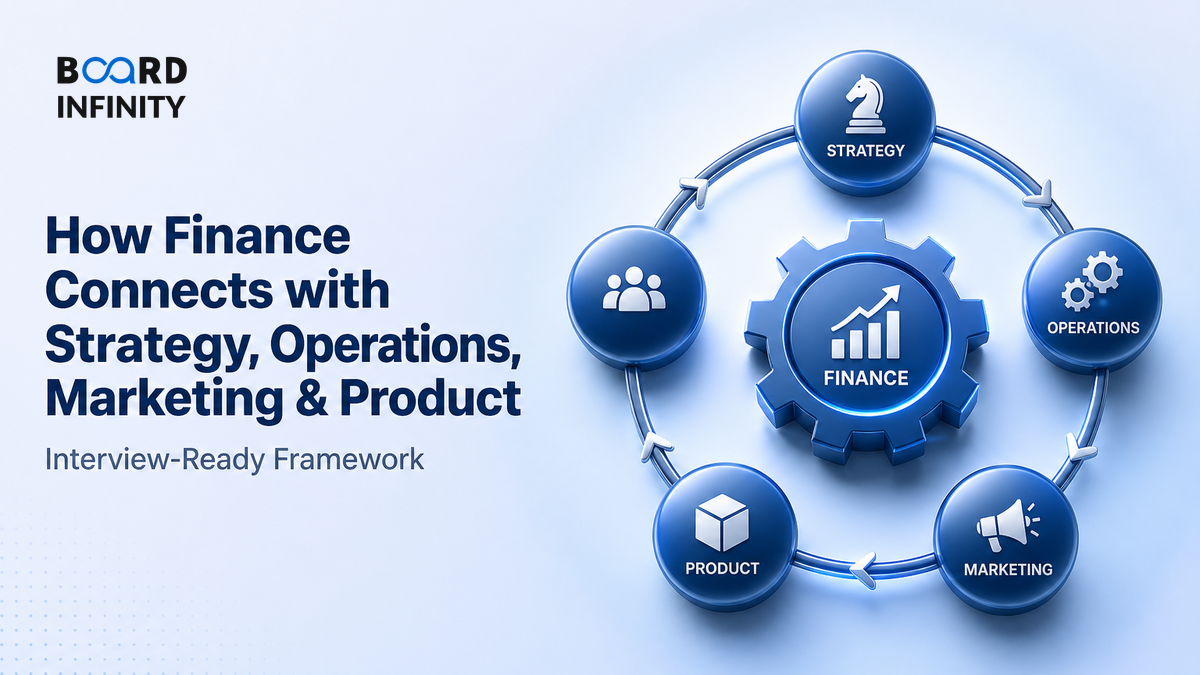
A fashion retailer can sell a T-shirt for a tempting price only if buying, store rent, inventory turns, markdowns and working capital all behave. That price tag looks like marketing, feels like product and depends on operations - but finance decides whether the model creates value or quietly burns cash.
- Finance connects every function by translating decisions into cash flows, risk, capital needs and value.
- Strategy asks where to play and how to win; finance tests whether that choice earns more than the cost of capital.
- Operations decides capacity, inventory and service levels; finance reads the impact on margins, working capital and cash conversion.
- Marketing creates demand; finance checks contribution margin, CAC payback, retention and profitable growth.
- Product shapes features, pricing and roadmap; finance tests unit economics, NPV and monetization potential.
- The best interview answer moves from business driver - financial impact - metric - trade-off - decision.
- The trap: treating finance as accounting ratios instead of a decision language for the whole business.
The Big Picture
Finance is the business translation layer. A manager may start with a strategic move, a campaign, a new product or an operations fix - finance converts that move into the same decision language: expected cash flows, timing, risk, capital required and value created.
Core Explanation: Finance Is the Common Language of Business
Finance does not “belong” only to the finance department. It sits underneath every major managerial choice because every choice consumes or releases scarce resources - money, time, capacity, attention and risk appetite.
The cleanest way to connect finance with other functions is to ask four translation questions:
How Finance Connects with Each Function
Think of finance as a translator, not a policeman. It does not simply reject ideas for being expensive; it helps managers choose where spending becomes investment and where spending remains waste.
The Decision Filter: Strategic Fit Plus Financial Return
A decision is not good just because the spreadsheet is positive. It must also fit the strategy. Equally, a strategically exciting idea cannot survive if it permanently destroys cash without a credible path to value.
Metrics That Prove Cross-Functional Financial Thinking
Use these metrics when you want to sound like a manager, not a textbook reader. The “good” number is always industry-specific, so in interviews say both the formula and the benchmark logic.
Apple’s product strategy is not only design-led. Premium pricing, ecosystem lock-in, supply-chain scale, services revenue and disciplined capital allocation all reinforce one another. The strategic so what: a product advantage becomes more powerful when finance converts it into margin durability, cash generation and reinvestment capacity.
Definitions You Can Say in One Breath
- Finance-business connection: Translating business choices into cash flows, risk, capital needs and value creation.
- Capital allocation: Deciding where scarce funds should go to maximize risk-adjusted value.
- Unit economics: Revenue and cost behavior measured at the level of one customer, order, product or transaction.
- Working capital: Operating funds tied up in inventory, receivables and payables.
- NPV: Present value of expected cash inflows minus present value of expected cash outflows.
- Strategy, in Porter’s phrase: “Competitive strategy is about being different.”
Case Study: Trent’s Zudio - Finance Behind a Value Fashion Engine
Zudio shows how a retail concept wins when strategy, operations, marketing, product and finance are designed as one system.
Situation: India’s apparel market has a large value-conscious segment: customers want fresh fashion, acceptable quality and accessible prices, especially beyond only premium malls. The challenge is that low prices can destroy profitability if inventory is slow, markdowns are high, store economics are weak or supply chains are loose.
The move: Trent built Zudio as a sharply focused value-fashion format. The primary driver is a tight retail operating model: accessible price architecture, frequent merchandise refresh, controlled assortment, efficient store format and disciplined expansion. Supporting drivers include private-label control, faster inventory movement, local-market relevance and marketing that relies more on store visibility and word of mouth than expensive celebrity-heavy advertising.
Outcome or lesson: Zudio has become a major growth engine for Trent in India. The deeper lesson is not “low price wins.” The lesson is that low price works only when finance, product, operations and strategy are mutually consistent - otherwise the same low price becomes a margin trap.
Takeaway: A shallow answer says Zudio grew because it is affordable. A complete finance-linked answer says affordability is viable because the full business system protects cash, margin and inventory productivity.
How AI Changes Finance Connections Across Functions
AI makes finance less backward-looking and more driver-led. In 2026, the strongest finance managers are not just closing books faster; they are helping teams simulate decisions before money is committed.
- Driver-based FP&A becomes faster: AI can connect sales pipeline, store footfall, ad spends, inventory levels and hiring plans to rolling forecasts. This helps finance test “what if demand falls 10%” or “what if delivery cost rises” scenarios quickly.
- Marketing and product decisions get sharper unit economics: AI models can identify which cohorts, channels, bundles or features produce better retention and gross profit, not just higher acquisition or usage.
- Operations finance becomes predictive: Machine learning can forecast stockouts, demand spikes, route costs, maintenance needs and working-capital pressure before they hit the P&L.
Use NotebookLM for revision: upload a company annual report, investor presentation and this lesson, then ask, “Map this company’s strategy, operations, marketing and product choices to ROIC, margins, working capital and cash-flow risks.” Cross-check every output against the source documents before using it in an interview.
Interview Relevance
“Finance is usually seen as a support function. Explain how finance connects with strategy, operations, marketing and product. Give an example.”
Use the phrase “finance is a decision language, not just a reporting function.” Then prove it with one metric from each function: ROIC for strategy, cash conversion cycle for operations, CAC payback for marketing and NPV for product.
Common Mistake
The biggest mistake is giving a siloed answer: “strategy grows revenue, operations reduces cost, marketing increases sales, product builds features.” That sounds basic because it misses trade-offs, cash timing and risk. The one-line fix: for every function, name the business decision, the financial line it affects and the metric that proves whether it creates value.
What to Revise Next
Now that you can explain finance as the connective tissue of business, move to the guardrails and career map of finance. Revise these next: