
Financial Markets Explained: Money Markets vs Capital Markets for Interviews
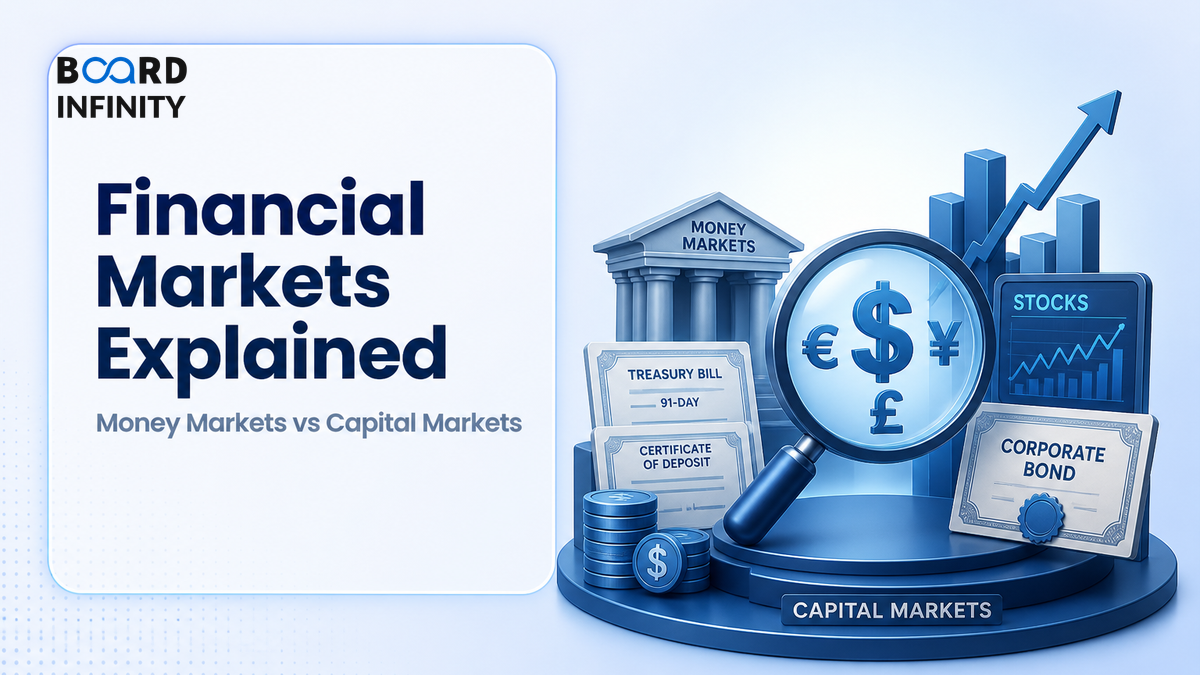
The stock market is not "the financial market" - it is only the loudest room in the building. While headlines follow IPOs and Nifty moves, a treasurer may be quietly raising 90-day cash through commercial paper, and a government may be rolling over Treasury bills before lunch.
- Money markets handle short-term funds - original maturity of one year or less - mainly for liquidity and working capital.
- Capital markets handle long-term funds - equity and debt beyond one year - mainly for growth, expansion and long-term assets.
- Money market instruments include Treasury bills, commercial paper, certificates of deposit, call money and repo.
- Capital market instruments include equity shares, preference shares, corporate bonds, debentures, government securities and mutual fund units.
- Primary market means new securities are issued; secondary market means existing securities are traded.
- In India, RBI is central to money markets and government securities; SEBI is central to listed securities and capital markets.
- The best interview answer starts with maturity and purpose, then moves to instruments, participants, risk, return and regulation.
Big Picture
Financial markets move money from surplus units - households, institutions, governments and companies with funds - to deficit units that need funds. The cleanest way to understand the split is by time horizon: money markets solve short-term liquidity; capital markets finance long-term capital formation.
Core Explanation: Money Market vs Capital Market
The big idea is simple: money markets are about managing cash timing; capital markets are about financing ownership and long-term assets. A company uses the money market to bridge a temporary cash gap, but uses the capital market to build a factory, fund acquisitions, reduce leverage or raise permanent equity.
Primary market and secondary market cut across both. When a company issues fresh commercial paper or launches an IPO, that is the primary market. When investors trade an existing Treasury bill, bond or share among themselves, that is the secondary market.
Think of instruments on two axes: maturity and claim type. Debt can be short-term or long-term. Equity is capital market by nature because it represents ownership, not a repayment due date.
Measures That Help You Compare Market Instruments
Interviewers like candidates who can move from definitions to decision-making. These measures tell you whether an instrument is cheap, risky, liquid or rate-sensitive.
Small worked example: suppose a 91-day Treasury bill yields 6.80 percent annually and a 91-day commercial paper yields 7.55 percent annually. The credit spread is 7.55 percent - 6.80 percent = 0.75 percent, or 75 basis points. On a hypothetical ₹100 crore CP, simple annualized interest for 91 days is roughly ₹100 crore × 7.55 percent × 91/365 = ₹1.88 crore. The investor's question is: does the extra 75 bps compensate for issuer credit risk and liquidity risk?
Definitions You Should Say Exactly
- Financial market: A system where financial assets are issued, priced, traded and settled between surplus and deficit units.
- Money market: Market for highly liquid debt instruments with original maturity of one year or less.
- Capital market: Market for long-term securities - equity and debt - used to raise and trade longer-tenor capital.
- Primary market: Market where issuers sell new securities to investors and receive funds.
- Secondary market: Market where existing securities trade among investors; the issuer does not receive new funds.
A clean one-breath answer: "Money markets fund short-term liquidity through instruments up to one year; capital markets fund long-term capital through equity and longer-term debt."
Case Study: REC Limited and the Discipline of Matching Tenor
REC Limited, an Indian power-sector financier, shows why financial managers use money markets for liquidity but capital markets for long-term lending.

Situation: REC lends to power and infrastructure-related borrowers, where assets and loan tenors are typically long-term. That creates a funding challenge: it needs dependable long-duration money, but it also needs day-to-day liquidity for disbursements, repayments and treasury operations.
The move: REC uses capital market borrowings such as bonds and long-term debt instruments to support longer-tenor lending. Shorter-term instruments and treasury borrowings can help manage liquidity, but they cannot become the main funding source for long-term assets without creating asset-liability mismatch risk.
The lesson: The primary driver is tenor matching - aligning the maturity of liabilities with the maturity of assets. Supporting drivers include credit rating strength, institutional investor access, regulatory discipline, diversified borrowing sources and active treasury management. This is the real difference between a textbook answer and a finance answer.
So what: Money market funding is not "inferior" and capital market funding is not always "better." The correct instrument depends on maturity, purpose, risk and cash-flow matching.
How AI Changes Financial Markets in 2026
1. AI speeds up market intelligence. Traders, treasury teams and analysts now use NLP tools to scan RBI policy documents, SEBI circulars, earnings calls, rating actions and bond disclosures faster. The advantage is not just speed - it is connecting weak signals across documents.
2. AI improves credit and liquidity monitoring. Lenders and institutional investors use machine learning models to flag early warning indicators such as deteriorating payment behavior, abnormal spread widening, news sentiment shifts and sector stress. The caveat: models must be explainable, audited and protected from biased or noisy inputs.
3. AI changes execution and advisory. Algorithmic trading, smart order routing and portfolio analytics help institutions reduce transaction cost, especially in liquid listed markets. In less liquid bond markets, AI can support price discovery, but human judgment remains critical because one trade may not represent the whole market.
Use NotebookLM before an interview: upload this lesson, RBI's latest monetary policy statement and one listed company's annual report. Ask: "Identify where this company uses short-term funding versus long-term capital, and generate five interview questions on its financing choices."
Interview Relevance
"Explain the difference between money markets and capital markets. If you were the CFO of a company, when would you use each?"
If asked a follow-up, bring in primary vs secondary market. Example: an IPO is primary capital market; trading the same shares on NSE later is secondary capital market.
Common Mistake
Mistake: Saying "money market is for banks and capital market is the stock market." This costs candidates because it ignores maturity, debt instruments, government securities, corporate bonds and the purpose of funding. Fix: classify by maturity and purpose first, then give instruments, participants and regulators.
What to Revise Next
Now that you understand where money moves in the financial system, revise how that movement appears inside company books and reporting rules.