
Accounting Fundamentals for Interviews: Double Entry, Accrual and the Accounting Equation
A passenger pays for a flight six weeks before takeoff. The airline has cash in the bank, but accounting says it has not yet earned revenue - it has a promise to keep.
That tension is the heart of accounting fundamentals: business reality is not just cash moving in and out; it is resources, obligations and ownership changing in a way that must always balance.
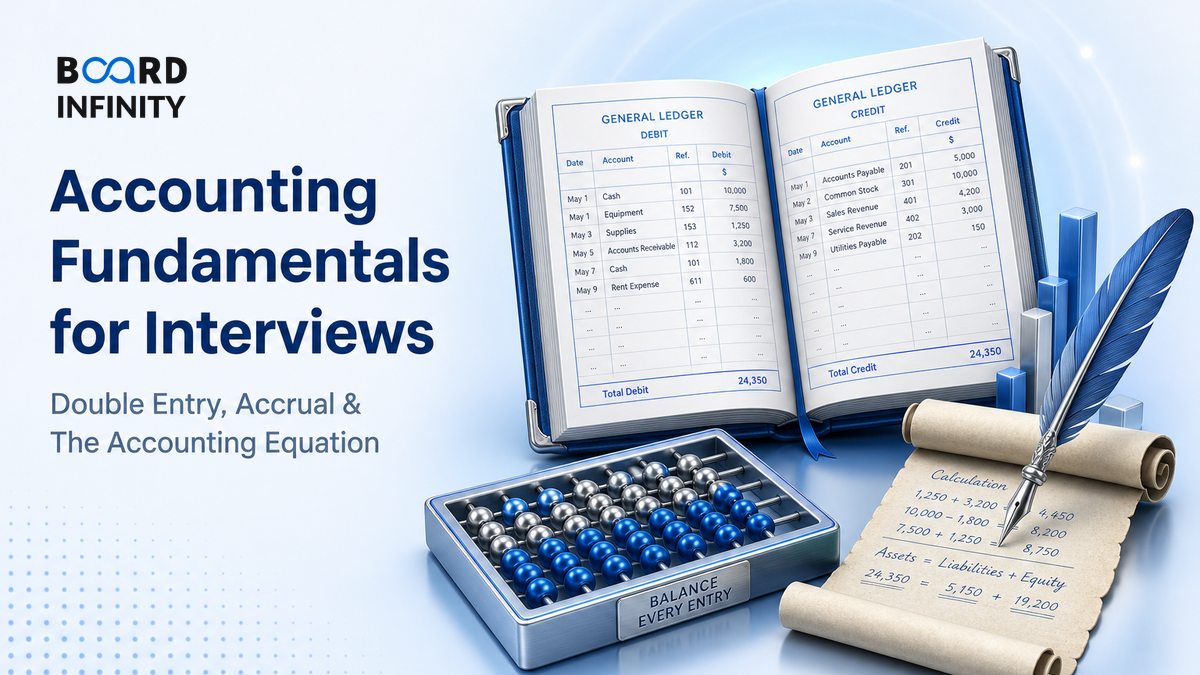
- Accounting equation: Assets = Liabilities + Equity. Every transaction must keep this equation balanced.
- Double entry: every transaction is recorded with equal debits and credits in at least two accounts.
- Debit does not mean good and credit does not mean bad. Debit simply means left side; credit means right side.
- Accrual accounting: record revenue when earned and expenses when incurred, not necessarily when cash moves.
- Cash profit is not accounting profit. A company can be profitable but cash-poor, or cash-rich before earning revenue.
- Interview shortcut: identify the transaction, name the affected accounts, apply debit-credit rules, then check the accounting equation.
Big Picture
Accounting fundamentals work like a reliability stack. Source documents capture what happened, double entry records both sides, the accounting equation checks balance, accrual accounting fixes timing, and financial statements tell the business story.
Core Explanation
The cleanest way to understand accounting is this: every business event changes what the company owns, owes, or belongs to owners. Accounting records those changes without breaking the equation.
1. The Accounting Equation: The Balance Sheet in One Line
The accounting equation is:
Assets = Liabilities + Equity
It says that everything a company controls must be financed either by outsiders, called liabilities, or by owners, called equity.
2. Double Entry: Why Every Transaction Has Two Sides
Double entry means every transaction affects at least two accounts, with total debits equal to total credits. It prevents one-sided thinking.
Example: if a company buys equipment for cash, it gains equipment but loses cash. Assets change form, but total assets may remain unchanged.
3. Accrual Accounting: Timing the Business Reality
Accrual accounting separates earning from collecting cash, and incurring cost from paying cash.
If a consulting firm completes a project in March but gets paid in April, March gets the revenue. If a retailer sells goods in December but pays the supplier in January, December gets the cost of goods sold.
Worked Example: One Sale, Three Accounting Effects
A business sells goods worth ₹1,000 on credit. The goods cost ₹600. The customer will pay next month.
This is why accounting profit and cash flow differ. Accrual accounting says the company earned ₹400 profit now; cash accounting would wait until the customer pays.
Quick Sanity Checks Recruiters Expect You to Know
Definitions
- Double entry: every transaction is recorded with equal debits and credits in at least two accounts.
- Accrual accounting: revenue is recorded when earned and expenses when incurred, not necessarily when cash moves.
- IFRS Conceptual Framework - Asset: “a present economic resource controlled by the entity as a result of past events.”
- IFRS Conceptual Framework - Liability: “a present obligation of the entity to transfer an economic resource as a result of past events.”
- IFRS Conceptual Framework - Equity: “the residual interest in the assets of the entity after deducting all its liabilities.”
IndiGo: Why Cash from a Ticket Is Not Yet Revenue
IndiGo shows accounting fundamentals beautifully because airline cash often arrives before the flight is delivered, while major obligations like leases and operating costs must still be recorded.

Situation: Airlines often receive cash when customers book tickets in advance. But until the passenger flies, the airline still owes a service. If the airline treated all advance ticket cash as immediate revenue, profits would look inflated before performance is complete.
The accounting move: Under accrual logic, the cash received is recorded first as an asset increase and a liability, often described as unearned revenue or contract liability. When the flight is operated, the liability is reduced and revenue is recognized. Separately, aircraft leases, fuel costs, airport charges, employee costs and maintenance obligations are recorded according to when resources are used or obligations arise, not merely when cash is paid.
Outcome and lesson: The primary driver here is accrual recognition of performance obligations: the airline earns revenue by flying passengers, not by merely collecting money. Supporting drivers are double-entry discipline, the accounting equation, and accounting standards that force both resources and obligations onto the books. The strategic so what: a finance manager who reads airline statements must look beyond ticket cash to deferred revenue, lease liabilities, operating costs and cash conversion.
How AI Changes Accounting Fundamentals
AI does not change the accounting equation. It changes how fast transactions are captured, classified, reconciled and questioned.
Student workflow: Load a listed company annual report and this lesson into NotebookLM. Ask: “Give me five transactions from this business where cash timing and accrual timing differ, and show the likely journal entry logic.” Then verify the answer against the notes to avoid blindly accepting AI-generated accounting treatment.
Interview Relevance
“A customer pays ₹10 lakh in advance for a one-year subscription. How will you account for it on day one and over the year?”
When answering accounting questions, always say both the journal entry and the business meaning. That is what separates a finance-ready MBA answer from rote commerce revision.
Common Mistake
The biggest mistake is treating cash received as revenue and cash paid as expense automatically. It costs candidates because it shows they have missed accrual accounting. One-line fix: ask, “Has the company earned the revenue or incurred the expense yet?” before recording profit impact.
What to Revise Next
Once double entry, accrual and the equation are clear, move from “how transactions are recorded” to “which rulebook governs them” and “how finance connects to business decisions.”