
Interest Rates Explained for Interviews: Nominal, Real, Simple and Compound
A loan officer says, "10% interest," an FD advertisement says "7% per annum," and your credit card statement quietly compounds charges every month. All three are using the same word - interest - but they are not speaking the same financial language.
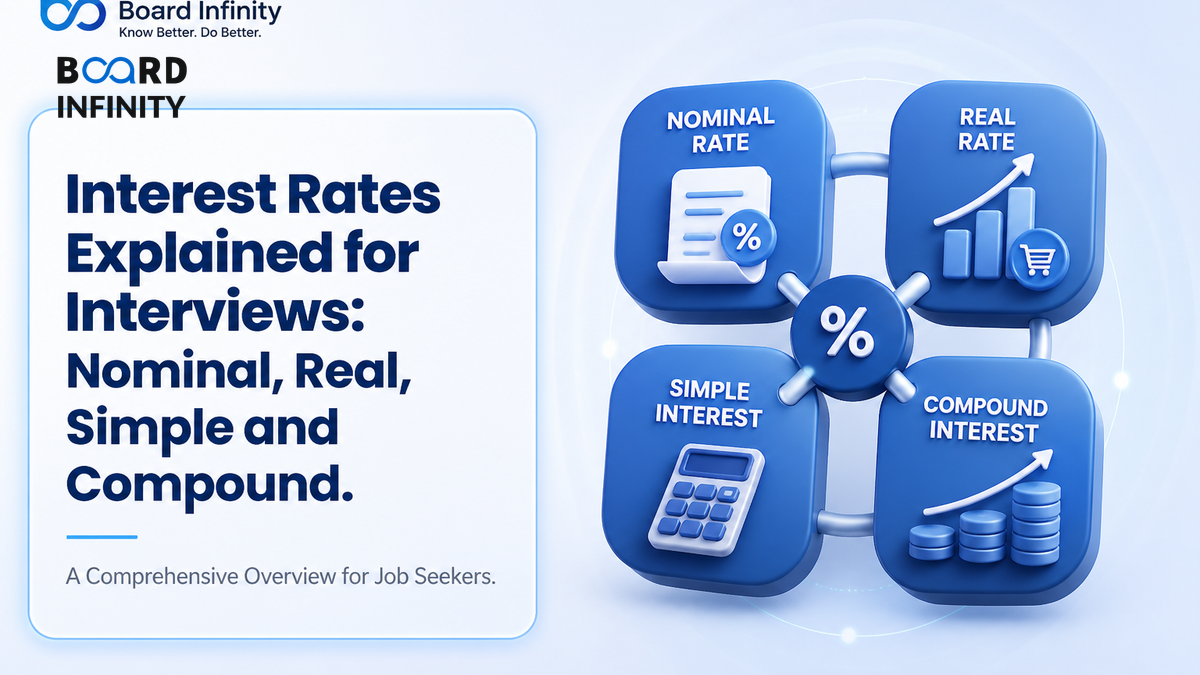
- Nominal interest rate is the stated rate before adjusting for inflation; it is the headline number you usually see.
- Real interest rate adjusts the nominal rate for inflation; it tells you whether purchasing power is actually rising.
- Simple interest earns interest only on the original principal: Interest = P × r × t.
- Compound interest earns interest on principal plus past interest: Amount = P × (1 + r/m)mt.
- To compare two offers, convert both to the same basis: annual, effective, after fees/tax, and then real if inflation matters.
- The Fisher equation links the ideas: 1 + nominal rate = (1 + real rate) × (1 + inflation rate).
- The biggest trap is comparing a quoted loan rate with an investment return without adjusting for compounding, fees, tax and inflation.
The Big Picture
Think of any interest rate as a headline number passing through a filter. The number you should use for decisions is rarely the first number quoted; it is the rate after compounding, costs, tax and inflation have been made comparable.
Core Explanation: The Four Interest Rate Ideas
Interest is the price of money over time. If you borrow, it is your cost. If you lend or invest, it is your return. The four terms below answer two different questions: "Is inflation considered?" and "Does interest earn further interest?"
Nominal vs Real Interest Rate
The nominal interest rate is the stated annual rate before adjusting for inflation. If a fixed deposit says 7% per annum, 7% is the nominal rate.
The real interest rate adjusts that return for inflation. It answers: "After prices rise, am I actually richer?"
Named after economist Irving Fisher: 1 + nominal rate = (1 + real rate) × (1 + inflation rate). For quick estimates: nominal rate ≈ real rate + inflation rate.
Example: if your nominal return is 8% and inflation is 5%, the approximate real return is 3%. The exact real return is (1.08 / 1.05) - 1 = 2.86%.
Simple vs Compound Interest
Simple interest calculates interest only on the original principal. It is linear: the same interest amount is added every period.
Compound interest calculates interest on principal plus accumulated interest. It is exponential: the base keeps growing.
Worked Example: Same Rate, Different Answers
Assume you invest ₹1,00,000 at 8% per annum for 3 years. Inflation is 5% per annum.
The interview-quality insight: the same "8%" can mean different outcomes depending on compounding and inflation. Always ask, "8% on what basis?"
Definitions You Must Say Cleanly
- Interest rate: The price paid for using money over time, expressed as a percentage of principal.
- Nominal interest rate: The stated rate before adjusting for inflation.
- Real interest rate: The inflation-adjusted rate that measures change in purchasing power.
- Simple interest: Interest calculated only on the original principal.
- Compound interest: Interest calculated on principal plus previously accumulated interest.
- Effective annual rate: The annual rate after incorporating intra-year compounding.
Key Measures and Formulas
When an interviewer gives you a rate, convert it into measurable terms. These are the six measures that make your answer practical.
Mini Case Study: Shriram Finance and the Business of Interest Rate Spreads
Shriram Finance shows how interest rates become a business model: borrow at one effective cost, lend at a risk-priced rate, and manage the spread through underwriting and collections.

Situation: Many Indian small transport operators and self-employed borrowers need financing for commercial vehicles, used vehicles and business assets. They may not always fit the clean, low-risk profile preferred by large banks.
The move: Shriram Finance built its business around risk-priced lending. It raises money through a mix of sources such as bank borrowing, debt instruments, deposits and securitisation, then lends to customers at rates that reflect credit risk, collateral, tenor and collection cost. During the RBI rate-hiking cycle that took the repo rate to 6.50% in 2023, the key challenge for NBFCs was not simply "raise loan rates." Funding cost, borrower affordability, asset quality and competitive pressure all moved together.
Outcome and lesson: The primary driver is disciplined spread management - earning enough over funding cost to compensate for risk. Supporting drivers are collateral-backed lending, local collections capability, diversified funding and deep understanding of borrower cash flows. The lesson for interviews: interest rates affect lenders through both sides of the balance sheet - cost of funds on liabilities and yield plus default risk on assets.
How AI Changes Interest Rate Analysis
1. Faster rate comparison from messy documents. AI tools can extract stated rates, fees, compounding frequency, prepayment clauses and penalties from loan agreements or term sheets. The finance skill is still yours: convert those extracted terms into effective annual cost.
2. Better real-rate scenario thinking. Instead of using one inflation assumption, analysts can quickly model multiple scenarios: high inflation, falling inflation, repo-rate cuts, deposit repricing and EMI sensitivity. This is especially useful in banking, NBFC and treasury roles.
3. Credit pricing with caution. Lenders increasingly use machine-learning models to estimate default risk and price loans. The caveat: AI can improve risk segmentation, but it must be monitored for bias, explainability and regulatory compliance, especially in retail lending.
Load an RBI monetary policy statement, one bank or NBFC annual report, and this lesson into NotebookLM. Ask: "List every interest-rate term mentioned, classify it as nominal, effective or real, and create five interview questions on how rate changes affect margins."
Interview Relevance
"A bank offers a fixed deposit at 7% per annum, inflation is 5%, and another product says 6.9% compounded quarterly. Which is better, and how would you compare them?"
If numbers are given, write the formula first and then calculate. Interviewers reward the structure even if the arithmetic is approximate.
Common Mistake
Comparing headline rates directly. Candidates say "8% is better than 7%" without checking compounding, tax, fees, risk or inflation. That costs marks because it shows rate memorisation, not financial thinking. Fix: convert every rate to the same effective annual, after-cost, real basis before comparing.
What to Revise Next
Now that you can decode the price of money, move to the markets where that money is raised and the accounting system that records it.