
Agentic Analytics for Interviews: How Agents Query, Analyse and Report
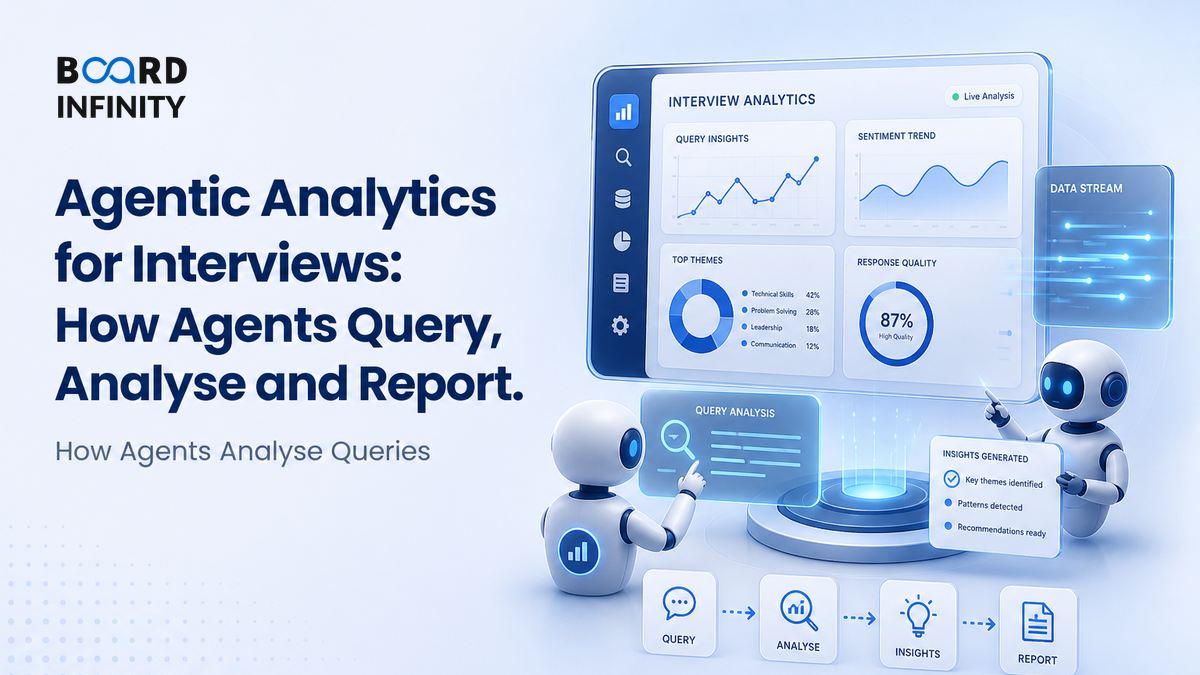
A sales head does not want another dashboard at 8:45 a.m. She wants to ask, "Why did North India revenue dip yesterday, and what should I do before the 10 a.m. review?" Agentic analytics is the shift from clicking charts to assigning an analytical task to an AI agent that can fetch data, reason over it, and prepare the first version of the answer.
- Agentic analytics means AI agents can query data, analyse patterns and produce reports with limited human step-by-step prompting.
- The core flow is: business question - plan - query - analyse - validate - report - human review.
- It is not just "chat with dashboard"; a true agent can decide sub-questions, call tools, check outputs and generate a usable narrative.
- The biggest value is analyst leverage: faster root-cause analysis, automated reporting and proactive anomaly explanation.
- The biggest risk is confident wrongness: bad SQL, misunderstood metrics, missing business context or ungrounded narratives.
- Good systems need a semantic layer, access controls, validation tests, audit logs and human-in-the-loop approval for high-impact decisions.
- In interviews, explain both upside and governance; do not sound like the agent should replace analytical judgment.
Big Picture: From Dashboard Pulling to Goal-Driven Analysis
Traditional BI asks the user to know which dashboard to open and which filter to apply. Agentic analytics starts with a business goal and lets specialised agents plan the analytical route, use data tools, check outputs and draft the answer for a human decision-maker.
Core Explanation: What Actually Makes Analytics “Agentic”
The big idea is simple: agentic analytics adds autonomy to business analytics. Instead of a user manually building every query and chart, an AI agent decomposes the question, chooses tools, retrieves data, performs analysis, generates a narrative and flags uncertainty.
A useful way to separate basic AI dashboards from agentic analytics is to ask: who decides the next analytical step? If the user must specify every filter and calculation, it is assisted BI. If the system can plan sub-questions, run queries, compare hypotheses and produce a report draft, it is agentic.
The Agentic Analytics Stack: The Five Layers You Should Mention
In a strong interview answer, do not describe this as "ChatGPT connected to data." Describe the stack. The agent is only as reliable as the data, definitions, tools and controls underneath it.
Zoho, an Indian SaaS company, offers Zoho Analytics with conversational capabilities such as Ask Zia, where users can ask business questions in natural language and receive charts or insights. The strategic so what: Indian SaaS firms are not just consuming AI analytics; they are building AI-native analytics layers for global business users. The primary driver is embedded business-data context, supported by report generation, visualisation and access-control capabilities.
Definitions You Can Say in One Breath
- Agentic analytics: analytics where AI agents autonomously plan, query, analyse and report data-backed answers for human decision-making.
- AI agent: software that pursues a goal by planning steps, using tools, observing results and adjusting its actions.
- Semantic layer: a business-meaning layer that standardises metrics, dimensions and relationships so users and systems interpret data consistently.
- Grounded answer: an AI-generated response supported by traceable data sources, calculations or retrieved evidence.
- Human-in-the-loop: a control design where people review, approve or override AI outputs before high-impact action.
Where Agentic Analytics Creates Business Value
Agentic analytics is strongest when the question is important, time-sensitive and cross-functional. It is weaker when data definitions are messy, the decision is legally sensitive or the agent cannot verify its own answer.
The Control Problem: Autonomy Must Match Business Risk
The more autonomy an analytics agent has, the stronger the governance must be. A low-risk agent may draft a weekly sales summary. A high-risk agent should not independently approve loans, change pricing or send regulatory reports without human control.
How to Evaluate an Agentic Analytics System
For analytics interviews, metrics matter because agentic systems can look impressive in demos and fail quietly in production. There is no universal benchmark across companies, so define the metric, set a validated test set and compare performance against human-reviewed ground truth.
Case Study: Zoho Analytics and Ask Zia
Zoho built conversational analytics into Zoho Analytics so business users could ask questions in natural language and receive data-backed insights instead of manually building every report.
Situation: Business intelligence tools often hit an adoption wall. Analysts can use SQL and dashboards, but sales, marketing and operations managers may not know the right table, metric definition or chart type. The result is a familiar gap: data exists, but decisions still depend on a few overloaded analysts.
The move: Zoho Analytics addressed this gap through Ask Zia, its AI assistant for conversational analytics. A user can ask a business question, and the system can return relevant visualisations or insights within the analytics workflow. This is not the same as giving an AI agent uncontrolled access to every business action; it is a practical step toward agentic analytics because it translates intent into analytical output inside a governed BI environment.
The lesson: Zoho's primary driver is its embedded business-software context: analytics sits close to CRM, finance, operations and reporting workflows. Supporting drivers include natural-language interaction, visual report generation, metric consistency and enterprise access controls. The strategic so what: agentic analytics wins when it is connected to real business context, not when it is a flashy chatbot sitting outside the workflow.

How AI Changes Agentic Analytics
By 2026, the shift is not only from dashboards to chat. AI is changing the entire analytics operating model in three concrete ways.
- Natural language becomes the analytics interface: managers ask questions in business language, while the system converts intent into SQL, BI queries or Python analysis. The catch is metric ambiguity - "revenue" may mean booked revenue, net revenue or collected cash.
- Multi-agent workflows replace single prompts: one agent plans the analysis, another queries data, another checks anomalies, and another writes the executive summary. This improves coverage but increases the need for orchestration and audit logs.
- Reports become proactive: instead of waiting for a user to ask, agents can monitor KPIs, detect unusual movement and draft a variance explanation. For high-impact areas such as credit, pricing or compliance, the final action still needs human approval.
Take a public company annual report or investor presentation, paste the business highlights into ChatGPT, and ask: "Act as an analytics product manager. Design an agentic analytics workflow that can query, analyse and report the top five management KPIs. Include validation checks and risks." Then compare the answer with the company's actual KPIs so you learn both the technology and the business context.
Interview Relevance
"Suppose a retail company wants to use AI agents for management reporting. How would you design an agentic analytics system, and what risks would you control?"
Use the phrase: "I would not deploy agentic analytics as autonomous decision-making on day one. I would start with decision support, validate against trusted reports and increase autonomy only where accuracy and risk controls are proven."
Common Mistake
The single biggest mistake is treating agentic analytics as a magic chatbot that replaces analysts. That costs candidates because it ignores data quality, metric definitions, access control and validation. The one-line fix: say, "The agent accelerates analysis, but trusted data, semantic definitions and human review make it decision-grade."
What to Revise Next
Now move from capability to control. Revise Validating AI Output: The Analyst's Quality Checklist to learn how to catch hallucinations, wrong calculations and weak evidence. Then revise Using NotebookLM to Research a Company Before an Interview so you can apply agentic thinking to real company preparation.