
AI-Assisted SQL & Python: Getting Code You Can Trust
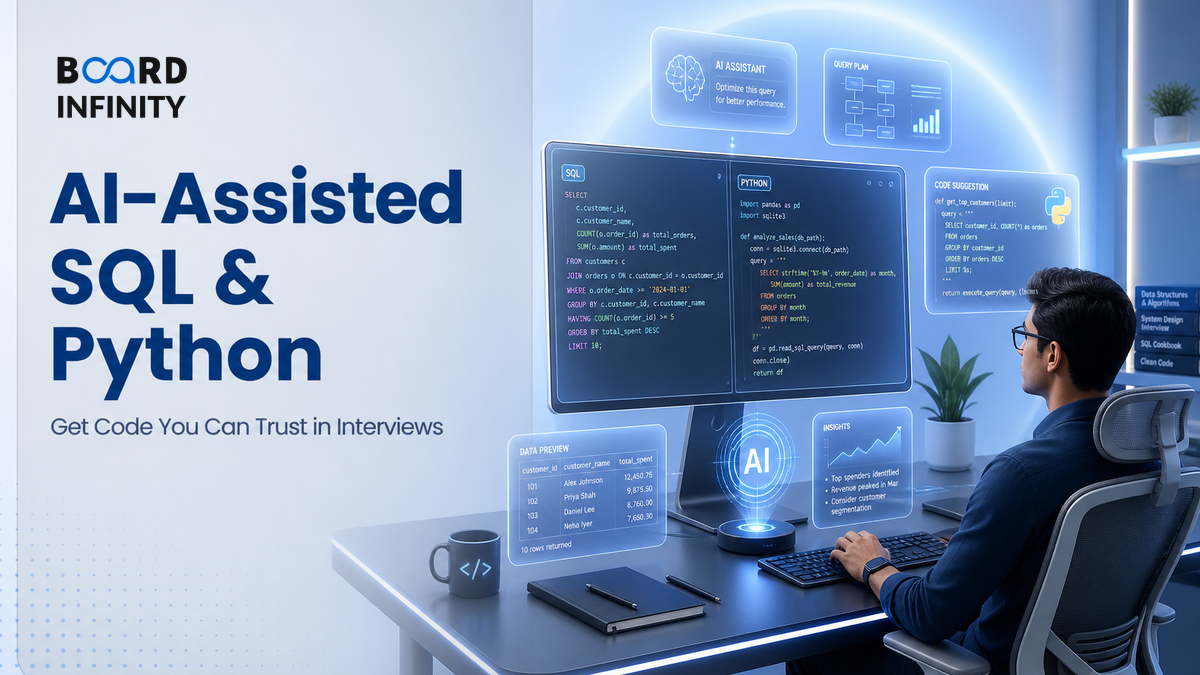
The biggest misconception about AI-assisted coding is that the risk is “bad syntax.” The real risk is worse: code that runs perfectly, produces a neat table, and quietly answers the wrong business question.
- Treat AI-generated SQL/Python as a draft, not an answer. Trust comes from validation, not fluency.
- The safe workflow is: define intent, provide schema/context, generate code, verify outputs, then document assumptions.
- SQL risk usually hides in joins, filters, date logic, aggregation level, duplicate rows, and missing business definitions.
- Python risk usually hides in data leakage, wrong libraries, silent type conversion, overfitting, and untested edge cases.
- For critical business analysis, use reconciliation checks: row counts, totals, null rates, duplicate rates, test pass rate, and runtime/cost.
- Never paste confidential customer data, PII, credentials, or proprietary code into public AI tools. Use approved enterprise tools and masked samples.
- In interviews, say: “I use AI to accelerate code drafting, but I trust only verified outputs.”
Big Picture: AI Is a Coding Co-Pilot, Not a Control System
AI can reduce the blank-page problem in SQL and Python. But the professional skill is not “prompting until something runs.” It is building a trust loop where business intent, data context, code generation, tests, and review reinforce each other.
Core Explanation: How to Get SQL and Python You Can Trust
The big idea is simple: AI can help write code, but only the analyst can certify the meaning of the output. SQL and Python fail differently, so your checks must match the language.
1. Start With the Business Question, Not the Code
A weak prompt says: “Write SQL for active users.” A strong prompt says: “Calculate monthly active users for paid customers only, using user_id, excluding internal test accounts, based on login events, grouped by calendar month.”
AI performs better when you give it:
2. Know Where AI-Generated SQL Usually Breaks
SQL looks deceptively simple because it is declarative: you describe the result, not every computational step. That is exactly why AI can produce correct-looking but wrong logic.
3. Know Where AI-Generated Python Usually Breaks
Python risk is less about syntax and more about silent assumptions. A notebook can run end to end while hiding data leakage, type conversion errors, biased sampling, or overfitted models.
4. Use a Risk Matrix Before Deciding How Much to Trust
Not all AI-generated code needs the same level of control. A quick chart for exploratory analysis can be checked lightly. A query that feeds revenue reporting, credit decisions, customer targeting, or compliance needs stronger gates.
5. Measure Trust With Checks, Not Feelings
For interview answers, avoid vague lines like “I will validate the output.” Name the checks. Typical targets vary by company and use case, but these are strong defaults for business-critical analysis.
Worked Example: The Query Runs, But the Metric Is Wrong
Suppose the business asks for monthly active users. AI writes a query that counts login events instead of distinct users.
The SQL may be syntactically correct, but the business answer is wrong. The fix is to define the metric grain: “Monthly active users = count of distinct user_id with at least one qualifying login event in the month.”
For an Indian payments company such as Razorpay, a SQL query used to reconcile successful UPI transactions with settlement files cannot be trusted merely because it runs. It must align transaction status, settlement date, refunds, bank files, and privacy controls under India-specific compliance expectations such as the DPDP Act, 2023 and RBI-regulated payment workflows. The strategic point: in regulated analytics, correctness means business reconciliation plus data protection, not only valid syntax.
Definitions You Should Be Able to Say Clearly
- SQL: A declarative language used to define, query, and update relational database data.
- Python: A general-purpose programming language widely used for analytics, automation, machine learning, and data engineering.
- AI-assisted coding: Using an LLM to draft, explain, refactor, debug, or test code under human validation.
- Code verification: Checking whether code meets stated requirements through tests, review, and reconciliation.
- Data leakage: Using information in model training that would not be available at the real prediction moment.
Case Study: Stack Overflow and the Plausible-Code Problem
Stack Overflow showed why AI-generated code must be verified: plausible answers can create more review burden than obvious errors.

Situation: When ChatGPT-style tools became widely accessible, coding communities saw a surge of AI-generated answers. Many looked polished, used convincing terminology, and were easy to post quickly.
The move: Stack Overflow temporarily restricted ChatGPT-generated answers because the core issue was not only incorrectness. The bigger operational problem was that wrong answers often looked right, making them harder for moderators and experts to review at scale.
Outcome and lesson: The lesson for analysts is direct: AI-generated SQL or Python can be dangerous precisely because it is fluent. The primary driver of risk is plausible incorrectness, supported by missing context, absent tests, weak provenance, and limited reviewer capacity. The right response is not to reject AI; it is to require evidence before trusting the output.
How AI Changes AI-Assisted SQL & Python
By 2026, the shift is from “AI writes snippets” to “AI participates in the analytics workflow.” Three changes matter for MBA and analytics interviews.
The practical workflow: load the assignment brief, schema notes, metric definitions, and a masked sample dataset into ChatGPT, Claude, or NotebookLM. Ask it to generate three things separately: the SQL/Python draft, a list of assumptions, and a validation checklist. Then run the code locally or in the approved company environment and reconcile outputs against known totals.
Do not paste customer PII, credentials, proprietary source code, or confidential company data into a public AI tool. Use masked data, enterprise-approved tools, and access-controlled environments.
Interview Relevance
“Suppose you use ChatGPT or Copilot to write a SQL query for customer churn analysis. How will you make sure the output is correct and safe to use?”
A strong answer uses this line: “I am comfortable using AI to accelerate drafting, debugging, and documentation, but I do not use AI-generated code for decisions until it passes business and data-quality checks.”
Common Mistake
The most costly mistake is saying, “I will run the AI-generated code and see if it works.” Code that runs is not necessarily code that answers the right question. The one-line fix: validate intent, schema, output totals, edge cases, and privacy before trusting the result.
What to Revise Next
Once you are comfortable getting trustworthy code, revise the next layer: how business users ask data questions without writing code, and why those systems still need governed definitions behind the scenes.