
Generative Reporting & Natural-Language Querying
A regional sales head types, “Why did western India miss target last week?” and expects an answer before the Monday review begins. The risk is not that AI cannot write a beautiful paragraph - the risk is that it writes a confident paragraph from the wrong metric, wrong filter, or wrong data grain.
- Natural-language querying lets users ask business data questions in plain English and get structured answers from BI systems.
- Generative reporting goes one step further: it creates narratives, summaries, explanations and report drafts from governed data.
- The winning architecture is not “LLM plus database”; it is LLM plus semantic layer plus governed metrics plus human review.
- Use NLQ for quick, specific questions: “Revenue by city in Q3.” Use generative reporting for synthesis: “Explain why margin fell this quarter.”
- The biggest value is speed-to-insight for non-technical users; the biggest risk is hallucinated or misinterpreted business logic.
- Evaluate it with answer accuracy, SQL validity, hallucination rate, adoption, time-to-insight and analyst rework saved.
- Interview-safe line: “Generative BI democratizes analytics only when the semantic layer defines the truth.”
Big Picture: From Question to Governed Business Answer
Generative reporting and natural-language querying sit at the front end of modern business intelligence. They replace “open dashboard, find filter, export, write summary” with a conversational path - but only if the back end protects the meaning of metrics.
Core Explanation: What Actually Happens Under the Hood
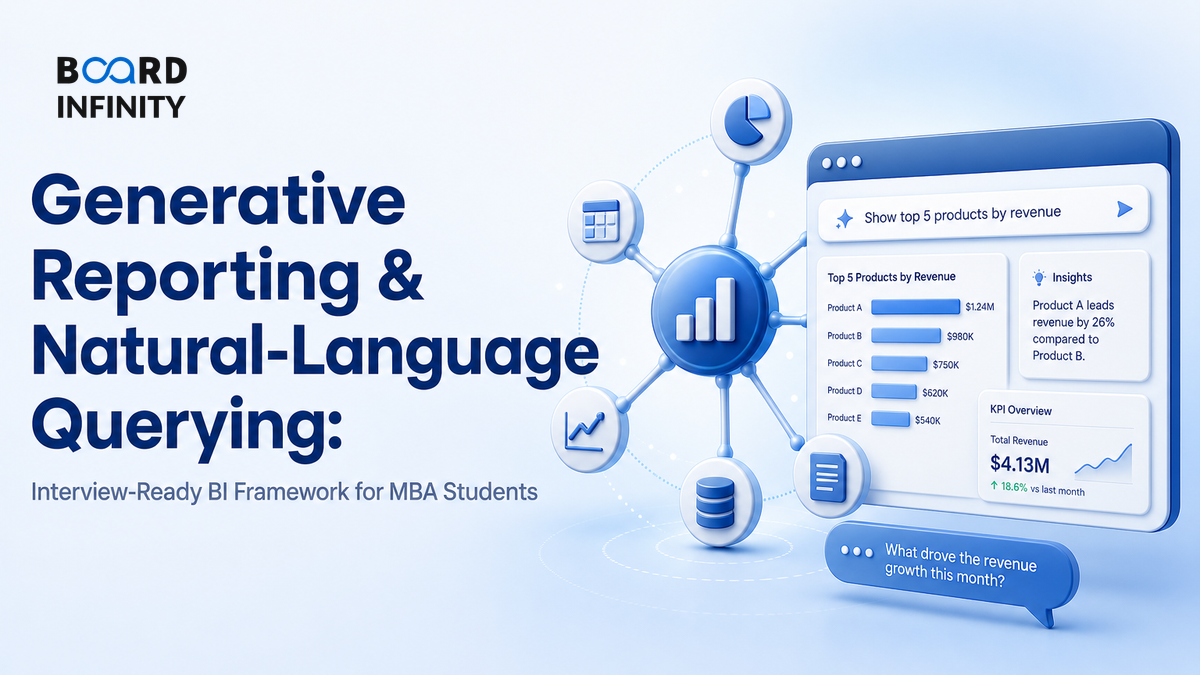
Natural-language querying is the ability to ask data questions in ordinary language - “Show revenue by channel for Q2” - and receive a chart, table or number. Generative reporting uses generative AI to draft summaries, commentary, anomaly explanations and report narratives from that data.
The important distinction: NLQ answers a question; generative reporting explains a business situation. A mature system usually combines both.
Think of the system as a ladder. If the bottom layers are weak, the top layer sounds fluent but cannot be trusted.
The Five-Step Operating Model
What to Measure: Six KPIs for Generative Reporting and NLQ
In interviews, do not say “we will track accuracy” and stop there. A good analytics product answer measures correctness, usability, risk and business impact.
Worked example: Suppose a pilot benchmark has 50 approved business questions. The system answers 42 correctly, generates 48 executable queries, and makes 5 unsupported narrative claims across 100 claims. Answer accuracy = 42/50 = 84%. Query validity = 48/50 = 96%. Hallucination rate = 5/100 = 5%. That is a usable pilot, but not yet safe for unsupervised board commentary.
Definitions You Can Say in One Breath
- Natural-language querying: Users ask data questions in ordinary language and receive structured answers from databases or BI systems.
- Generative reporting: Generative AI drafts summaries, explanations, charts and report narratives from governed business data.
- Semantic layer: A business logic layer that maps technical data fields to consistent metrics, dimensions, relationships and permissions.
- Hallucination: An AI output that sounds plausible but is unsupported, incorrect or not grounded in the source data.
Case Study: Zoho Analytics and Ask Zia
Zoho Analytics uses its AI assistant Ask Zia to let business users ask questions, generate charts and receive insight summaries without writing SQL.

Situation: Many Indian SMBs and mid-market teams run on a mix of spreadsheets, CRM data, finance systems, marketing tools and operations trackers. The decision-maker often knows the business question but not SQL, joins, dashboard filters or metric definitions.
The move: Zoho Analytics built conversational analytics through Ask Zia, allowing users to ask questions in natural language and receive visual answers. Its broader AI capabilities also support automated insights and narrative summaries. The primary driver is the combination of a natural-language interface with a structured analytics platform. Supporting drivers include Zoho’s app ecosystem, data connectors, visualization layer and the ability to model business metrics before users ask questions.
Outcome and lesson: The lesson is not “chatbots replace analysts.” The lesson is that conversational BI expands the number of people who can explore data, while analysts still design models, definitions, data quality checks and review processes.
How AI Changes Generative Reporting & Natural-Language Querying
1. From dashboard search to proactive insight generation: Tools such as Microsoft Power BI Copilot, Tableau Pulse, ThoughtSpot Spotter and Zoho’s Zia-style assistants increasingly surface anomalies, summarize movement and suggest follow-up questions instead of waiting for users to inspect charts manually.
2. From generic chat to governed analytics copilots: By 2026, the differentiator is grounding. Enterprise systems are using semantic layers, retrieval, metadata, lineage and permission controls so the AI answers from approved business logic rather than guessing from raw tables.
3. From static reports to living management narratives: Monthly business reviews can become dynamic narratives where AI drafts the first version, links every claim to a chart or metric, and lets managers drill down conversationally.
Use NotebookLM for interview prep: upload a company annual report, a sample dashboard screenshot description and your notes on semantic layers. Ask it to generate 10 business questions a CXO might ask, then classify each as NLQ, generative reporting or analyst-led deep dive.
Interview Relevance
“Our sales leaders want to ask questions directly in English and get automated performance summaries. How would you design and evaluate a generative reporting or NLQ solution?”
If you get a product, analytics or consulting interviewer, use this sentence: “I would not connect an LLM directly to raw tables; I would first create a semantic layer so business terms, joins and permissions are controlled.”
Common Mistake
The mistake: Treating generative reporting as a chatbot UI problem. That costs candidates because interviewers know the real challenge is trusted business meaning, not fluent language. One-line fix: Always anchor your answer in the semantic layer, governed metrics and validation loop.
What to Revise Next
Revise this as a journey from interface to architecture to autonomy. First, study Why Conversational Analytics Needs a Semantic Layer so you can explain why NLQ fails without governed definitions. Then move to Agentic Analytics: Agents That Query, Analyse and Report to understand the next step - AI systems that do not just answer, but plan analysis workflows and produce decision-ready reports.