
AI Across the Hiring Funnel: Sourcing, Screening & Matching for Interviews
A retail recruiter has 400 applications for 40 festive-season store roles, and the best candidates may accept another offer before lunch. The real question is not whether AI can “shortlist faster” - it is whether it can find job-relevant signals without quietly filtering out the wrong people.
- AI in hiring means using algorithms to source, screen, rank or match candidates using job-relevant data.
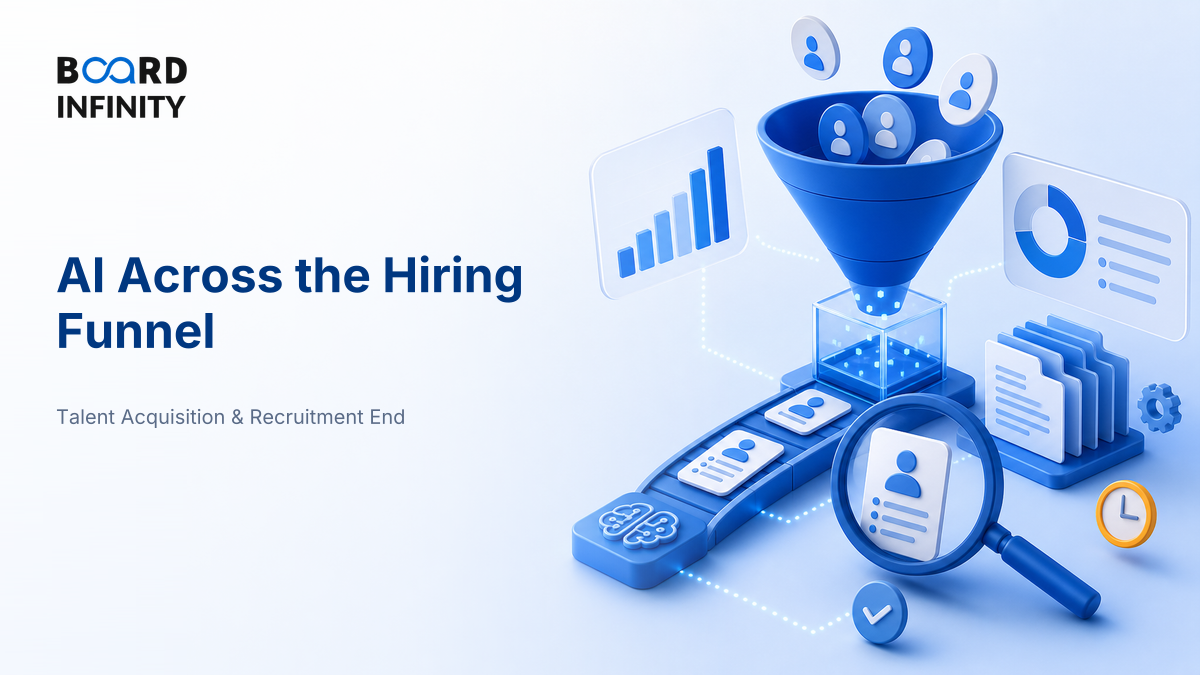
- The hiring funnel has three AI-heavy zones: sourcing expands the pool, screening filters for minimum fit, and matching ranks best-fit candidates or roles.
- Good AI hiring starts with clean job criteria. A vague job description creates a vague model.
- The best systems keep humans in the loop for judgement, context and accountability.
- Track both efficiency and fairness: time-to-slate, qualified applicant rate, precision@K, conversion, candidate drop-off and adverse impact ratio.
- The biggest risk is proxy discrimination - the model may learn patterns linked to gender, caste, geography, college brand or career breaks without naming them directly.
- Interview answer formula: define the funnel, explain AI use cases, name metrics, add governance, then give a real example.
Big Picture
AI does not replace hiring judgement. It changes where judgement is applied: from manually reading every profile to designing criteria, supervising rankings, auditing outcomes and improving the funnel.
The Three AI Use Cases You Must Know
Sourcing is about reach. A recruiter may not know every relevant campus, gig worker community, alumni database or frontline labour pool. AI can widen the top of the funnel by finding adjacent skills and similar profiles. For example, a customer support role may fit candidates from retail sales, hospitality or call centres, even if their resumes use different keywords.
Screening is about minimum qualification. Here, AI is useful for high-volume roles where recruiters need to remove clearly ineligible applications. But it is also where many risks begin. If the screen is based on narrow keywords, elite college filters or unexplained career gaps, it may reject capable candidates for weak reasons.
Matching is the more strategic layer. Instead of asking “Does this resume contain the exact keyword?”, matching asks “Which candidate is most likely to succeed in this role, under these constraints?” Good matching uses structured job requirements, skill evidence, location, compensation fit, availability and sometimes past hiring outcomes.
What AI Should and Should Not Use
The safest test is job relevance. Data should be connected to the work, explainable to the candidate and defensible to HR, business and legal stakeholders.
Metrics: How to Judge Whether AI Hiring Is Actually Working
There is no honest universal benchmark across roles, industries and seniority levels. A strong number is one that improves against the company’s own baseline while maintaining quality and fairness.
Definitions
- Artificial intelligence - ISO/IEC 22989: “Capability of an engineered system to acquire, process and apply knowledge and skills.”
- AI in hiring: Use of algorithms to source, screen, rank or match candidates using job-relevant data.
- Sourcing: Identifying and attracting potential candidates before formal selection begins.
- Screening: Filtering applicants against minimum job requirements before deeper assessment.
- Matching: Ranking candidates or roles by predicted fit using skills, constraints and preference signals.
- Adverse impact: A selection process disproportionately disadvantages a protected group, even without explicit intent.
Case Study: Apna and AI Matching for India’s Frontline Hiring
Apna built a mobile-first jobs and professional networking platform for India’s blue-collar and grey-collar workforce, where matching matters because resumes are often incomplete and hiring is time-sensitive.
Core Explanation: How AI Works Across the Hiring Funnel
Think of AI hiring as a funnel with three jobs. First, it helps employers find relevant people. Then it helps them filter against minimum requirements. Finally, it helps them match candidates to roles based on fit, constraints and probability of success.
The Three AI Use Cases You Must Know
Sourcing is about reach. A recruiter may not know every relevant campus, gig worker community, alumni database or frontline labour pool. AI can widen the top of the funnel by finding adjacent skills and similar profiles. For example, a customer support role may fit candidates from retail sales, hospitality or call centres, even if their resumes use different keywords.
Screening is about minimum qualification. Here, AI is useful for high-volume roles where recruiters need to remove clearly ineligible applications. But it is also where many risks begin. If the screen is based on narrow keywords, elite college filters or unexplained career gaps, it may reject capable candidates for weak reasons.
Matching is the more strategic layer. Instead of asking “Does this resume contain the exact keyword?”, matching asks “Which candidate is most likely to succeed in this role, under these constraints?” Good matching uses structured job requirements, skill evidence, location, compensation fit, availability and sometimes past hiring outcomes.
What AI Should and Should Not Use
The safest test is job relevance. Data should be connected to the work, explainable to the candidate and defensible to HR, business and legal stakeholders.
Metrics: How to Judge Whether AI Hiring Is Actually Working
There is no honest universal benchmark across roles, industries and seniority levels. A strong number is one that improves against the company’s own baseline while maintaining quality and fairness.
Definitions
- Artificial intelligence - ISO/IEC 22989: “Capability of an engineered system to acquire, process and apply knowledge and skills.”
- AI in hiring: Use of algorithms to source, screen, rank or match candidates using job-relevant data.
- Sourcing: Identifying and attracting potential candidates before formal selection begins.
- Screening: Filtering applicants against minimum job requirements before deeper assessment.
- Matching: Ranking candidates or roles by predicted fit using skills, constraints and preference signals.
- Adverse impact: A selection process disproportionately disadvantages a protected group, even without explicit intent.
Case Study: Apna and AI Matching for India’s Frontline Hiring
Apna built a mobile-first jobs and professional networking platform for India’s blue-collar and grey-collar workforce, where matching matters because resumes are often incomplete and hiring is time-sensitive.
Core Explanation: How AI Works Across the Hiring Funnel
Think of AI hiring as a funnel with three jobs. First, it helps employers find relevant people. Then it helps them filter against minimum requirements. Finally, it helps them match candidates to roles based on fit, constraints and probability of success.
The Three AI Use Cases You Must Know
Sourcing is about reach. A recruiter may not know every relevant campus, gig worker community, alumni database or frontline labour pool. AI can widen the top of the funnel by finding adjacent skills and similar profiles. For example, a customer support role may fit candidates from retail sales, hospitality or call centres, even if their resumes use different keywords.
Screening is about minimum qualification. Here, AI is useful for high-volume roles where recruiters need to remove clearly ineligible applications. But it is also where many risks begin. If the screen is based on narrow keywords, elite college filters or unexplained career gaps, it may reject capable candidates for weak reasons.
Matching is the more strategic layer. Instead of asking “Does this resume contain the exact keyword?”, matching asks “Which candidate is most likely to succeed in this role, under these constraints?” Good matching uses structured job requirements, skill evidence, location, compensation fit, availability and sometimes past hiring outcomes.
Matching is a decision-support workflow, not an automatic hiring decision.Matching is a decision-support workflow, not an automatic hiring decision.Job criteriaSkills andconstraintsCandidatedataProfile andsignalsRankingmodelScores best fitRecruiterreviewContext andjudgementMatching is a decision-support workflow, not an automatic hiring decision.
What AI Should and Should Not Use
The safest test is job relevance. Data should be connected to the work, explainable to the candidate and defensible to HR, business and legal stakeholders.
Metrics: How to Judge Whether AI Hiring Is Actually Working
There is no honest universal benchmark across roles, industries and seniority levels. A strong number is one that improves against the company’s own baseline while maintaining quality and fairness.
Definitions
- Artificial intelligence - ISO/IEC 22989: “Capability of an engineered system to acquire, process and apply knowledge and skills.”
- AI in hiring: Use of algorithms to source, screen, rank or match candidates using job-relevant data.
- Sourcing: Identifying and attracting potential candidates before formal selection begins.
- Screening: Filtering applicants against minimum job requirements before deeper assessment.
- Matching: Ranking candidates or roles by predicted fit using skills, constraints and preference signals.
- Adverse impact: A selection process disproportionately disadvantages a protected group, even without explicit intent.
Case Study: Apna and AI Matching for India’s Frontline Hiring
Apna built a mobile-first jobs and professional networking platform for India’s blue-collar and grey-collar workforce, where matching matters because resumes are often incomplete and hiring is time-sensitive.
[[GOLD-IMAGE: A blue-toned Indian street-side hiring moment, with a young job seeker holding a smartphone showing generic job cards, a small retail storefront and delivery bikes in the background, no logos and no readable text | caption: Frontline hiring in India depends on speed, trust and mobile-first matching, not just formal resumes.
Situation: In many Indian frontline roles - sales promoters, delivery partners, telecallers, retail staff and operations associates - the classic white-collar resume is a weak signal. Candidates may have informal experience, short notice availability, location constraints, language preferences and urgent income needs. Employers, meanwhile, want quick shortlists and lower no-show rates.
The move: Apna approached the problem as a matching marketplace rather than only a job board. The primary driver was mobile-first candidate-role matching: helping candidates discover relevant jobs and helping employers access a more suitable pool. Supporting drivers included local job discovery, community-style professional groups, simplified profiles, employer access to large candidate pools, and workflow design suited to high-volume hiring.
The lesson: AI matching is strongest when it is designed around the real labour market. In India, that means mobile access, location fit, language comfort, role urgency, consented data use and simple recruiter actionability. The “so what” for interviews: do not describe AI hiring as resume parsing alone - in high-volume Indian hiring, the bigger value is faster and better matching between demand and supply.
Risk Map: Where AI Hiring Can Go Wrong
The danger is not only “AI bias” in the abstract. The practical problem is that a model may learn shortcuts that look predictive but are not truly job-relevant.
The goal is not maximum automation; the goal is high predictive value with strong governance.The goal is not maximum automation; the goal is high predictive value with strong governance.Safe but weakCompliant low signalBest zoneRelevant and auditedBad automationFast wrong filtersRisky shortcutPredictive but unfairPredictive valueGovernance strengthThe goal is not maximum automation; the goal is high predictive value with strong governance.
A strong hiring AI system needs four controls:
How AI Changes Sourcing, Screening & Matching
1. From keyword search to skills inference. Modern hiring tools increasingly infer adjacent skills instead of matching exact resume words. A candidate who wrote “handled walk-in customers and billing” may be surfaced for a retail sales role even without the exact phrase “customer relationship management.”
2. From one-way screening to two-sided matching. Better systems rank not just “best candidate for job” but also “best job for candidate.” This matters in India where commute, shift, pay cycle, language and joining urgency strongly influence acceptance and retention.
3. From static funnels to continuously learned funnels. AI can learn which sources produce candidates who pass interviews, accept offers and stay, but this must be audited so the system does not simply reproduce past bias.
Use NotebookLM: upload the job description, the company careers page and your notes on AI hiring. Ask: “Create five interview questions on how this company could use AI in sourcing, screening and matching, including metrics and bias risks.” Then practise answering each in the funnel-metrics-governance structure.
Interview Relevance
“Our company receives thousands of applications for entry-level roles. How would you use AI to improve sourcing, screening and candidate matching without creating bias?”
Use the phrase “decision support, not decision replacement”. It shows maturity because you understand both efficiency and accountability.
Common Mistake
The mistake that costs candidates is saying “AI removes bias because it is objective.” It costs you because algorithms learn from historical data, and historical hiring data often contains human bias. The one-line fix: AI can reduce inconsistency, but only if job criteria, data quality, human oversight and fairness audits are built in.
What to Revise Next
Now move one step deeper into the hiring funnel. Revise AI in Interviewing & Assessment: Claims versus Evidence to separate valid assessment from hype, then practise Case Study: Fixing a Broken Hiring Funnel to apply sourcing, screening, matching, metrics and governance in one integrated answer.