
Psychometrics, Assessment Centres & Work Sample Tests: Interview-Ready Selection Framework
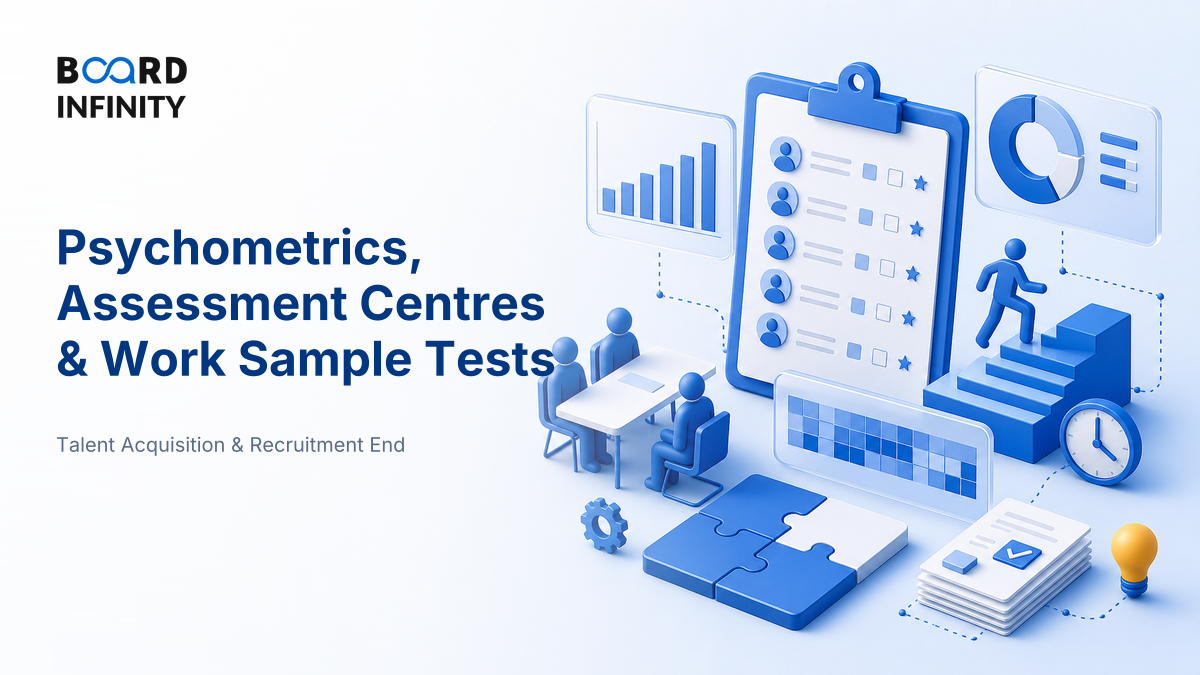
A résumé can make two candidates look identical; a 20-minute case simulation can make them look completely different. That is the point of modern hiring science - move from what people claim to have done, to evidence of how they think, behave and perform.
- Psychometric tests measure stable constructs such as cognitive ability, personality traits, motivation, integrity or judgement.
- Assessment centres combine multiple exercises, assessors and competencies to observe behaviour in simulated job situations.
- Work sample tests ask candidates to do a realistic slice of the actual job - a sales pitch, case analysis, coding task, presentation or in-basket exercise.
- The strongest selection systems start with job analysis, then choose tools that predict performance, are fair and are practical to administer.
- Judge any assessment using reliability, validity, adverse impact, completion rate and candidate experience - not just “it feels rigorous”.
- The best interview answer compares the three tools by what they measure, how they are used, strengths, risks and example roles.
Big Picture: Hiring Evidence Has Three Layers
Think of selection as a ladder of evidence. Psychometrics estimate the candidate’s underlying traits, assessment centres observe behaviour across situations, and work sample tests get closest to actual job performance.
Psychometrics: What It Measures - and How You Judge the Test
Psychometrics is the measurement of psychological attributes such as ability, personality, interests, motivation and judgement. In recruitment, it helps answer: “What is this candidate likely to do consistently across situations?”
Common constructs measured in hiring include:
- Cognitive ability - numerical reasoning, verbal reasoning, logical reasoning and problem-solving speed.
- Personality traits - for example conscientiousness, openness, emotional stability and extraversion.
- Motivation and interests - what kind of work energises the candidate.
- Integrity and dependability - tendency to follow rules, avoid counterproductive behaviour and act responsibly.
- Situational judgement - choosing effective responses to workplace scenarios.
A good candidate does not say “psychometric tests measure personality” and stop. They explain that a test must be reliable, valid, fair and job-relevant.
Worked example - adverse impact: Suppose 100 candidates from Group A apply and 40 are selected, so the selection rate is 40%. From Group B, 100 apply and 25 are selected, so the selection rate is 25%. The adverse impact ratio for Group B is 25% / 40% = 0.625. Because 0.625 is below 0.80, the employer should investigate whether the test or process is unfairly screening out Group B.
Assessment Centres: Behaviour Under Observation
An assessment centre is not a physical centre. It is a method: multiple candidates complete multiple exercises, while trained assessors rate them against pre-defined competencies.
Typical assessment centre exercises include group discussion, case analysis, role play, in-basket exercise, presentation, structured interview and leaderless group task. The power comes from triangulation: one candidate is not judged by one interviewer in one conversation.
Many Indian management trainee and leadership hiring processes use assessment-centre style rounds: case discussions, role plays, presentations and structured interviews. The strategic point is that recruiters are not only checking knowledge; they are observing collaboration, communication, commercial thinking and composure under ambiguity.
Work Sample Tests: The Closest Proxy for the Job
A work sample test asks the candidate to perform a task that closely resembles the real work. For an area sales manager role, it could be a distributor negotiation role play. For a product role, it could be prioritising a roadmap from customer complaints. For consulting, it could be solving a market-entry case.
Work samples are powerful because they have high face validity: candidates can see the link to the job. But they are harder to design well. A poor work sample becomes a random puzzle; a good work sample mirrors the actual role.
Definitions You Can Say in One Breath
Anne Anastasi described a psychological test as “an objective and standardized measure of a sample of behavior.”
- Psychometrics: The science of measuring psychological attributes such as ability, personality, motivation and judgement.
- Assessment centre: A multi-exercise, multi-assessor method for observing job-relevant behaviour against defined competencies.
- Work sample test: A selection test where candidates perform a realistic task drawn from the actual job.
- Validity: The degree to which evidence supports the intended interpretation and use of assessment scores.
L’Oréal Brandstorm: Work Sample Hiring as a Talent Signal
L’Oréal’s Brandstorm turns student hiring into a live innovation challenge, making candidates demonstrate marketing, creativity and business thinking before recruiters make talent decisions.
Core Explanation: The Three Tools and When to Use Each
The cleanest way to understand this topic is not to memorise definitions separately. Ask one question: How close is the assessment to the real job?
Psychometrics: What It Measures - and How You Judge the Test
Psychometrics is the measurement of psychological attributes such as ability, personality, interests, motivation and judgement. In recruitment, it helps answer: “What is this candidate likely to do consistently across situations?”
Common constructs measured in hiring include:
- Cognitive ability - numerical reasoning, verbal reasoning, logical reasoning and problem-solving speed.
- Personality traits - for example conscientiousness, openness, emotional stability and extraversion.
- Motivation and interests - what kind of work energises the candidate.
- Integrity and dependability - tendency to follow rules, avoid counterproductive behaviour and act responsibly.
- Situational judgement - choosing effective responses to workplace scenarios.
A good candidate does not say “psychometric tests measure personality” and stop. They explain that a test must be reliable, valid, fair and job-relevant.
Worked example - adverse impact: Suppose 100 candidates from Group A apply and 40 are selected, so the selection rate is 40%. From Group B, 100 apply and 25 are selected, so the selection rate is 25%. The adverse impact ratio for Group B is 25% / 40% = 0.625. Because 0.625 is below 0.80, the employer should investigate whether the test or process is unfairly screening out Group B.
Assessment Centres: Behaviour Under Observation
An assessment centre is not a physical centre. It is a method: multiple candidates complete multiple exercises, while trained assessors rate them against pre-defined competencies.
Typical assessment centre exercises include group discussion, case analysis, role play, in-basket exercise, presentation, structured interview and leaderless group task. The power comes from triangulation: one candidate is not judged by one interviewer in one conversation.
Many Indian management trainee and leadership hiring processes use assessment-centre style rounds: case discussions, role plays, presentations and structured interviews. The strategic point is that recruiters are not only checking knowledge; they are observing collaboration, communication, commercial thinking and composure under ambiguity.
Work Sample Tests: The Closest Proxy for the Job
A work sample test asks the candidate to perform a task that closely resembles the real work. For an area sales manager role, it could be a distributor negotiation role play. For a product role, it could be prioritising a roadmap from customer complaints. For consulting, it could be solving a market-entry case.
Work samples are powerful because they have high face validity: candidates can see the link to the job. But they are harder to design well. A poor work sample becomes a random puzzle; a good work sample mirrors the actual role.
Definitions You Can Say in One Breath
Anne Anastasi described a psychological test as “an objective and standardized measure of a sample of behavior.”
- Psychometrics: The science of measuring psychological attributes such as ability, personality, motivation and judgement.
- Assessment centre: A multi-exercise, multi-assessor method for observing job-relevant behaviour against defined competencies.
- Work sample test: A selection test where candidates perform a realistic task drawn from the actual job.
- Validity: The degree to which evidence supports the intended interpretation and use of assessment scores.
L’Oréal Brandstorm: Work Sample Hiring as a Talent Signal
L’Oréal’s Brandstorm turns student hiring into a live innovation challenge, making candidates demonstrate marketing, creativity and business thinking before recruiters make talent decisions.
Core Explanation: The Three Tools and When to Use Each
The cleanest way to understand this topic is not to memorise definitions separately. Ask one question: How close is the assessment to the real job?
Psychometrics: What It Measures - and How You Judge the Test
Psychometrics is the measurement of psychological attributes such as ability, personality, interests, motivation and judgement. In recruitment, it helps answer: “What is this candidate likely to do consistently across situations?”
Common constructs measured in hiring include:
- Cognitive ability - numerical reasoning, verbal reasoning, logical reasoning and problem-solving speed.
- Personality traits - for example conscientiousness, openness, emotional stability and extraversion.
- Motivation and interests - what kind of work energises the candidate.
- Integrity and dependability - tendency to follow rules, avoid counterproductive behaviour and act responsibly.
- Situational judgement - choosing effective responses to workplace scenarios.
A good candidate does not say “psychometric tests measure personality” and stop. They explain that a test must be reliable, valid, fair and job-relevant.
Worked example - adverse impact: Suppose 100 candidates from Group A apply and 40 are selected, so the selection rate is 40%. From Group B, 100 apply and 25 are selected, so the selection rate is 25%. The adverse impact ratio for Group B is 25% / 40% = 0.625. Because 0.625 is below 0.80, the employer should investigate whether the test or process is unfairly screening out Group B.
Assessment Centres: Behaviour Under Observation
An assessment centre is not a physical centre. It is a method: multiple candidates complete multiple exercises, while trained assessors rate them against pre-defined competencies.
Typical assessment centre exercises include group discussion, case analysis, role play, in-basket exercise, presentation, structured interview and leaderless group task. The power comes from triangulation: one candidate is not judged by one interviewer in one conversation.
Assessment centres work only when every exercise maps back to job competencies.Assessment centres work only when every exercise maps back to job competencies.JobAnalysisDefinecompetenciesExercisesSimulatesituationsAssessorsObservebehaviourRatingScoreevidenceDecisionCombinesignalsAssessment centres work only when every exercise maps back to job competencies.
Many Indian management trainee and leadership hiring processes use assessment-centre style rounds: case discussions, role plays, presentations and structured interviews. The strategic point is that recruiters are not only checking knowledge; they are observing collaboration, communication, commercial thinking and composure under ambiguity.
Work Sample Tests: The Closest Proxy for the Job
A work sample test asks the candidate to perform a task that closely resembles the real work. For an area sales manager role, it could be a distributor negotiation role play. For a product role, it could be prioritising a roadmap from customer complaints. For consulting, it could be solving a market-entry case.
Work samples are powerful because they have high face validity: candidates can see the link to the job. But they are harder to design well. A poor work sample becomes a random puzzle; a good work sample mirrors the actual role.
Definitions You Can Say in One Breath
Anne Anastasi described a psychological test as “an objective and standardized measure of a sample of behavior.”
- Psychometrics: The science of measuring psychological attributes such as ability, personality, motivation and judgement.
- Assessment centre: A multi-exercise, multi-assessor method for observing job-relevant behaviour against defined competencies.
- Work sample test: A selection test where candidates perform a realistic task drawn from the actual job.
- Validity: The degree to which evidence supports the intended interpretation and use of assessment scores.
L’Oréal Brandstorm: Work Sample Hiring as a Talent Signal
L’Oréal’s Brandstorm turns student hiring into a live innovation challenge, making candidates demonstrate marketing, creativity and business thinking before recruiters make talent decisions.
[[GOLD-IMAGE: A university team presenting a beauty-tech concept on a stage lit in deep red and white, with generic cosmetic bottles and a laptop on the table, no logos or readable text | caption: A strong work sample makes talent visible through action, not claims.
Situation: For marketing, digital and management trainee roles, a CV often says “creative”, “strategic” and “consumer-centric”. Those words are cheap unless the candidate can prove them through a real business problem.
The move: L’Oréal Brandstorm asks student teams across countries, including India, to solve a live innovation challenge linked to beauty, technology, sustainability or consumer experience. Participants research consumers, build ideas, pitch solutions and defend their thinking. Recruiters get evidence of collaboration, insight generation, storytelling, business logic and comfort with ambiguity.
Outcome and lesson: The primary driver is job realism - candidates perform a marketing innovation task, not just talk about marketing. Supporting drivers include global employer branding, team-based assessment, structured pitching and exposure to real category problems. The “so what” is simple: work samples are strongest when the task feels like the job and the evaluation criteria are explicit.
How AI Changes Psychometrics, Assessment Centres & Work Sample Tests
AI is changing assessment design, scoring and candidate preparation - but it also raises fairness and transparency questions.
- Adaptive psychometric testing: AI-enabled platforms can adjust item difficulty based on earlier responses, reducing test time while preserving measurement quality. The caution is that the scoring model must be validated and explainable.
- Simulation scoring: AI can help score written cases, sales role plays or customer-service responses using rubrics. Human moderation remains important because communication style, accent, disability and context can create bias.
- Skills intelligence: Companies increasingly map roles to skills, then design assessments around observable capabilities rather than degree labels. This supports skills-based hiring, especially for digital, analytics and operations roles.
Use NotebookLM or Claude to prepare for an assessment centre: upload the job description, company annual report and role brief, then ask it to generate likely competencies, two role-play scenarios, one in-basket exercise and a scoring rubric. Practise aloud; do not memorise scripts.
Interview Relevance
“Compare psychometric tests, assessment centres and work sample tests. Which one would you use for hiring management trainees, and why?”
A strong answer never argues that one tool is universally best. It says: “The best method depends on role complexity, volume, cost, fairness and how close the test is to actual performance.”
Common Mistake
The mistake is treating psychometrics, assessment centres and work samples as interchangeable “HR tests”. That costs candidates because it shows they do not understand measurement quality or job relevance. The fix: always link the tool to the construct, the job task and the evidence it produces.
What to Revise Next
Next, move from assessment methods to the broader hiring philosophy and execution system. Revise Skills-Based Hiring: Assessing Beyond Degrees to understand why companies are shifting from credentials to capabilities, then study Campus Recruitment in India: Running the Season to see how these tools fit into real placement processes.