
The AI Impact Map: Which HR Activities Change and by How Much
A recruiter opens a dashboard on Monday morning: 3,000 applications have already been ranked, interview slots are suggested, and a chatbot has answered most candidate questions before breakfast. But the same team still hesitates before rejecting a borderline candidate, handling a grievance, or deciding who gets promoted - because the hardest HR decisions are not just data problems.
- The AI Impact Map explains HR activity by activity: what gets automated, what gets augmented, and what must remain human-led.
- AI changes HR most where tasks are high-volume, rules-based, data-rich and low-risk - for example scheduling, policy queries and resume parsing.
- AI augments work where judgment is needed but data helps - for example sourcing, learning recommendations, performance review summaries and workforce planning.
- AI should not independently decide high-stakes people outcomes like hiring, firing, promotion, pay, discipline or grievance resolution.
- The best answer is not “AI will replace HR”; it is “AI moves HR from transaction processing to decision quality, employee trust and workforce design.”
- Measure AI in HR through time saved, quality of hire, adverse impact ratio, candidate experience, self-service deflection and internal mobility.
Big Picture: AI Does Not Hit All HR Work Equally
Think of HR as a portfolio of activities. Some are repetitive transactions, some are advisory judgments, and some are sensitive trust-building moments. AI impact depends on two questions: How structured is the work? and How high is the human risk?
Core Explanation: The AI Impact Map for HR Activities
The simplest way to understand AI in HR is to stop asking, “Which jobs will AI replace?” and start asking, “Which tasks inside HR will change?” A role like recruiter, HR business partner or L&D manager contains many tasks. AI may automate one task, augment another, and barely touch a third.
AI Impact Map: a task-level view of HR that classifies each activity by likely AI change - automate, augment, govern closely, or keep human-led.
The Four Zones of AI Impact in HR
Use these four zones as your interview map. It is practical because it links the type of HR activity to the degree of AI change.
The key is not to sound anti-AI or blindly pro-AI. Strong candidates say: AI changes the work content, but human accountability remains strongest where decisions affect dignity, livelihood and trust.
A Simple Scoring Heuristic: How Much Will an HR Activity Change?
For a quick interview answer, score each HR task on four signals. This is not a universal law; it is a practical thinking tool.
AI Change Score = Routine + Data availability + Volume + Low people risk. A score near 8 suggests high automation potential. A score near 0 suggests the task should remain human-led.
TCS operates in a people-intensive services model where HR must manage recruitment, learning, deployment and employee support at very large scale. AI is most useful in this context for high-volume internal HR operations, skills matching and learning recommendations, while managers and HR leaders remain accountable for deployment, career conversations and sensitive employee decisions. The strategic lesson: scale makes AI valuable, but employee trust makes human governance non-negotiable.
Definitions You Should Be Able to Say Clearly
Gary Dessler: “Human resource management is the process of acquiring, training, appraising, and compensating employees, and attending to their labor relations, health and safety, and fairness concerns.”
What to Measure When AI Enters HR
Do not measure AI in HR only by cost reduction. A good AI-HR pilot must improve speed, quality and fairness together. If speed improves but bias worsens, the pilot is not successful.
Case Study: Schneider Electric and the AI-Enabled Talent Marketplace
Schneider Electric used an AI-powered internal talent marketplace to match employees with roles, projects and mentors, making workforce mobility more transparent.
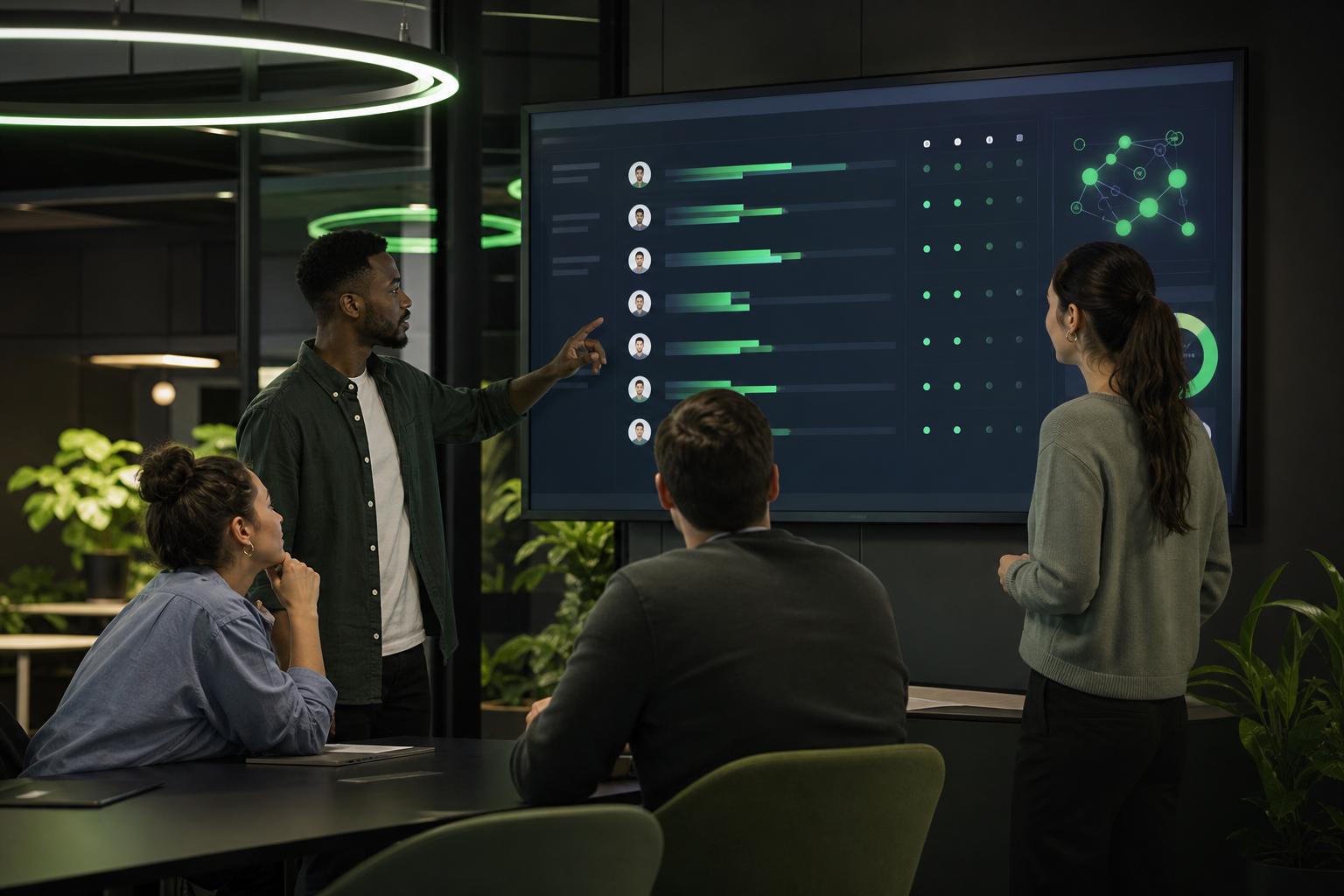
Situation: Large global companies often have a paradox: they hire externally while internal employees feel they cannot see career opportunities. Skills are scattered across resumes, manager knowledge, learning records and project histories. That makes internal mobility slow and uneven.
The move: Schneider Electric introduced an internal talent marketplace that uses AI to connect employees with open roles, short-term projects, mentoring and learning opportunities. The system helps surface possible matches, but the career conversation still involves the employee, manager and HR. This is a classic augmentation case: AI expands visibility, while humans preserve motivation, context and fairness.
Outcome or lesson: The primary driver was not “AI magic”; it was creating a skills-based internal market. Supporting drivers included better employee data, leadership support for mobility, manager participation and integration with learning and career processes. The lesson for interviews is powerful: AI in HR creates value when it changes the operating model, not merely when it adds a tool.
How AI Changes The AI Impact Map for HR
By 2026, AI is changing the impact map itself in three concrete ways.
Practical student workflow: Use NotebookLM to upload a company annual report, careers page and two recent HR news articles. Ask: “Map this company’s HR activities into automate, augment, govern tightly and human-led zones. Give likely interview questions and risks.” Then use ChatGPT or Claude to convert the output into a 90-second answer.
Interview Relevance
“If you were the HR head of a large Indian services company, where would you apply AI first and where would you avoid full automation?”
Use the phrase “AI should be decision support, not decision authority, in high-stakes HR decisions.” It signals both business understanding and ethical maturity.
Common Mistake
The biggest mistake is giving a generic answer like “AI will replace HR operations and improve recruitment.” That sounds shallow because it ignores task differences, bias risk and human accountability. Fix: always map HR activities into automate, augment, govern tightly and human-led zones before giving examples.