
Workforce Planning for an AI Transition: Redeployment & Reskilling
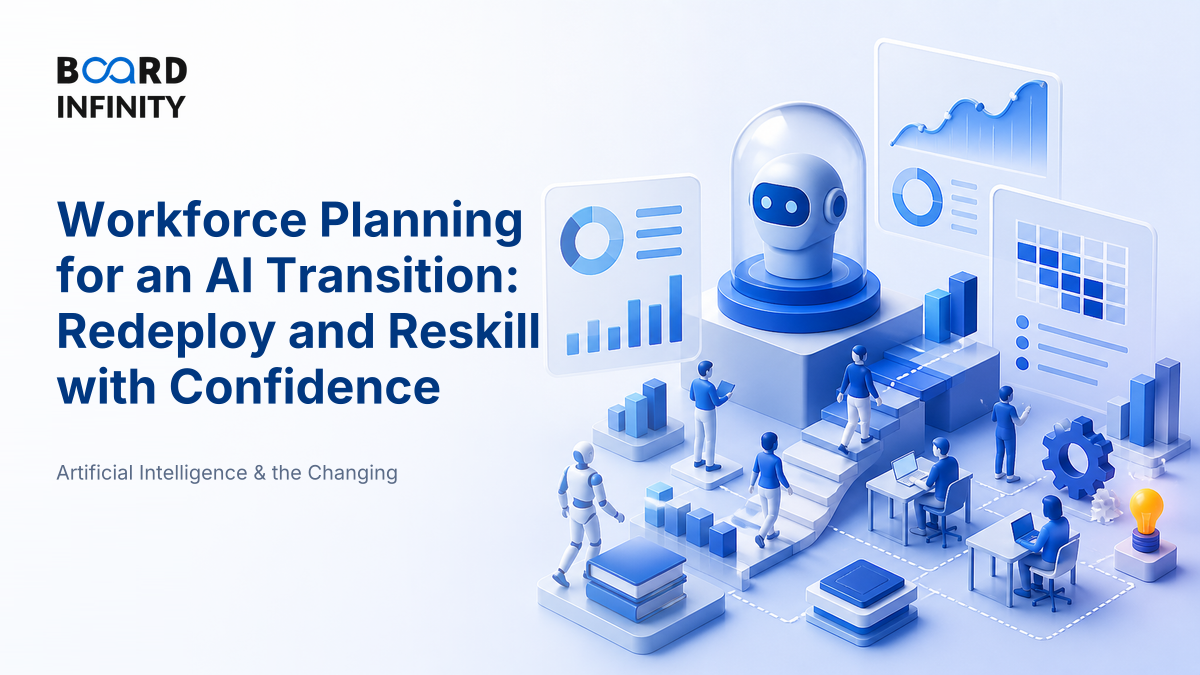
Yesterday, a service team needed 40 analysts to read tickets, tag issues and draft replies. Today, an AI copilot does the first draft in seconds - but the company still needs people who can judge exceptions, manage customers, audit outputs and redesign workflows.
That before-and-after is the heart of AI workforce planning: the goal is not simply to reduce headcount, but to redesign work, move people into higher-value roles and build skills before the talent gap becomes a business risk.
- AI workforce planning asks: which tasks change, which roles shrink or grow, and which people can be redeployed or reskilled?
- Do not start with job titles. Start with tasks - because AI automates tasks, not whole jobs cleanly.
- The core decision is a four-way choice: automate, augment, redeploy, or hire.
- Redeployment moves employees into adjacent roles; reskilling builds new capabilities for materially different work.
- A strong plan combines workforce analytics, skills inventory, learning pathways, manager accountability and change communication.
- Track outcomes with internal fill rate, skill gap closure, time-to-proficiency, redeployment retention and productivity lift.
- The interview trap: saying “AI will replace jobs” without showing a humane, measurable transition plan.
Big Picture: AI Changes Work Before It Changes Headcount
Think of an AI transition as a workforce redesign problem. The company must translate a technology change into a role map, a skills map and a talent movement plan. The smartest firms do not wait for layoffs to reveal skill gaps; they forecast the shift and start moving people early.
Core Explanation: The Practical Framework
The big idea is simple: AI workforce planning is demand-supply planning for skills under technological change. Demand changes because new workflows need different skills. Supply changes because existing employees may or may not be able to move into those new roles fast enough.
A good answer always separates three layers:
- Work layer: tasks, process steps and decisions affected by AI.
- Role layer: jobs that will shrink, grow, split or emerge.
- People layer: employees who can be redeployed, reskilled, upskilled or exited respectfully.
The Five-Step Workforce Planning Process for an AI Transition
This sequence matters. If a company jumps straight from “AI tool purchased” to “people reduction target,” it misses hidden work: exception handling, model supervision, customer empathy, regulatory control and cross-functional coordination.
The Four-Way Decision: Automate, Augment, Redeploy or Hire
Managers need a clean decision rule. Use a 2x2: how exposed is the task to AI, and how transferable are the employee’s skills?
- Automate: Use when the task is repetitive, rule-based, low judgment and has limited need for human context.
- Augment: Use when AI improves speed or quality but humans remain accountable for judgment, empathy or compliance.
- Redeploy: Use when employees have transferable domain knowledge but their current role is shrinking.
- Hire: Use when the future role needs scarce skills that cannot be built fast enough internally.
Metrics That Prove the Transition Is Working
AI workforce planning must be measured as a business transformation, not just an L&D program. Use metrics that link capability building to deployment and outcomes.
In interviews, say the caveat clearly: there is no universal “good” number for these HR metrics. The right benchmark depends on industry, role complexity, labour market supply and the company’s baseline.
Definitions You Can Say in One Breath
- Workforce planning: SHRM defines it as “the process an organization uses to analyze its workforce and determine the steps it must take to prepare for future staffing needs.”
- Redeployment: Moving employees from shrinking or redundant work into roles where their skills remain valuable.
- Reskilling: Training employees for substantially different roles when existing skills no longer match future work.
- Upskilling: Deepening current-role skills so employees can perform more complex or AI-augmented work.
- Skills inventory: A structured record of employee capabilities, proficiency levels, certifications, experience and career interests.
Case Study: Wipro’s AI-First Workforce Transition
Wipro announced its ai360 initiative in 2023, including a commitment to invest $1 billion over three years in AI capabilities, training and responsible AI adoption.
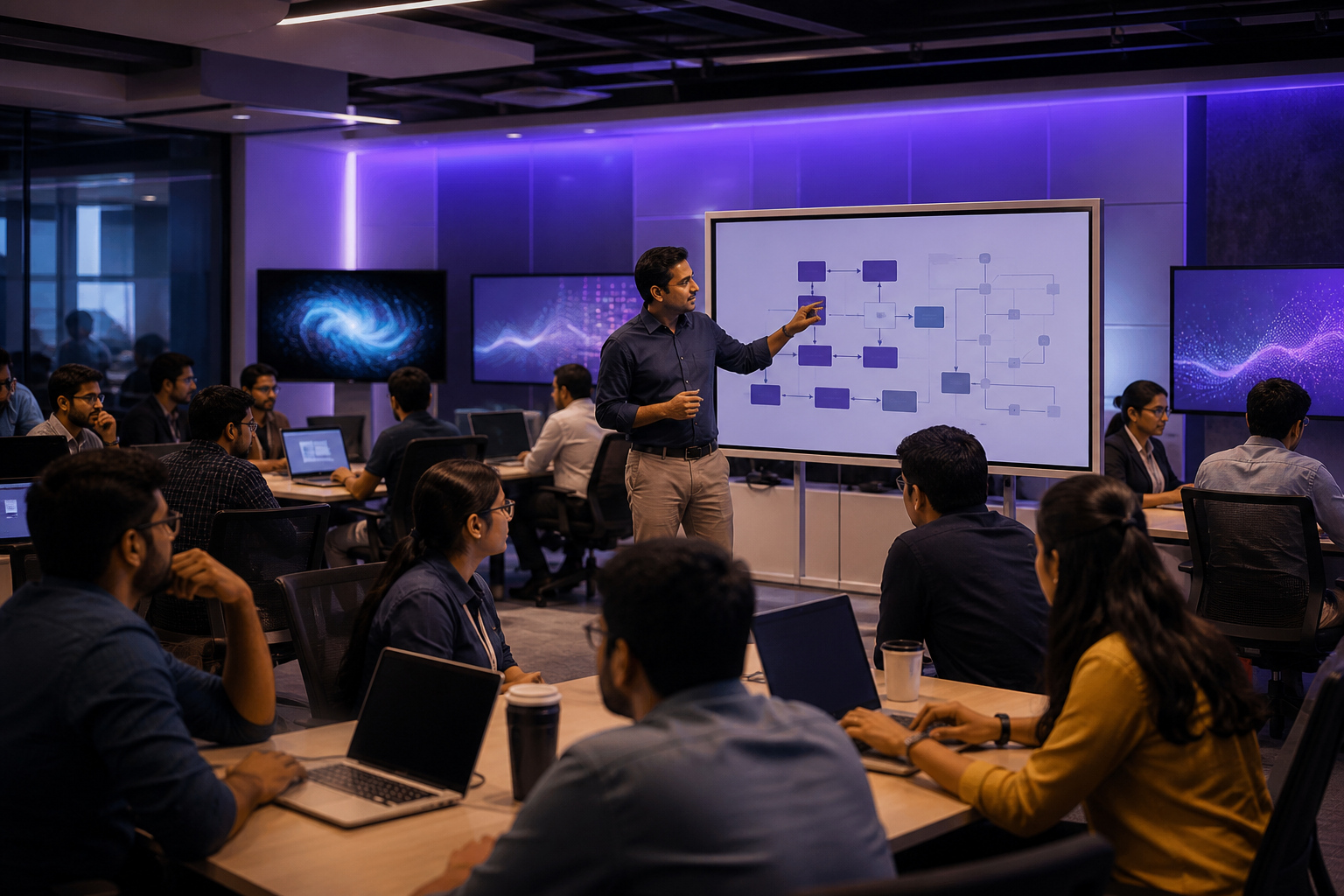
Situation: Generative AI rapidly became relevant to IT services work - coding assistance, testing, knowledge management, support workflows, consulting prototypes and productivity tools. For a services company, the workforce itself is the operating system. If client delivery changes, employee skills must change at scale.
The move: Wipro’s ai360 initiative brought together AI investments, employee training and responsible AI practices. The strategic logic was not just “teach everyone AI.” It was to create a common AI capability base, deepen role-specific skills and embed governance so employees could use AI in client work with accountability.
Outcome and lesson: The measurable business outcome will depend on client adoption, execution quality and market demand, so do not overclaim. The lesson for workforce planning is clear: the primary driver is enterprise-wide capability building, supported by leadership commitment, responsible AI guardrails, role-specific learning and integration into client delivery.
Indian Example: Why GCCs Make Redeployment Urgent
India’s Global Capability Centres are increasingly doing analytics, product, cybersecurity, finance operations and AI-enabled process work for multinational firms. As routine reporting and ticket-based workflows become AI-assisted, the talent need shifts toward process owners, data translators, AI supervisors and domain specialists.
The strategic “so what” is important: India does not only face job displacement risk; it also has an opportunity to move employees from execution-heavy roles into judgment-heavy roles. The primary driver is the rise of higher-value digital work, supported by India’s large skilled talent base, strong technology services ecosystem and growing enterprise AI demand.
How AI Changes Workforce Planning for an AI Transition
AI changes this topic in a slightly ironic way: companies use AI both as the disruption they are planning for and as the tool that improves the planning itself.
- Skills intelligence becomes dynamic: AI can infer skills from project histories, resumes, learning records and internal work platforms, helping HR see adjacent talent pools faster than manual spreadsheets.
- Scenario planning becomes more granular: HR can model multiple futures - aggressive automation, moderate augmentation or slow adoption - and estimate role demand under each scenario.
- Learning becomes personalized: AI tutors and adaptive learning platforms can recommend role-specific pathways, practice tasks and assessments instead of giving everyone the same generic course.
Use NotebookLM or ChatGPT to prepare for a company-specific HR interview: upload the company’s annual report, recent AI announcements and job postings, then ask, “Which roles are likely to be automated, augmented, redeployed or newly hired, and what workforce metrics should HR track?” Verify every factual claim before using it.
Interview Relevance
“Our company is introducing generative AI into customer operations. As an HR manager, how would you plan redeployment and reskilling so productivity improves without damaging morale?”
Use the phrase “AI automates tasks, not entire jobs cleanly.” It signals maturity because you are thinking like a workforce planner, not like a headline writer.
Common Mistake
The biggest mistake is giving a one-sided answer: “AI will reduce headcount.” It costs candidates because it ignores redeployment, reskilling, governance, morale and execution risk. The fix: always move from task impact to role impact to people action to measured outcome.