
AI in India's Financial Ecosystem: Regulators, Banks, Exchanges and Brokers
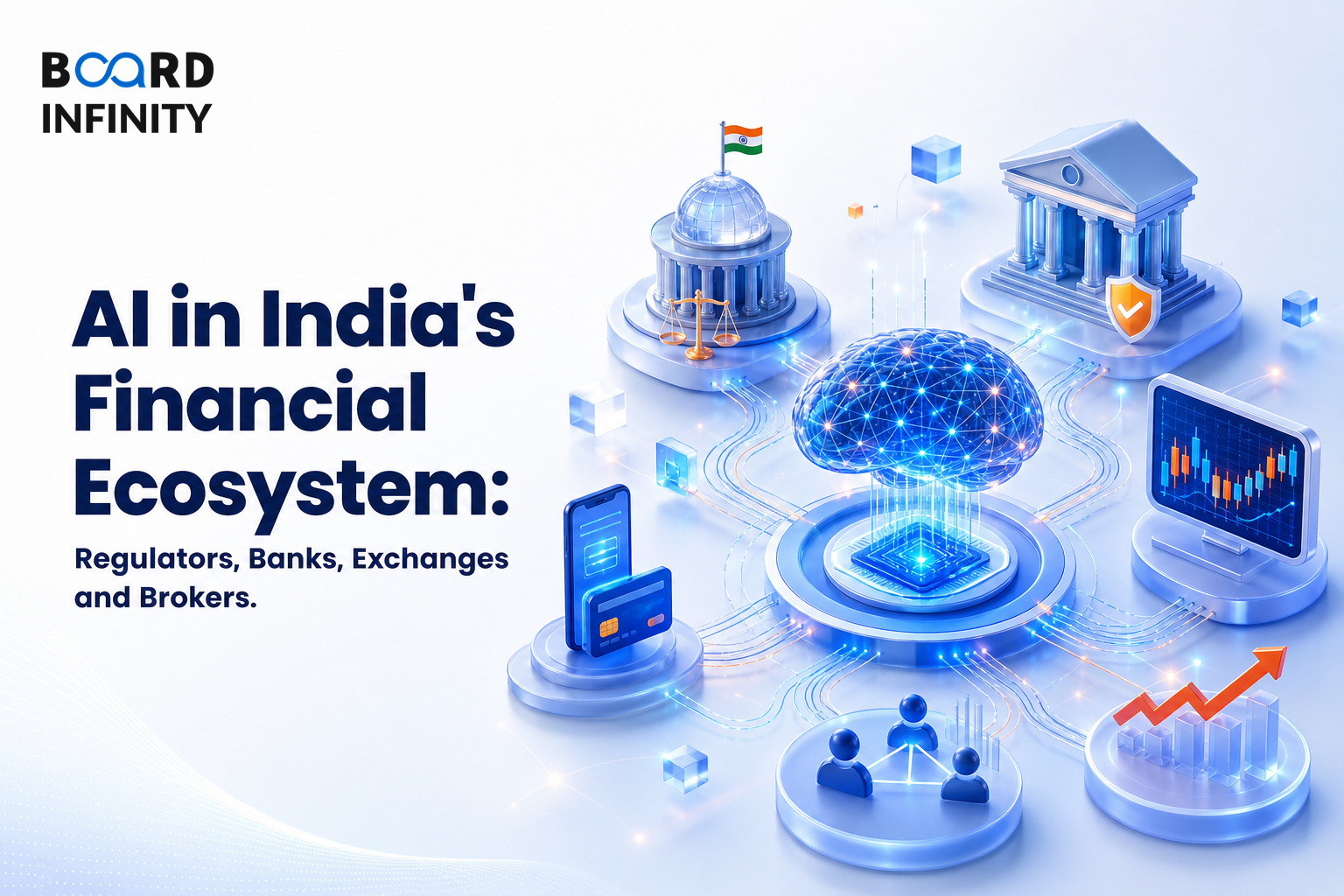
After Best AI Tools for Finance Professionals, the next interview question is how those tools show up inside India's financial ecosystem. Indian regulators and financial institutions are actively engaging with AI, with a mix of adoption and caution, so candidates need to connect use cases such as fraud detection, market surveillance, underwriting, advisory, and customer support with governance and explainability.
- Indian regulators and financial institutions are actively engaging with AI, with a mix of adoption and caution.
- RBI published 'Report on Currency & Finance 2022-23' devoted to AI in finance and issued draft guidelines on AI governance for banks.
- SEBI's surveillance system flags unusual trading patterns via AI, and its Integrated Market Surveillance System (IMSS) uses ML for insider trading detection.
- NPCI uses ML for real-time UPI fraud detection, with 14 billion+ monthly transactions screened.
- BSE / NSE use AI for market surveillance, risk management, and NLP for corporate announcement analysis.
- HDFC Bank's EVA handles 90%+ routine banking queries without human intervention, while AI-based credit underwriting reduced MSME loan turnaround from 15 days to 59 minutes.
- Zerodha's Kite platform's 'Nudge' system uses AI-powered behavioural nudges to warn retail traders about high-risk F&O trades in real time.
Big Picture - Adoption With Caution
Artificial Intelligence is reshaping every function in finance - from algorithmic trading to credit underwriting, research automation, and regulatory compliance. In India, the shift is visible across regulators, payment networks, exchanges, banks, and brokers: RBI and SEBI focus on governance, model risk, explainability, advisory disclosure, and surveillance, while NPCI, BSE, NSE, HDFC Bank, and Zerodha show how AI works at market scale.
AI for Your Finance Career
Three AI tools every finance student should master before placement season:
These skills signal readiness for Day 1 productivity.
RBI and SEBI - Governance, Explainability and Surveillance
RBI published 'Report on Currency & Finance 2022-23' devoted to AI in finance and issued draft guidelines on AI governance for banks, covering model risk management and explainability. The interview point is clear: banks must document AI model risk, and explainability is required for credit decisions under SEBI/RBI frameworks.
SEBI's role connects AI adoption to capital markets regulation. Algo trading regulation has existed since 2008, while the 2023 circular on AI-based advisory says SEBI registered Investment Advisers using AI must disclose methodology. SEBI's surveillance system flags unusual trading patterns via AI, and SEBI's Integrated Market Surveillance System (IMSS) uses ML for insider trading detection.
NPCI, UPI and AI-First Payment Security
NPCI uses ML for real-time UPI fraud detection, with 14 billion+ monthly transactions screened. NPCI Bharat BillPay also uses AI for dispute resolution.
The impact is high-scale and practical: UPI fraud rate reduced to <0.002% despite massive volume. This makes NPCI a strong example when explaining AI-first approach to payment security in India's financial ecosystem.
BSE / NSE - Market Surveillance and Risk Management
BSE's AI-powered market surveillance is named 'Project SMART'. NSE uses AI for risk management at clearing corporation, and both exchanges use NLP for corporate announcement analysis.
The impact is early detection of market manipulation, circular trading, and coordinated pump-and-dump schemes. For interviews, this example shows AI not only as a productivity tool, but also as a market integrity tool.
HDFC Bank and Zerodha - Customer Support, Underwriting and Behavioural Nudges
HDFC Bank's EVA, Electronic Virtual Assistant, is India's first AI-powered banking chatbot. It has handled 100M+ queries, and EVA handles 90%+ routine banking queries without human intervention.
HDFC Bank also uses AI-based credit underwriting for MSME loans, including MSME loan in 59 minutes. The impact is a clear worked example: the turnaround for MSME loans reduced from 15 days to 59 minutes, showing how AI can affect credit underwriting and customer experience together.
Zerodha's Kite platform's 'Nudge' system uses AI-powered behavioural nudges that warn retail traders about high-risk F&O trades in real time. The impact is reduced retail trader losses, and SEBI cited Zerodha's nudge system as best practice in its 2023 study on F&O trader profitability.
Structuring a AI in India's Financial Ecosystem Interview Answer
"How are Indian regulators and financial institutions using AI, and what governance risks should they manage?"
The strongest answers avoid treating AI as a generic technology trend. Tie each example to a specific institution or regulator, then state the impact: explainability for credit decisions, insider trading detection, UPI fraud reduction, faster MSME loans, or behavioural nudges for retail traders.
The most frequent error is listing AI use cases without showing the mix of adoption and caution. That costs points because the India-specific story is regulator-led: RBI and SEBI matter as much as HDFC Bank, Zerodha, NPCI, BSE, NSE, and UPI.
Conclusion
AI in India's financial ecosystem is a high-scale shift across regulation, payments, exchanges, banks, and brokers, with adoption balanced by model risk management, explainability, disclosure, and surveillance. For interviews, lead with the regulator-led frame and support it with named examples and measurable impacts.